Freedom251 › Translation Software
OPUS-MT
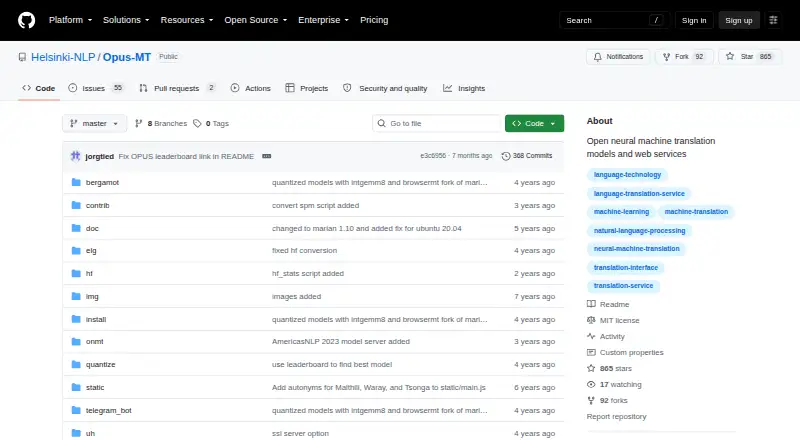
What OPUS-MT is
OPUS-MT provides neural machine translation models and tools for building translation services. Its models use Marian-NMT and are trained on OPUS data with OPUS-MT-train. Downloadable pretrained models are licensed CC-BY 4.0, while the software repository lists the MIT license. One documented serving setup is a Tornado-based web application with a browser interface and API for multiple language pairs; it can be installed manually or run with Docker, including a CUDA GPU option. A separate setup provides a WebSocket translation service on Ubuntu. Its example returns translated text, alignment, and source and target segments, and its client sends JSON with text and language IDs. A JSON configuration specifies language pairs and decoder settings or remote hosts. The project also points to OPUS-CAT integrations for translation tools. The maintainers caution that evaluation scores based on short Tatoeba sentences may overstate performance on realistic data. They note that current models lack filtering, data augmentation, and domain adaptation, with no quality control beyond automatic evaluation on selected test sets. Training scripts are tailored to the University of Helsinki and CSC computing environment.
Who it suits
OPUS-MT may suit developers or teams building translation services from pretrained models, including those looking for web, API, or WebSocket serving options. The training scripts may be less suited to teams seeking a ready-made general training workflow.
What it does well
- Downloadable models use the CC-BY 4.0 license
- Documents web, API, and WebSocket serving setups
- Docker deployment includes a CUDA GPU option
- Supports JSON configuration for language pairs
- Points to OPUS-CAT translation-tool integrations
What to know first
- Evaluation scores may overstate realistic performance
- Models lack filtering and domain adaptation
- Training scripts are tailored to a specific computing environment
- Quality control is limited to automatic evaluation
Plans
| Plan | Billed and limits | Price |
|---|---|---|
| OPUS-MT models and services | pretrained models are downloadable under CC-BY 4.0 · no commercial pricing listed | Free |
As github.com lists them, read 12 Oct 2026. The maker's own page has the final word.
Getting started
- Open the OPUS-MT GitHub repository
- Download a pretrained model under its CC-BY 4.0 license
- Install the Tornado web application manually or run its Docker setup
- Configure language pairs and decoder settings in JSON
- Alternatively install the WebSocket service on Ubuntu
- Connect through the web interface, API, or WebSocket client
Verdict
OPUS-MT offers model downloads and documented service setups, but its maintainers spell out quality and training constraints. Consider those limitations when judging its suitability for realistic translation workflows.
Questions
Is OPUS-MT free?
The OPUS-MT models and services plan is free. The project is open source, with MIT software licensing and CC-BY 4.0 pretrained models.
Which platforms are supported?
OPUS-MT supports API, Linux, self-hosted, and web use.
Can it run in Docker?
Yes. The documented web application can run with Docker, including a CUDA GPU option.
Does it provide an API?
Yes. The web application includes an API, and a separate WebSocket service accepts JSON requests.
What integrations are available?
The project points to OPUS-CAT integrations for Trados Studio, memoQ, and custom-provider use in Wordfast CAT.
Facts from OPUS-MT's own pages
- API access
- Yes · github.com, 22 Sept 2026
- API behavior
- The WebSocket client sends JSON with source text and source and target language IDs, and can request language detection by setting the source to detect or DL. · github.com, 12 Oct 2026
- Deployment
- The web application can be installed manually or with Docker, with a separate Dockerfile for CUDA GPU use. · github.com, 12 Oct 2026
- Integrations
- The project links to OPUS-CAT, which provides a local offline engine and plugins for SDL Trados Studio and memoQ, plus custom-provider use in Wordfast CAT. · github.com, 12 Oct 2026
- Known quality limits
- The project warns that many automatic evaluation scores come from simple, short Tatoeba sentences and may overstate performance on more realistic data. · github.com, 12 Oct 2026
- Language pair configuration
- The web server uses a JSON configuration to specify translation language pairs and model decoder configurations or remote hosts. · github.com, 5 Oct 2026
- License
- The OPUS-MT software repository lists the MIT license, while its downloadable pretrained translation models are listed under CC-BY 4.0. · github.com, 12 Oct 2026
- Linux service
- The project documents installing a WebSocket translation service on Ubuntu. · github.com, 5 Oct 2026
- Maintainer
- The repository belongs to the Language Technology Research Group at the University of Helsinki, whose GitHub organization lists Helsinki, Finland. · github.com, 12 Oct 2026
- Model foundation
- The models are based on Marian-NMT and trained on OPUS data using OPUS-MT-train. · github.com, 5 Oct 2026
- Model framework
- The models and services are based on Marian-NMT and are mainly segmented with SentencePiece. · github.com, 12 Oct 2026
- Model license
- The repository says its downloadable pre-trained translation models are licensed CC-BY 4.0. · github.com, 5 Oct 2026
- Model limitations
- The maintainers state that current models lack filtering, data augmentation, domain adaptation, and quality control beyond automatic evaluation on selected test sets. · github.com, 5 Oct 2026
- Privacy deployment
- The related OPUS-CAT engine is described as local and offline, intended to provide confidential machine translation on local computers. · github.com, 12 Oct 2026
- Purpose
- OPUS-MT provides open neural machine translation models and web services. · github.com, 12 Oct 2026
- Quality limitation
- The maintainers caution that many automatic evaluation scores use simple, short Tatoeba sentences and may be too optimistic for realistic data. · github.com, 5 Oct 2026
- Training environment
- The project says its model-training scripts are currently tailored to the University of Helsinki and CSC computing environment. · github.com, 12 Oct 2026
- Training limitation
- The maintainers say the model training scripts are heavily customized for the University of Helsinki and CSC computing environment. · github.com, 5 Oct 2026
- Training limits
- The project says current models lack filtering, data augmentation and domain adaptation, and that there is no quality control beyond automatic evaluation on automatically selected test sets. · github.com, 12 Oct 2026
- Translation models
- The project provides downloadable pretrained models trained on OPUS data, and the listed models use a CC-BY 4.0 license. · github.com, 12 Oct 2026
- Translation output
- The WebSocket example returns translated text along with alignment and source and target segments. · github.com, 5 Oct 2026
- Translation workflow integration
- The project points to OPUS-CAT as an NMT plugin for Trados Studio that can run OPUS-MT models. · github.com, 5 Oct 2026
- Web application
- One setup is a Tornado-based web application with a web interface and API for multiple language pairs. · github.com, 12 Oct 2026
- Web interface and API
- One included setup is a Tornado-based web application with a web UI and API for multiple language pairs. · github.com, 5 Oct 2026
Where OPUS-MT stands on Freedom251
- Translation Software#38 of 156
- Translation apps#56 of 158