Freedom251 › User and Entity Behavior Analytics Software
OpenUBA
What OpenUBA is
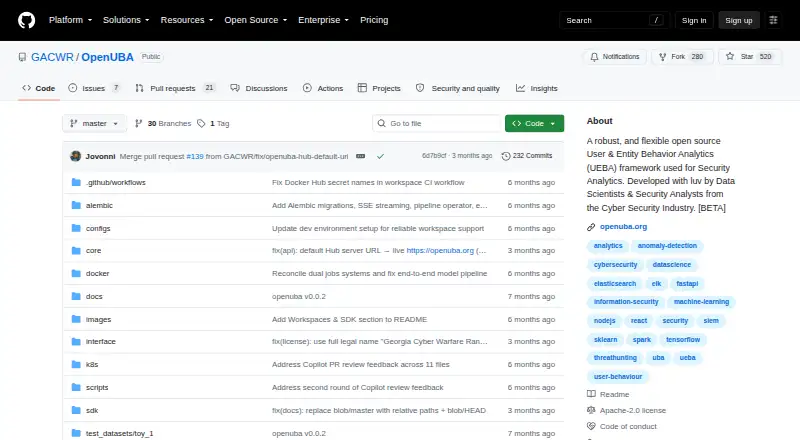
OpenUBA is a free, open-source framework for user and entity behavior analytics in security analytics. It is built around models that users can inspect and audit, with the project describing transparency as useful for compliance, investigations, and decisions. Users can install, train, and run models, track their versions and artifacts, and use feedback and shadow modes. Listed model frameworks include scikit-learn, PyTorch, TensorFlow, Keras, NetworkX, and Spark MLlib.
For detection, a visual flow-based rule builder combines model outputs with logical conditions. Triggered alerts can be linked to anomalies and cases. Data loaders cover local CSV files, Elasticsearch, Spark, and aggregated multi-source data. The project describes a Kubernetes-native architecture, with containerized components for development on a Kind cluster or deployment to a production Kubernetes cluster. It provides REST endpoints, a GraphQL API, and a Python SDK for model registration, job submission, and visualization. Listed access controls include JWT authentication, four roles, configurable page-level read and write permissions, and audit logging. Model training and inference run in isolated Docker containers or temporary Kubernetes Jobs with resource limits. The repository labels the project beta, and its v0.0.2 release is marked as a pre-release.
Who it suits
OpenUBA is aimed at security analysts interested in how behavior analytics models work, as well as teams building user and entity analytics workflows. It suits teams prepared to deploy and operate a Kubernetes-native framework and work with its beta release.
What it does well
- Models are inspectable and auditable.
- Model workflows include version and artifact tracking, feedback, and shadow modes.
- A visual rule builder combines model outputs and logical conditions.
- Data loaders include CSV, Elasticsearch, Spark, and multi-source groups.
- REST, GraphQL, and Python SDK interfaces are available.
- Training and inference run in isolated containers or Kubernetes Jobs.
What to know first
- The repository labels the project beta.
- The v0.0.2 release is marked as a pre-release.
- Production deployment is described for Kubernetes clusters.
Getting started
- Visit the OpenUBA GitHub repository.
- Choose a development Kind cluster or production Kubernetes cluster for deployment.
- Deploy the containerized components to the chosen cluster.
- Use the REST endpoints, GraphQL API, or Python SDK to work with models.
- Load data from local CSV, Elasticsearch, Spark, or aggregated sources.
OpenUBA is a free, open-source framework for security analytics built around user and entity behavior analytics. It is best suited to security analysts and engineering teams that want to inspect models and build detection workflows around them. Its modeling and API flexibility is attractive, but its beta release and Kubernetes-native architecture call for technical ownership.
Overview
OpenUBA brings model operations and detection rules into one framework. Teams can install, train, and run models, track versions and artifacts, and use feedback and shadow modes. Model source code is open to inspection, a meaningful advantage when analysts need to understand model behavior during investigations or compliance work. That transparency does not remove the operational burden of building and running the surrounding environment.
The framework addresses both users and other entities with hybrid anomaly methods. Its README labels the project beta, and v0.0.2 is a pre-release. That makes it a more defensible choice for evaluation or teams prepared to manage an early-stage platform than for security operations that depend on a mature, turnkey product.
Key features
Models, rules, and data
OpenUBA lists support for scikit-learn, PyTorch, TensorFlow, Keras, NetworkX, and Spark MLlib, giving teams several established model frameworks to work with. Its visual flow-based rule builder combines model outputs with logical conditions; resulting alerts can link to anomalies and cases. This connects analytics to investigation workflows, though teams still need to define the models and rules that suit their environment.
Data loaders cover local CSV files, Elasticsearch, Spark, and aggregated multi-source loading. The README names GitHub, OpenUBA Hub, Kubeflow, and local filesystem among model registry options. It also mentions HuggingFace, but marks that adapter integration as planned rather than available. Teams should not treat that planned connection as a current capability.
Access, execution, and APIs
REST endpoints, a GraphQL API, and a Python SDK support model registration, job submission, and visualization. JWT authentication, four roles, configurable per-page read and write permissions, audit logging, and cryptographic model-hash verification provide useful control points. Training and inference run in isolated Docker containers or ephemeral Kubernetes Jobs, with resource limits intended to contain misbehaving models.
Those controls are building blocks, not a substitute for deployment security. The project recommends TLS behind a reverse proxy, Kubernetes RBAC, Kubernetes Secrets for database credentials, network policies, and regular container image updates. Teams must be equipped to implement and maintain that setup.
The built-in assistant supports local Ollama and cloud APIs from OpenAI, Claude, and Gemini. This gives teams a choice of local or cloud-backed providers, but the framework's beta status remains relevant when assessing its place in a security workflow.
Pricing
OpenUBA is free and open source. There are no paid plans or published seat or usage caps in the project’s pricing model. The trade-off is operational responsibility: teams deploy and maintain the framework themselves, including its Kubernetes environment and recommended security controls.
Platforms
OpenUBA supports API access and web use, with Linux and self-hosted deployment. Its Kubernetes-native design includes containerized components for a development Kind cluster or a production Kubernetes cluster. This is a strong fit for teams already operating Kubernetes; it is a poor fit for buyers seeking a managed service or a conventional desktop application.
Who it's for
OpenUBA suits security analysts who want to inspect how models work, plus engineering teams able to operate Kubernetes and shape their own analytics workflows. Its model framework choices, data loaders, APIs, and rule builder offer room to adapt the system. Organizations that need a stable, fully managed UEBA product or lack the capacity to run Kubernetes should look elsewhere.
Pros and cons
- Inspectable models: Source code and auditable model behavior can support investigation and compliance decisions.
- Flexible model and rule workflows: Multiple model frameworks, feedback and shadow modes, and visual rules let teams construct analytics rather than depend on a single detection path.
- Integration access: REST, GraphQL, and a Python SDK serve teams building model operations into their own tools.
- Early release: Beta status and a v0.0.2 pre-release make it a risky choice for production-critical operations that require maturity.
- Deployment demands: Kubernetes-native operation and security hardening require infrastructure expertise and ongoing maintenance.
- One planned adapter: HuggingFace integration is planned, so teams relying on it cannot assume it is ready.
Alternatives
For a paid, broader-platform behavior analytics product, consider Netskope One Behavior Analytics, which supports mobile, desktop, Linux, web, and API platforms and has a Standard UEBA plan with sequential anomaly rules for cloud-app activity, failed logins, rare events, risky countries, and data movement. Security Vision TIP may suit buyers comparing a paid, self-hosted threat-intelligence platform with modular pricing based on products, connectors or event volume, nodes, and support. For insider-risk management, DTEX Insider Risk Management is another paid option across Linux, macOS, web, and Windows.
Security Vision UEBA is a paid UEBA alternative with individual pricing tied to modules, connectors or event volume, nodes, support, license type, and multi-tenancy. NetWitness Platform is a paid Linux, self-hosted, and web option. Securonix UEBA is another paid web-based alternative, with plans differentiated by storage and search capacity. Teramind is a paid option for Windows, Mac, and Linux deployments, with a five-seat minimum on its Starter, UAM, and DLP plans. Varonis SSPM is a paid web product sold by quote.
Compare more options in User and Entity Behavior Analytics Software.
Verdict
Choose OpenUBA if your team wants free, inspectable UEBA models and can own a Kubernetes-based deployment. Its open model workflows, rule builder, and API and SDK access make it compelling for teams building and examining their own security analytics. Look elsewhere if beta maturity or self-managed infrastructure is unacceptable for your security operations.
Verdict
Choose OpenUBA if you need an open-source framework for inspectable security analytics models, detection rules, and API or SDK access. Its beta status and Kubernetes-native deployment make it a better fit for teams able to manage that environment than buyers seeking a mature, turnkey product.
Questions
Is OpenUBA free and open source?
Yes. OpenUBA is listed as free and open source.
Which platforms does it support?
Its listed platforms are API, Linux, self-hosted, and web. Deployment is described for a development Kind cluster or production Kubernetes cluster.
Which model frameworks are listed?
OpenUBA lists scikit-learn, PyTorch, TensorFlow, Keras, NetworkX, and Spark MLlib.
What data sources can it load?
Listed data loaders cover local CSV files, Elasticsearch, Spark, and aggregated multi-source loading.
What is its release status?
The repository labels OpenUBA beta. Its v0.0.2 release is marked as a pre-release.
Which LLM providers does its assistant support?
The built-in assistant supports local Ollama and cloud APIs from OpenAI, Claude, and Gemini.
Facts from OpenUBA's own pages
- Access control
- The README lists JWT authentication, four roles, configurable per-page read/write permissions, and audit logging. · github.com, 4 Oct 2026
- API and SDK
- The project documents a REST API, GraphQL API, and Python SDK installable with pip for model registration, job submission, and visualization. · github.com, 8 Oct 2026
- Approach
- It uses inspectable, auditable models and says model transparency supports compliance, investigations, and decision making. · github.com, 4 Oct 2026
- Current maturity
- The repository README labels the project beta and identifies the release as v0.0.2. · github.com, 4 Oct 2026
- Data integrations
- Built-in data loaders support local CSV files, Elasticsearch, Spark, and aggregated source groups. · github.com, 8 Oct 2026
- Data sources
- Listed data loaders include local CSV, Elasticsearch, Spark, and aggregated multi-source loading. · github.com, 4 Oct 2026
- Deployment
- OpenUBA is Kubernetes-native, with Docker containers and ephemeral Kubernetes jobs for model training and inference. · github.com, 8 Oct 2026
- Deployment security guidance
- The security policy recommends TLS behind a reverse proxy, Kubernetes RBAC, Kubernetes Secrets for database credentials, network policies, and regular container image updates. · github.com, 8 Oct 2026
- Detection and response
- A visual flow-based rule builder combines model outputs and logical conditions to generate alerts that can be linked to anomalies and cases. · github.com, 8 Oct 2026
- Detection rules
- A visual flow-based rule builder composes model outputs and logical conditions, with triggered alerts linked to anomalies and cases. · github.com, 4 Oct 2026
- Execution isolation
- Model training and inference run in isolated Docker containers or ephemeral Kubernetes Jobs, with resource limits described as a way to contain misbehaving models. · github.com, 4 Oct 2026
- Intended users
- OpenUBA is designed for security analysts interested in understanding how detection models work under the hood. · github.com, 8 Oct 2026
- LLM integrations
- The built-in assistant supports Ollama locally and cloud API providers OpenAI, Claude, and Gemini. · github.com, 8 Oct 2026
- LLM providers
- The built-in assistant supports local Ollama and cloud APIs from OpenAI, Claude, and Gemini. · github.com, 4 Oct 2026
- Model frameworks
- Documented model frameworks include scikit-learn, PyTorch, TensorFlow, Keras, NetworkX, and Spark MLlib. · github.com, 8 Oct 2026
- Model lifecycle
- The platform supports installing, training, and running inference with models, and tracks model versions and artifacts. · github.com, 8 Oct 2026
- Model registries
- The README lists GitHub, OpenUBA Hub, HuggingFace, Kubeflow, and local filesystem as model registry options, while noting HuggingFace integration as planned in its adapter table. · github.com, 8 Oct 2026
- Model transparency
- The project describes its models as inspectable and auditable, with model source code available for inspection. · github.com, 8 Oct 2026
- Product
- OpenUBA is an open-source User and Entity Behavior Analytics framework for security analytics. · github.com, 8 Oct 2026
- Release status
- The GitHub releases page lists OpenUBA v0.0.2 as a pre-release. · github.com, 8 Oct 2026
- Security controls
- The README describes JWT authentication, role-based access control, per-page permissions, audit logging, and cryptographic model hash verification. · github.com, 8 Oct 2026
- Support
- The security policy asks vulnerability reporters to email [email protected] and states an acknowledgment target of 48 hours and an initial assessment target of 7 days. · github.com, 8 Oct 2026