Freedom251 › Text-to-Speech Software
OpenTTS
What OpenTTS is
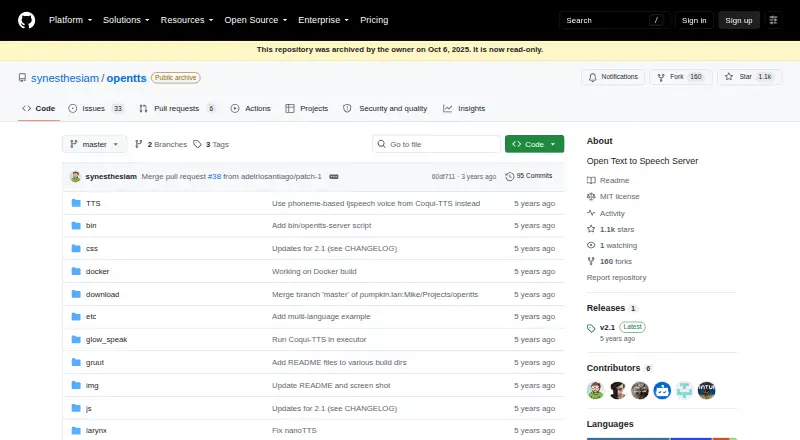
OpenTTS is free, open-source software that unifies multiple text-to-speech engines and voices behind one interface. It runs as a self-hosted Docker server and offers web access plus an HTTP API. API endpoints convert text to WAV and list available voices and languages. A MaryTTS-compatible endpoint can replace MaryTTS integrations. Listed engines include Larynx, Glow-Speak, Coqui-TTS, nanoTTS, MaryTTS, flite, Festival, and eSpeak. OpenTTS supports part of SSML for voice changes, language settings, pauses, and text substitutions. Docker images are described for linux/amd64, linux/arm64, and linux/arm/v7, including language-specific and all-languages images. An optional WAV cache can use temporary container storage or a mounted directory. Larynx and Glow-Speak provide high, medium, and low quality settings. The MIT-licensed project allows commercial use, but its repository was archived on October 6, 2025, and is read-only, with no security policy file or published advisories.
Who it suits
It suits developers and self-hosters who need one API for multiple open-source speech engines and voices. Commercial users can use it under the MIT License, while accepting the archived project status.
What it does well
- Free MIT-licensed open-source software
- HTTP API converts text to WAV
- Multiple speech engines and voices
- MaryTTS-compatible endpoint available
- Supports several Linux architectures
What to know first
- Repository is archived and read-only
- No published security policy or advisories
- Self-hosted Docker deployment required
- Only a subset of SSML is supported
Plans
| Plan | Billed and limits | Price |
|---|---|---|
| OpenTTS | open-source software · self-hosted Docker server | Free |
As github.com lists them, read 12 Oct 2026. The maker's own page has the final word.
Verdict
OpenTTS provides a unified, self-hosted route to many speech engines, with API endpoints and MaryTTS compatibility. Its archived, read-only repository means users should account for limited ongoing project maintenance.
Facts from OpenTTS's own pages
- API access
- Yes · github.com, 20 Sept 2026
- Audio cache
- An optional WAV cache can store generated audio in a temporary container directory or a specified mounted directory. · github.com, 12 Oct 2026
- Commercial use
- Yes · github.com, 20 Sept 2026
- Deployment
- The README runs OpenTTS as a Docker container and provides language-specific images, including an all-languages image. · github.com, 12 Oct 2026
- Export formats
- WAV · github.com, 20 Sept 2026
- HTTP API
- The API provides text-to-WAV, voice-listing, and language-listing endpoints. · github.com, 12 Oct 2026
- Integration
- OpenTTS documents a MaryTTS-compatible endpoint that can act as a drop-in replacement for MaryTTS. · github.com, 12 Oct 2026
- License
- The repository provides the software under the MIT License. · github.com, 12 Oct 2026
- Linux architectures
- Its build instructions show Docker images for linux/amd64, linux/arm64, and linux/arm/v7. · github.com, 12 Oct 2026
- Maintenance
- GitHub says the repository was archived by its owner on October 6, 2025, and is read-only. · github.com, 12 Oct 2026
- Platforms
- web,linux,API,self-hosted · github.com, 20 Sept 2026
- Purpose
- OpenTTS unifies access to multiple open-source text-to-speech systems and voices for many languages. · github.com, 12 Oct 2026
- Security
- GitHub reports that the project has no security policy file and no published security advisories. · github.com, 12 Oct 2026
- Speech markup
- It supports a subset of SSML, including voice changes, language settings, pauses, and text substitutions. · github.com, 12 Oct 2026
- Support
- The repository page links to issues for project discussion and tracking. · github.com, 12 Oct 2026
- Voice engines
- The listed systems include Larynx, Glow-Speak, Coqui-TTS, nanoTTS, MaryTTS, flite, Festival, and eSpeak. · github.com, 12 Oct 2026
- Voice quality
- Larynx and Glow-Speak voices offer high, medium, and low quality settings, and the README notes lower quality may improve Raspberry Pi response times. · github.com, 12 Oct 2026
Where OpenTTS stands on Freedom251
- Text-to-Speech Software#48 of 223
- Text-to-speech tools#55 of 232