
OpenReq
What OpenReq is
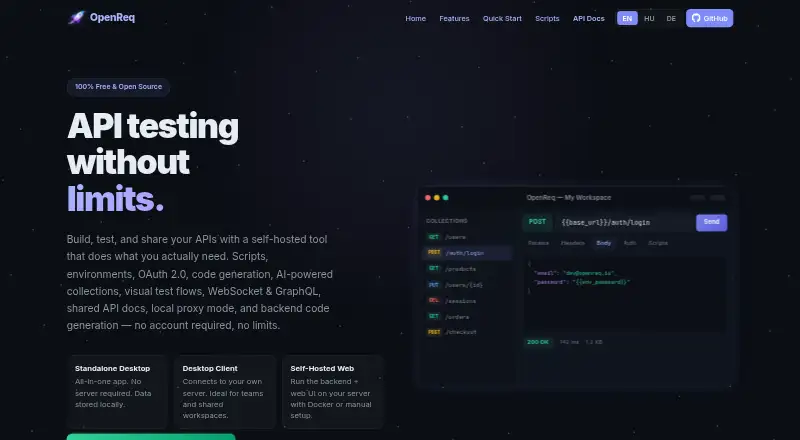
OpenReq is a free, community-driven API testing tool released under the MIT License. It supports HTTP, WebSocket, and GraphQL requests, with visual test flows, collection runs, assertions, scripts, delays, conditions, loops, and reports. API testing has no stated usage limits. Collections can be shared as read-only API documentation links, optionally password-protected; viewers can open them without an account. OpenReq generates code for cURL, Python, JavaScript, Go, Java, C#, and PHP. Integrations include Ollama, Postman, OpenAPI, raw cURL, Chrome, and Electron. Ollama can support local AI features without a cloud API key or data leaving the machine. OpenReq is available as a self-hosted web application and desktop application. Its Windows desktop client is frontend-only and needs a separately hosted backend. Most API endpoints use JWT bearer authentication, while local proxy preparation and completion use HMAC-signed tokens. The project gives no formal support channels, and no security certifications are stated.
Who it suits
OpenReq suits developers who want a free API testing tool with multiple request types and programmable test flows. It may also suit teams sharing read-only API documentation or using local AI features through Ollama.
What it does well
- Supports HTTP, WebSocket, and GraphQL requests.
- API testing has no stated usage limits.
- Shared documentation links need no viewer account.
- Generates code in seven listed languages.
- Local Ollama features do not require a cloud API key.
What to know first
- Windows desktop client requires a separately hosted backend.
- No formal support channels are given.
- No security certifications are stated.
Limits
API testing has no stated usage limits. The Windows desktop client is frontend-only and requires a separately hosted backend.
Plans
| Plan | Billed and limits | Price |
|---|---|---|
| Free and open source | Self-hosted web application · Standalone desktop application · Windows desktop client · No subscription tiers | Free |
| Free Forever | — | On request |
As openreq.app lists them, read 20 Sept 2026. The maker's own page has the final word.
Getting started
- Visit the OpenReq website.
- Choose the self-hosted web application or a desktop application.
- For the Windows desktop client, arrange a separately hosted backend.
- Create API requests using HTTP, WebSocket, or GraphQL.
- Build a visual test flow or collection run.
- Share a collection as read-only API documentation, optionally protected with a password.
Verdict
OpenReq offers broad API test workflows and documentation sharing without subscription tiers. The Windows client’s backend requirement and the lack of formal support channels are important considerations.
Questions
Is OpenReq free?
Yes. OpenReq is free and open source, with no subscription tiers.
What platforms does it support?
It is available as a self-hosted web application and a desktop application, including a Windows client.
Does the Windows desktop client work on its own?
No. It is frontend-only and requires a separately hosted backend.
Which API protocols can I test?
OpenReq supports HTTP, WebSocket, and GraphQL requests.
Can I share API documentation publicly?
Collections can become read-only documentation links, optionally protected with passwords. Viewers do not need accounts.
What license does OpenReq use?
OpenReq is released under the MIT License.
Facts from OpenReq's own pages
- Local AI Privacy
- Ollama enables local AI features without a cloud API key or data leaving the machine. · openreq.app, 28 Sept 2026
- API Doc Sharing
- Collections can become read-only public API documentation links with optional passwords. · openreq.app, 28 Sept 2026
- API documentation
- Yes · openreq.app, 20 Sept 2026
- API Testing
- Supports visual test flows, collection runs, assertions, scripts, delays, conditions, loops, and reports. · openreq.app, 28 Sept 2026
- Automated test runs
- Yes · openreq.app, 20 Sept 2026
- Available Platforms
- Windows desktop apps, self-hosted web, Chrome extension, and Electron client. · openreq.app, 28 Sept 2026
- Billing Requirement
- There are no subscription tiers to compare. · openreq.app, 28 Sept 2026
- Certifications
- No security certifications are stated on the page. · openreq.app, 28 Sept 2026
- Code Generation
- Generates code for cURL, Python, JavaScript, Go, Java, C#, and PHP. · openreq.app, 28 Sept 2026
- Company Status
- OpenReq is community-driven and released under the MIT License. · openreq.app, 28 Sept 2026
- Desktop Client Limit
- The Windows desktop client is frontend-only and requires a separately hosted backend. · openreq.app, 28 Sept 2026
- Free plan
- Yes · openreq.app, 20 Sept 2026
- Free Tier Limits
- API testing has no stated usage limits. · openreq.app, 28 Sept 2026
- GraphQL support
- Yes · openreq.app, 20 Sept 2026
- gRPC support
- No · openreq.app, 20 Sept 2026
- Integrations
- Integrates with Ollama, Postman, OpenAPI, raw cURL, Chrome, and Electron. · openreq.app, 28 Sept 2026
- Available platforms
- web_and_desktop · openreq.app, 20 Sept 2026
- Pricing Model
- Free and open source with no subscription tiers. · openreq.app, 28 Sept 2026
- Protocol Support
- HTTP, WebSocket, and GraphQL requests are supported as first-class request types. · openreq.app, 28 Sept 2026
- Secure Handshake
- Local proxy preparation and completion use HMAC-signed tokens. · openreq.app, 28 Sept 2026
- Security Authentication
- The API uses JWT bearer authentication for most endpoints. · openreq.app, 28 Sept 2026
- Support Model
- The page identifies the project as community-driven but gives no formal support channels. · openreq.app, 28 Sept 2026
- Team Workspaces
- The server-connected client is intended for teams and shared workspaces. · openreq.app, 28 Sept 2026
- Trial Or Refund
- No trial or refund policy is stated on the page. · openreq.app, 28 Sept 2026
Where OpenReq stands on Freedom251
- API clients#10 of 38