Freedom251 › WAN Optimization Software
OpenNOP
What OpenNOP is
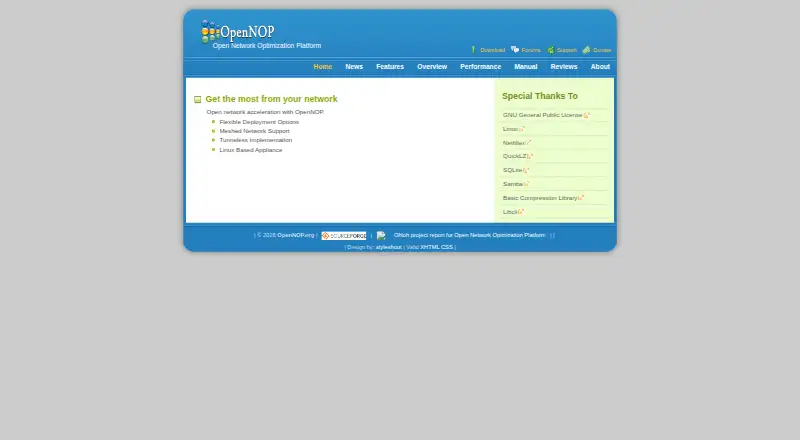
OpenNOP is a free, open-source Linux network accelerator intended to optimize traffic on point-to-point, partially meshed, and full-meshed IP networks. Its stated aim is to improve performance over slower connections, including ISDN, DSL, DS1, frame-relay, and VPN circuits. Implemented functionality includes LZ compression of TCP segment payloads. The software finds other accelerators by detecting custom TCP options they add to IP packets. A heartbeat between its user-space daemon and kernel module lets the kernel module switch to bypass mode. The manual describes inline deployment and an out-of-line setup using policy-based routing. A prebuilt appliance image is identified as the easiest installation option. For a custom host, the manual says any Linux distribution should work and lists libnfnetlink, libnetfilter_queue, and libnl as required software. The project is intended for system administrators and uses a command-line interface. Its license is GPLv3, and SourceForge labels the project Alpha with a last update listed as 2015-12-28. Several features, including a web interface, remain listed as todo.
Who it suits
OpenNOP may suit system administrators looking for a self-hosted Linux accelerator for slower IP connections. The listed deployment options and command-line interface point to users comfortable managing Linux systems.
What it does well
- Free and open source under GPLv3.
- Supports inline and policy-based routing deployments.
- Compresses TCP segment payloads with LZ.
- Includes a prebuilt appliance image option.
What to know first
- SourceForge labels the project Alpha.
- Last update is listed as 2015-12-28.
- A web interface remains listed as todo.
- Custom hosts require listed Linux libraries.
Limits
OpenNOP is free under GPLv3. Its feature page marks block-based data reduction, the WCCPv2 client, CLI configuration and statistics, and a web interface as todo items.
Plans
| Plan | Billed and limits | Price |
|---|---|---|
| OpenNOP | GPLv3 open-source Linux network accelerator | Free |
As opennop.org lists them, read 4 Oct 2026. The maker's own page has the final word.
Getting started
- Visit https://www.opennop.org/ for project information and support links.
- Choose inline deployment or an out-of-line setup using policy-based routing.
- Use the prebuilt appliance image, described in the manual as the easiest installation option.
- For a custom Linux host, install libnfnetlink, libnetfilter_queue, and libnl.
- Use the command-line interface on a Linux deployment.
OpenNOP is a free, open-source Linux accelerator for administrators improving traffic across constrained or meshed IP links. It suits teams comfortable operating self-hosted, command-line infrastructure and accepting an Alpha-stage project. The main appeal is TCP compression with flexible network placement; the main drawback is unfinished management tooling and an old project release.
Overview
OpenNOP targets point-to-point, partially meshed, and fully meshed IP networks, with an emphasis on low-speed paths such as ISDN, DSL, DS1, frame-relay, and VPN circuits. It runs on Linux and is licensed under GPLv3, so there is no software fee or per-site subscription. Its audience is system administrators rather than general desktop users.
The design places an accelerator in the traffic path and lets other OpenNOP instances identify it through custom TCP options added to packets. That can reduce the need to maintain a separate peer list, but it also assumes control of network infrastructure and Linux hosts. SourceForge classifies the project as Alpha and records a last update of 2015-12-28, signals that organizations needing a current commercial product should look elsewhere.
Key features
TCP compression and peer discovery
LZ compression operates on TCP segment payloads. On bandwidth-limited circuits, reducing payload size can make existing links more usable, especially for traffic that compresses well; it is not a promise of faster processing for every workload. Peer discovery based on custom TCP options helps accelerators recognize each other across the network without a separately maintained directory.
Resilient operation
A heartbeat connects the user-space daemon with the kernel module. If the daemon fails, the kernel module can switch to bypass mode, allowing traffic to continue without the accelerator rather than remaining trapped in a failed processing path. That is a meaningful safeguard for links where availability matters more than maximum optimization.
Deployment and integration
The manual supports inline placement and out-of-line deployment through policy-based routing. Inline mode is direct but requires the device to sit in the forwarding path; policy-based routing can fit an existing topology while demanding more routing administration. The project describes a WCCPv2 client intended to tell Cisco routers which traffic to redirect, but that client remains a todo item, so Cisco integration should not be treated as finished capability.
A prebuilt appliance image is described as the easiest installation route. For a custom host, the manual requires libnfnetlink, libnetfilter_queue, and libnl, and says any Linux distribution should work. Those options help experienced Linux operators choose between convenience and control, while offering little reassurance to teams without kernel and routing expertise.
Unfinished tooling
Block-based data reduction, a WCCPv2 client, command-line configuration and statistics, and a web interface are all identified as unfinished. The result is a narrow optimization core surrounded by limited operational visibility and automation. Teams expecting dashboards, mature statistics, or centralized configuration will find the gaps consequential.
Pricing
The OpenNOP plan costs nothing. It is GPLv3 open source, with no paid tier and no trial period because the software is free to use. This is the right choice for organizations able to supply their own Linux hosts, deployment work, monitoring, and support. The zero license cost does not remove the engineering effort required for routing, dependencies, and ongoing maintenance.
Platforms
OpenNOP runs on Linux and is self-hosted. The hybrid deployment model supports both inline and out-of-line policy-based-routing arrangements. It is not a hosted service, browser application, or cross-platform endpoint utility, so it belongs in a Linux network infrastructure stack.
Who it's for
Choose OpenNOP when you administer Linux networks with slow or expensive links, need TCP payload compression, and can manage routing and kernel-adjacent components yourself. It is particularly suitable for system administrators who value GPLv3 control and can tolerate an Alpha project. Avoid it when you need a supported commercial appliance, a web console, finished WCCPv2 integration, or current product development.
Pros and cons
Pros
- No license cost: the GPLv3 plan is free, making trials and internal deployments inexpensive.
- Useful placement choices: inline and policy-based-routing deployments can fit different network designs.
- TCP payload compression: LZ processing directly addresses bandwidth-constrained circuits.
- Bypass failover: daemon-heartbeat monitoring lets the kernel module avoid leaving traffic dependent on a failed user-space process.
Cons
- Alpha status and old update: the project carries more lifecycle risk than a maintained commercial accelerator.
- Incomplete administration: web management, CLI configuration and statistics, block reduction, and the WCCPv2 client are unfinished.
- Linux-only self-hosting: deployment requires suitable infrastructure and technical staff.
Alternatives
Wanos is a better fit when you want Linux or self-hosted deployment with web access, a free trial, and a Free Express edition capped at 10 Mbps WAN optimization, 100 Mbps SD-WAN, limited remote sites, and no professional support.
CacheGuard-OS suits readers wanting a free Linux, self-hosted, web-managed option whose install capacity is selected during setup; excess capacity can slow or block traffic.
Neverfail HybriStor is an alternative for storage-focused virtual-appliance deployments, including a free 1TB unlimited-instance plan and a 45-day trial.
Veeam Agent for Mac is for macOS backup rather than Linux WAN acceleration.
Veeam Recovery Orchestrator is a recovery-orchestration product with free demonstration and evaluation licenses.
Riverbed Aternity is an enterprise digital-experience management offering.
AppEx CloudWAN targets paid, bandwidth-billed connectivity across more than 600 POPs.
Riverbed SaaS Accelerator is a paid alternative for SaaS acceleration.
Verdict
OpenNOP is worth choosing for technically capable Linux administrators who need free TCP compression on difficult links and want control over deployment. Its bypass behavior and two placement models strengthen that case. Look elsewhere if operational polish, finished router integration, vendor support, or an actively maintained release is more important than eliminating license fees.
Verdict
OpenNOP offers TCP compression and two deployment approaches for Linux networks. Its Alpha label, old listed update, and unfinished features are important considerations.
Questions
How much does OpenNOP cost?
The listed plan is free. OpenNOP is open source under GPLv3.
Does OpenNOP have a free plan or trial?
A free plan is listed, and the listed free trial status is no.
What platforms does OpenNOP support?
The listed platforms are Linux and self-hosted deployment.
How can OpenNOP be deployed?
The manual describes inline deployment and out-of-line deployment using policy-based routing.
What does OpenNOP do to TCP traffic?
Its implemented features include LZ compression of TCP segment payloads.
What support options are listed?
The official site links to SourceForge forums and support requests.
Facts from OpenNOP's own pages
- Appliance
- The manual calls the prebuilt appliance image the easiest installation option. · opennop.org, 4 Oct 2026
- Deployment
- The manual describes inline deployment and out-of-line deployment using policy-based routing. · opennop.org, 4 Oct 2026
- Failure handling
- A heartbeat between the user-space daemon and kernel module allows the kernel module to switch to bypass mode. · opennop.org, 4 Oct 2026
- Integration
- The overview describes a WCCPv2 client that informs Cisco routers what traffic to redirect to the accelerator. · opennop.org, 4 Oct 2026
- Intended audience
- SourceForge lists system administrators as the intended audience and command-line as the user interface. · sourceforge.net, 4 Oct 2026
- Intended goal
- The project aims to improve performance over low-speed connections such as ISDN, DSL, DS1, frame-relay, and VPN circuits. · opennop.org, 4 Oct 2026
- License
- The SourceForge project page identifies the license as GNU General Public License version 3.0 (GPLv3). · sourceforge.net, 4 Oct 2026
- Linux requirements
- The manual says any Linux distribution should work and lists libnfnetlink, libnetfilter_queue, and libnl as required software for a custom host. · opennop.org, 4 Oct 2026
- Peer discovery
- OpenNOP discovers other accelerators by detecting custom TCP options they add to IP packets. · opennop.org, 4 Oct 2026
- Project status
- SourceForge labels the project Alpha and lists its last update as 2015-12-28. · sourceforge.net, 4 Oct 2026
- Purpose
- OpenNOP is an open-source Linux network accelerator designed to optimize traffic over point-to-point, partially meshed, and full-meshed IP networks. · opennop.org, 4 Oct 2026
- Support
- The official site links to SourceForge forums and support requests. · opennop.org, 4 Oct 2026
- TCP compression
- The implemented features include LZ compression of TCP segment payloads. · opennop.org, 4 Oct 2026
- Unfinished features
- The Features page lists block-based data reduction, a WCCPv2 client, CLI configuration and statistics, and a web interface as todo items. · opennop.org, 4 Oct 2026
Where OpenNOP stands on Freedom251
- WAN Optimization Software#3 of 19