Freedom251 › Game Compatibility Layers
OpenNative
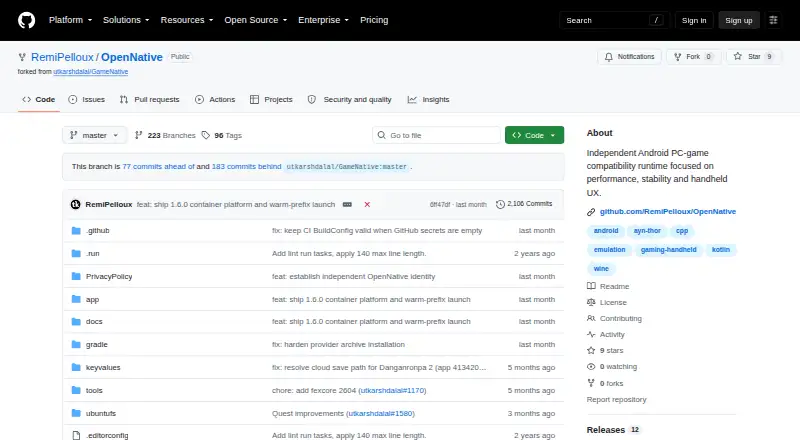
What OpenNative is
OpenNative is an Android runtime for PC-game compatibility on gaming handhelds, combining Wine/Proton, DXVK, VKD3D, Mesa, Box64, and FEX in one interface. Its library flows support Steam, Epic, GOG, Amazon, and custom executables. Users can set graphics, runtime, controller, and display options per title, and save portable, versioned profiles. Performance tools include per-game graphics cache generations, local cache warmup, shader health reporting, and post-session maintenance. An optional Adaptive Engine can change resolution on the next launch and roll that change back. The controller-aware interface includes a secondary-display performance cockpit and an in-game drawer fallback. OpenNative targets Android ARM64 API 29 and later; its current release is an ARM64 APK available through GitHub Releases, without a third-party in-app updater. Compatibility and performance vary by game and runtime conditions, and anti-cheat is unsupported. The source is GPL-3.0 licensed, though bundled components may use different licenses.
Who it suits
OpenNative suits Android ARM64 handheld users who want to configure PC games title by title and use libraries such as Steam, Epic, GOG, or custom executables. It is not suited to games that require anti-cheat support.
What it does well
- Supports Steam, Epic, GOG, Amazon, and custom executables.
- Per-title graphics, runtime, controller, and display settings.
- Portable, versioned profiles are supported.
- Diagnostics exclude credentials, saves, and game binaries.
- Gameplay telemetry and diagnostic reports are not automatically uploaded.
What to know first
- Anti-cheat is unsupported.
- Compatibility and performance vary by game and runtime conditions.
- Primary target is Android ARM64 API 29 and later.
- No third-party in-app updater is available.
Limits
Android ARM64 API 29 and later is the primary target; legacy 32-bit Android is buildable but not a primary optimization target. Compatibility and performance depend on the game, runtime, driver, and thermal conditions.
Getting started
- Visit the project on GitHub at https://github.com/RemiPelloux/OpenNative
- Use an Android ARM64 device running Android API 29 or later
- Get the ARM64 Android APK from GitHub Releases
- Add a library flow for Steam, Epic, GOG, Amazon, or a custom executable
- Configure graphics, runtime, controller, and display settings for a title
Verdict
OpenNative offers a configurable Android gaming-handheld runtime with multiple game-library flows and per-title settings. Its Android ARM64 focus, variable game compatibility, and lack of anti-cheat support are important boundaries to consider.
Questions
Is OpenNative free?
Yes. It has a free plan and is listed with a free pricing model.
Which devices does OpenNative target?
Android ARM64 API 29 and later is the primary release target. The project names the AYN Thor Max running Android 13 as its primary device-validation target.
Which game libraries can it use?
Its library flows support Steam, Epic, GOG, Amazon, and custom executables.
Is OpenNative open source?
Yes. Its source is licensed under GPL-3.0, while bundled components may have different licenses.
Does OpenNative support anti-cheat?
Anti-cheat is listed as unsupported.
How is OpenNative distributed?
The current release is an ARM64 Android APK available through GitHub Releases. The repository says there is no third-party in-app updater.
Facts from OpenNative's own pages
- Android support
- The project lists Android ARM64 API 29+ as its primary release target and the AYN Thor Max running Android 13 as its primary device-validation target. · github.com, 8 Oct 2026
- Compatibility limit
- Compatibility with individual Windows games depends on the title and selected runtime stack, and performance varies by game, runtime, driver and thermal conditions. · github.com, 8 Oct 2026
- Compatibility limits
- Performance varies by game, runtime, driver and thermal conditions, and the project makes no claim of universal FPS improvements. · github.com, 8 Oct 2026
- Configuration
- Users can set graphics, runtime, controller and display options per title and use portable versioned profiles. · github.com, 8 Oct 2026
- Diagnostic exports
- Sanitized diagnostic exports exclude credentials, saves and game binaries. · github.com, 8 Oct 2026
- Diagnostics
- Sanitized diagnostic exports exclude credentials, saves and game binaries. · github.com, 8 Oct 2026
- Distribution
- The current release is an ARM64 Android APK available through GitHub Releases, and the repository says there is no third-party in-app updater. · github.com, 8 Oct 2026
- Game libraries
- Its library flows support Steam, Epic, GOG, Amazon and custom executables. · github.com, 8 Oct 2026
- Game settings
- Users can configure graphics, runtime, controller and display settings per title. · github.com, 8 Oct 2026
- Handheld interface
- The app supports controller-aware navigation and a secondary-display performance cockpit with an in-game drawer fallback. · github.com, 8 Oct 2026
- Integrations
- Provider tabs can use user-supplied HTTPS JSON or RSS/Atom feeds, and supported debrid services include AllDebrid, Real-Debrid, Premiumize, Debrid-Link and TorBox. · github.com, 8 Oct 2026
- License
- The OpenNative source is licensed under GPL-3.0, while bundled components may have different licenses. · github.com, 8 Oct 2026
- Performance features
- It provides per-game graphics cache generations, local cache warmup, post-session maintenance and optional next-launch resolution changes with rollback. · github.com, 8 Oct 2026
- Performance tools
- Features include per-game graphics cache generations, shader health reporting, local warmup and an optional Adaptive Engine that can change resolution on the next launch with rollback. · github.com, 8 Oct 2026
- Platform support
- Android ARM64 API 29 and later is the primary release target; legacy 32-bit Android is buildable but not a primary optimization target. · github.com, 8 Oct 2026
- Privacy
- OpenNative says it does not automatically upload gameplay telemetry or diagnostic reports. · github.com, 8 Oct 2026
- Provider feeds
- Users can create provider tabs backed by their own HTTPS JSON or RSS/Atom feeds; the project says feeds are user-supplied. · github.com, 8 Oct 2026
- Provider integrations
- Provider settings list AllDebrid, Real-Debrid, Premiumize, Debrid-Link and TorBox, each with its own encrypted API key. · github.com, 8 Oct 2026
- Purpose
- OpenNative is an independent Android PC-game compatibility runtime designed for gaming handhelds. · github.com, 8 Oct 2026
- Runtime stack
- It combines Wine/Proton, DXVK, VKD3D, Mesa, Box64 and FEX in an Android interface. · github.com, 8 Oct 2026
- Security
- Provider credentials are required to stay in Keystore-backed local storage and are excluded from exports and diagnostics. · github.com, 8 Oct 2026
Where OpenNative stands on Freedom251
- Game Compatibility Layers#27 of 27