Freedom251 › AI Guardrail Software
Openlayer Guardrails
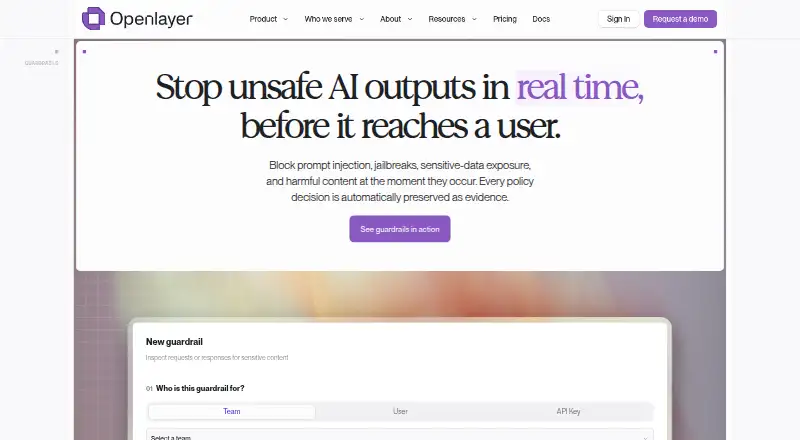
What Openlayer Guardrails is
Openlayer Guardrails inspects live AI inputs and outputs to enforce policies before unsafe behavior reaches a model or user. Its targets include prompt injection, jailbreaks, exposure of sensitive data such as PII and PHI, and harmful or toxic content. For policy violations, it can block or redact content, escalate it, or send it for review; decisions can be recorded as evidence. Openlayer says it detects and blocks more than 50 PII and PHI entity types inline. Organizations can configure categories of sensitive data to block and topics an assistant should avoid. Guardrails are commonly applied through the Gateway and can also be used directly through the SDK. Evaluations, enforcement actions, exceptions, and outcomes can be logged with timestamps, system versions, owners, and supporting traces. The Basic plan costs nothing and includes one member, five projects, one inference pipeline per project, 20,000 inferences per month, 20 tests per project, three months of data retention, and community support. Enterprise pricing is custom and lists on-premise deployment.
Who it suits
It suits engineering, AI, security, compliance, and finance teams that need configurable runtime policies for AI systems. Its stated focus on regulated industries and support for deployment in a customer's own VPC may be relevant to organizations with those requirements.
What it does well
- Targets prompt injection, jailbreaks, PII, and PHI exposure.
- Detects and blocks more than 50 PII and PHI entity types.
- Policies can block, redact, escalate, or route for review.
- Supports Gateway and SDK enforcement.
- Basic plan includes 20,000 inferences per month.
What to know first
- Basic is limited to one member and five projects.
- Basic retention is three months.
- Enterprise pricing is custom and not listed.
- On-premise deployment is listed for Enterprise.
Limits
Basic includes one member, five projects, one inference pipeline per project, 20,000 inferences per month, 20 tests per project, and three months of data retention. On-premise deployment is listed for Enterprise, which has custom pricing.
Plans
| Plan | Billed and limits | Price |
|---|---|---|
| Basic | Free to start · 1 member · 5 projects · 1 inference pipeline per project · 20,000 inferences per month · 20 tests per project · 3 months data retention · Community support | Free |
| Enterprise | Custom · Unlimited members and projects · Custom inference volume · On-premise deployment · SAML SSO · 99.99% SLA · White-glove onboarding · Advanced support | On request |
As openlayer.com lists them, read 30 Sept 2026. The maker's own page has the final word.
Getting started
- Visit the Openlayer Guardrails product page.
- Start with the free Basic plan, or contact Openlayer about custom Enterprise pricing.
- Choose Gateway enforcement or apply guardrails directly through the SDK.
- Configure policies for sensitive-data categories and topics to avoid.
- Select a supported SDK language if using the SDK: Python, TypeScript, Go, Ruby, or Java.
- Contact Openlayer about customer VPC or air-gapped deployment options.
Openlayer Guardrails is a runtime policy layer for teams controlling AI inputs and outputs in production. It suits engineering, security, compliance, and finance groups—particularly in regulated environments—that need both intervention and an auditable record. The free tier is a practical pilot, but its narrow quotas and short retention make Enterprise the more realistic choice for sustained or broad use.
Overview
Guardrails examines live prompts and responses before they reach a model or user. Organizations can define rules for sensitive-data categories and topics an assistant should avoid, then choose whether a violation is blocked, redacted, escalated, or sent for review. Every evaluation, action, exception, and outcome can carry a timestamp, system version, owner, and supporting trace, giving investigations and compliance reviews a concrete record rather than an unexplained allow-or-deny result.
Enforcement commonly runs through the Gateway or directly through the SDK. Inline operation is designed to add minimal production latency. API, web, and self-hosted deployment are supported, including a customer’s own VPC and air-gapped environments; on-premise deployment is reserved for Enterprise.
Key features
- Threat coverage: Policies address prompt injection, jailbreaks, PII and PHI exposure, and harmful or toxic content. Openlayer says more than 50 PII and PHI entity types can be detected and blocked inline, a meaningful baseline for applications handling regulated data.
- Flexible enforcement: Blocking is not the only response. Redaction can remove sensitive material, escalation can flag a case, and review routing supports human judgment when an automatic rejection would be too blunt.
- Custom policies: Teams can align controls with organizational rules instead of relying only on fixed categories. That flexibility is valuable, but it also means someone must maintain policies as products, risks, and acceptable topics change.
- Audit evidence: Recorded policy outcomes help explain what happened and who owned the decision. This is stronger than a simple filter log for teams that need traceability.
- Developer access: SDKs are provided for Python, TypeScript, Go, Ruby, and Java, alongside Gateway integration. The language coverage supports mixed application stacks without limiting enforcement to one integration path.
- Security and deployment: Openlayer lists SOC 2 Type II, GDPR, and HIPAA, with AES-256 encryption at rest and TLS 1.2 or higher in transit. VPC and air-gapped options fit stricter environments.
Pricing
Basic
Basic costs nothing and starts with one member, five projects, one inference pipeline per project, 20,000 inferences per month, and 20 tests per project. Data retention is three months, and support is through the community Discord. It is well suited to a small proof of concept or a single team validating policy behavior; the one-member limit, project ceiling, and monthly inference cap quickly constrain shared or high-volume production work.
Enterprise
Enterprise uses custom pricing and removes the published member and project limits, with custom inference volume. It adds on-premise deployment, SAML SSO, a 99.99% SLA, white-glove onboarding, advanced support, and direct Slack access to the Openlayer team. This is the appropriate tier for organizations that need formal identity controls, contractual availability, or deployment outside a hosted environment.
Platforms
Openlayer Guardrails runs through API, web, and self-hosted deployments. Gateway and SDK integration cover common implementation patterns, and SDKs support Python, TypeScript, Go, Ruby, and Java.
Who it's for
Choose it when AI security and compliance require preventive controls plus evidence of each decision, especially for systems processing PII or PHI. Basic fits early evaluation and small workloads. Teams needing multiple contributors, longer-lived records, substantial inference volume, SAML, an SLA, or on-premise operation should plan around Enterprise. It is less suitable when you only need a small, standalone scan quota or an open-source library without a policy-management service.
Pros and cons
- Pros: Covers prompt injection, jailbreaks, toxic content, and more than 50 PII/PHI entity types; supports block, redact, escalate, and review actions; records detailed enforcement evidence; offers VPC and air-gapped deployment; provides broad SDK language support.
- Cons: Basic allows only one member and 20,000 monthly inferences; three-month retention limits longer audits; on-premise, SSO, SLA, and direct support require Enterprise custom pricing; custom policies require ongoing governance.
Alternatives
For a broader catalog of products, see AI Guardrail Software.
- PromptGuard is a better fit for users wanting desktop platforms and a 20,000-scan free allowance with 24-hour logs, or a $19.00 USD monthly Team plan.
- NVIDIA NeMo Guardrails suits developers seeking a free, open-source Python package; external models and services require separate setup.
- Oracle Mobile Authenticator is a free mobile authenticator rather than an AI runtime guardrail.
- Amazon Bedrock Guardrails fits teams already using Bedrock and willing to pay usage-based content-filter and denied-topic charges.
- Enkrypt AI Guardrails offers a free Explore tier with 500 starting credits, 50 credits per month, and seven-day retention.
- Fiddler Guardrails is an alternative freemium service for real-time harmful-exposure, hallucination, toxicity, PII/PHI, injection, and jailbreak detection.
- OpenSecureAI Prompt Firewall is aimed at self-hosted or web use with a free 2,000 API requests per month.
- CyberSecEval is a free open-source benchmark suite, not a runtime enforcement layer.
Verdict
Openlayer Guardrails is a strong choice for regulated or security-conscious teams that need configurable runtime intervention and defensible records of policy outcomes. Choose it for the combination of broad threat coverage, deployment control, and audit evidence; look elsewhere if your priority is an open-source library, a very small standalone quota, or predictable low-cost scaling beyond Basic.
Verdict
Openlayer Guardrails combines configurable runtime controls with records of policy evaluations and outcomes. The free Basic plan has defined member, project, inference, test, and retention limits, while on-premise deployment is listed for Enterprise.
Questions
Does Openlayer Guardrails have a free plan?
Yes. The Basic plan costs nothing and includes one member, five projects, one inference pipeline per project, 20,000 monthly inferences, 20 tests per project, three months of data retention, and community support.
How much does Enterprise cost?
Enterprise pricing is custom. The listed plan includes unlimited members and projects, custom inference volume, on-premise deployment, SAML SSO, a 99.99% SLA, white-glove onboarding, and advanced support.
How can guardrails be applied?
They are commonly enforced through the Gateway and can also be applied directly through the SDK. Listed SDK languages are Python, TypeScript, Go, Ruby, and Java.
Can it run in our own environment?
Openlayer supports deployment in a customer VPC and air-gapped deployments. On-premise deployment is available on Enterprise.
What threats does it address?
Its stated targets include prompt injection, jailbreaks, PII and PHI exposure, and harmful or toxic content. Policies can be customized to cover an organization’s sensitive-data categories and topics an assistant should avoid.
What support is included?
Basic includes community support through Discord. Enterprise includes white-glove onboarding and direct Slack access to the Openlayer team.
Facts from Openlayer Guardrails's own pages
- Audit evidence
- Each policy evaluation, enforcement action, exception, and outcome can be recorded with a timestamp, system version, owner, and supporting trace. · openlayer.com, 30 Sept 2026
- Deployment
- Openlayer supports deployment in a customer's own VPC and air-gapped deployments; on-premise deployment is available on Enterprise. · openlayer.com, 30 Sept 2026
- Founded
- 2021 · openlayer.com, 28 Sept 2026
- Integration methods
- Guardrails are commonly enforced through the Gateway and can also be applied directly through the SDK. · openlayer.com, 30 Sept 2026
- Intended users
- Openlayer says engineering, AI, security, compliance, and finance teams use the platform, and identifies regulated industries as a focus. · openlayer.com, 30 Sept 2026
- Latency
- Guardrails run inline and are designed to add minimal latency in production. · openlayer.com, 30 Sept 2026
- Policy actions
- Policy violations can be blocked, redacted, escalated, or routed for review, with each decision recorded as evidence. · openlayer.com, 30 Sept 2026
- Policy configuration
- Guardrail policies can be customized for an organization's rules, including sensitive-data categories to block and topics an assistant should avoid. · openlayer.com, 30 Sept 2026
- Runtime enforcement
- Guardrails inspect live AI inputs and outputs and block unsafe behavior before it reaches a model or user. · openlayer.com, 30 Sept 2026
- Security
- Openlayer lists SOC 2 Type II, GDPR, and HIPAA, and says data is encrypted at rest with AES-256 and in transit with TLS 1.2 or higher. · openlayer.com, 30 Sept 2026
- Sensitive data detection
- The product page says it detects and blocks inline more than 50 PII and PHI entity types. · openlayer.com, 30 Sept 2026
- Support
- Basic includes community support through Discord, while Enterprise includes white-glove onboarding and direct Slack access to the Openlayer team. · openlayer.com, 30 Sept 2026
- Threat coverage
- Guardrails target prompt injection, jailbreaks, sensitive data exposure including PII and PHI, and harmful or toxic content. · openlayer.com, 30 Sept 2026
Where Openlayer Guardrails stands on Freedom251
- AI Guardrail Software#7 of 23