Freedom251 › Relational Databases
openGauss
What openGauss is
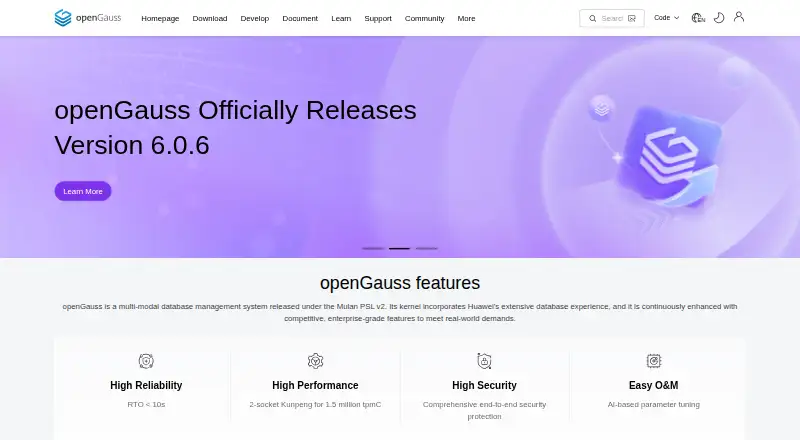
openGauss is a free, open-source relational database management system for enterprise use. It supports Linux, Windows, and self-hosted deployment, with standalone and high-availability options. Its mixed query capabilities bring together structured filtering, knowledge graph retrieval, full-text indexing, and vector retrieval. High-availability configurations support synchronous, asynchronous, and cascaded standby deployments. A setup can have one primary and at least one standby, with as many as four standbys; documentation reports standby promotion in under 10 seconds. It also reports a TPCC result of 1.5 million tpmC on a two-socket Kunpeng system.
Security capabilities include full-encryption computing, access control, encryption authentication, auditing, dynamic data masking, transparent encryption, and tamper-resistant ledger databases. For operations, the project lists AI-based parameter tuning and index recommendations, slow SQL diagnosis, performance monitoring views, and DataKit plugins. The dolphin plugin supports compatibility with most MySQL syntax, functions, and protocols. Official support tools include Python drivers, including a Linux-only psycopg2 driver and a pure Python driver for multiple operating systems, plus a Go driver. Related tools include ShardingSphere, HAProxy, Kubernetes, Patroni, Debezium, DBeaver, Zabbix, Prometheus, and Yukon. Migration tools cover Oracle-to-openGauss, MySQL-to-openGauss, and data imports. LTS releases receive three years of community support; preview releases receive six months.
Who it suits
openGauss suits teams seeking an open-source database they can deploy on Linux, Windows, or their own infrastructure. Its standby configurations, security controls, mixed query options, drivers, and migration tools may also suit organizations planning database operations across several tools.
What it does well
- Combines structured, graph, full-text, and vector retrieval.
- Supports synchronous, asynchronous, and cascaded standby deployments.
- High-availability setups can use up to four standbys.
- Lists broad security controls, including auditing and data masking.
- Offers Python and Go drivers.
What to know first
- The site lists no managed service.
- The psycopg2 Python driver is Linux-only.
- Preview releases receive six months of community support.
Limits
The openGauss plan is free. LTS releases receive three years of community support, while preview releases receive six months.
Plans
| Plan | Billed and limits | Price |
|---|---|---|
| openGauss | Open-source database software under Mulan PSL v2 | Free |
As opengauss.org lists them, read 9 Oct 2026. The maker's own page has the final word.
Getting started
- Visit the openGauss website.
- Choose Linux, Windows, or self-hosted deployment.
- Select standalone or standalone high-availability deployment.
- For high availability, configure one primary and at least one standby, with up to four standbys.
- Consult the listed support tools and migration tools for drivers or data migration.
Verdict
Choose openGauss if you need a free, self-hosted database with mixed query capabilities and high-availability deployment options. Teams seeking a managed service should look elsewhere, as the listed deployment model is self-hosted and no managed service is offered.
Questions
What does openGauss cost?
The openGauss plan is free, and the database is open source under Mulan PSL v2.
Is openGauss a managed service?
No. The listed deployment model is self-hosted, and no managed service is offered.
Which platforms are supported?
The listed platforms are Linux, Windows, and self-hosted deployment.
Does it support high availability and read replicas?
Yes. It supports high availability and read replicas, including synchronous, asynchronous, and cascaded standby deployments.
Which integrations and drivers are listed?
Related tools include ShardingSphere, HAProxy, Kubernetes, Patroni, Debezium, DBeaver, Zabbix, Prometheus, and Yukon. Official support tools include Python and Go drivers.
How long does community support last?
LTS releases receive three years of community support. Preview releases receive six months.
Facts from openGauss's own pages
- Availability
- It supports synchronous, asynchronous, and cascaded standby deployments, with standby promotion in under 10 seconds. · docs.opengauss.org, 9 Oct 2026
- Compatibility
- The dolphin plugin supports compatibility with most MySQL syntax, functions, and protocols. · docs.opengauss.org, 9 Oct 2026
- Connectors
- The official support-tools page lists Python drivers, including a Linux-only psycopg2 driver and a multi-OS pure Python driver, as well as a Go driver. · opengauss.org, 9 Oct 2026
- Deployment
- The official site describes standalone and standalone high-availability deployment; HA supports one primary and at least one standby, with up to four standbys. · opengauss.org, 9 Oct 2026
- Integrations
- Listed related tools include ShardingSphere, HAProxy, Kubernetes, Patroni, Debezium, DBeaver, Zabbix, Prometheus, and Yukon. · opengauss.org, 9 Oct 2026
- Migration
- Listed migration tools include Ora2Pg for Oracle-to-openGauss, pg_chameleon for MySQL-to-openGauss, and pgloader for importing data into openGauss. · opengauss.org, 9 Oct 2026
- Operations
- AI-based parameter tuning and index recommendations, slow SQL diagnosis, performance monitoring views, and DataKit operations plugins are listed as operations capabilities. · docs.opengauss.org, 9 Oct 2026
- Performance
- The documentation reports a TPCC benchmark result of 1.5 million tpmC on a two-socket Kunpeng system. · docs.opengauss.org, 9 Oct 2026
- Platforms
- The download page lists AArch64 and x86_64 packages for openEuler versions and CentOS 7.6, and lists Windows JDBC, ODBC, Python-psycopg2, and libpq drivers. · opengauss.org, 9 Oct 2026
- Product
- openGauss is an enterprise-level, open-source multimodal relational database management system. · opengauss.org, 9 Oct 2026
- Query
- Its mixed query capabilities combine structured filtering, knowledge graph retrieval, full-text indexing, and vector retrieval. · docs.opengauss.org, 9 Oct 2026
- Release cadence
- LTS releases are made every two years and preview releases every six months; preview releases receive six months of community support. · opengauss.org, 9 Oct 2026
- Security
- Documented security features include full-encryption computing, access control, encryption authentication, database auditing, dynamic data masking, transparent encryption, and tamper-resistant ledger databases. · docs.opengauss.org, 9 Oct 2026
- Support
- The site directs users to FAQs and a community forum, and says LTS releases receive three years of community support. · opengauss.org, 9 Oct 2026
Where openGauss stands on Freedom251
- Relational Databases#19 of 38