Freedom251 › Employee Directory Software
Openbook
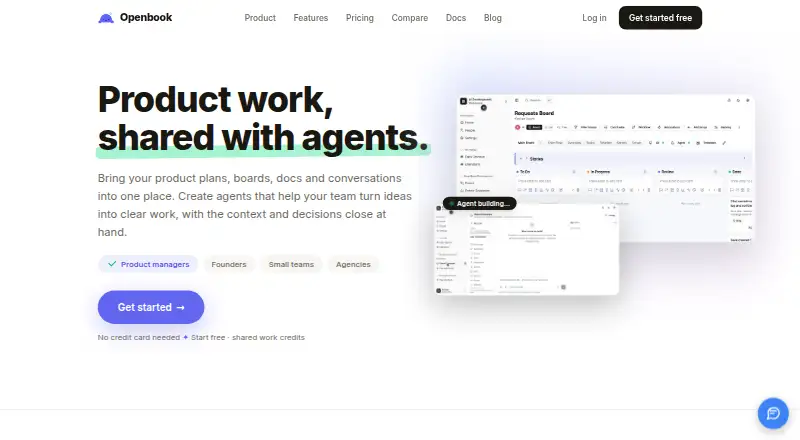
What Openbook is
Openbook is a team workspace that groups work into organizations, spaces, and rooms. Its 21 room types support planning, writing, discussion, and tracking. Teams can use an AI build agent to connect with GitHub or GitLab repositories, implement changes, run builds, and open pull requests. Organizations can use platform-run AI models or configure provider keys for services including OpenAI, Anthropic, DeepSeek, xAI, Google, and Azure OpenAI.
Built-in agent connectors cover services such as WordPress, Slack, Figma, Lovable, Shopify, Stripe, Google Calendar, Cal.com, Calendly, five helpdesks, HubSpot, and Salesforce. Connector writes require explicit enablement, and irreversible third-party actions run only in auto mode. Files can be stored on Openbook’s server, in an S3-compatible bucket, Dropbox, or Microsoft SharePoint/Teams. The read-only Board API returns Kanban board data as JSON through revocable tokens and supports change webhooks.
The Free plan costs nothing and includes all room types. New organizations start with a 14-day Pro trial without a card. Business costs $15 a month, billed monthly, and adds API access, SSO/SAML, audit logs, and advanced permissions.
Who it suits
Openbook suits product managers, founders, small teams, and agencies that want a shared workspace with rooms for different kinds of work. Teams that need repository changes, connected services, or configurable AI providers may also find its agent tools relevant.
What it does well
- Twenty-one room types cover planning, writing, discussion, and tracking.
- Build agent can implement repository changes and open pull requests.
- AI provider keys can be configured for six listed providers.
- Files can use server, S3-compatible, Dropbox, or SharePoint/Teams storage.
- Board API provides JSON data and change webhooks.
What to know first
- Free plan allows up to 10 members with edit access and 3 spaces.
- Default server file storage is limited to 30MB.
- SSO/SAML and API access are listed under the Business plan.
Limits
The Free plan includes up to 10 members with edit access and 3 spaces; viewers and guests are free. Openbook server storage defaults to 30MB. The organization Pro trial lasts 14 days and requires no card.
Plans
| Plan | Billed and limits | Price |
|---|---|---|
| Enterprise | SCIM provisioning · Custom contracts · Security review · Dedicated environment | On request |
| Free | Free forever · Up to 10 members with edit access · 3 spaces · all 18 room types · 30-day chat/feed history · viewers and guests always free | Free |
| Pro | $15/user/month; $12/user/month billed annually · Unlimited members and spaces · all 18 room types · full history · dashboards and proofing rooms · priority support | $15 a month |
| Business | $29/user/month; $23/user/month billed annually · Unlimited members and spaces · all 18 room types · full history · advanced permissions · dedicated support | $29 a month |
As openbook.work lists them, read 20 Sept 2026. The maker's own page has the final word.
Getting started
- Visit https://openbook.work/.
- Create an organization; each new organization starts with a 14-day Pro trial without a card.
- Use the web platform or API.
- Choose a storage option: Openbook server, S3-compatible bucket, Dropbox, or Microsoft SharePoint/Teams.
- Connect supported services or GitHub/GitLab repositories as needed; enable integration writes explicitly.
Openbook is a room-based team workspace for product managers, founders, small teams, and agencies that need planning, writing, discussion, tracking, and software work together. Its repository agent and broad connector set make it more capable than a basic collaboration hub, while the Free plan’s three-space limit will matter as an organization expands.
Choose it when one workspace should coordinate people, rooms, repositories, and connected services. Look elsewhere if your priority is a narrowly focused directory, chat tool, or standup product.
Overview
Openbook structures each organization into spaces and rooms, with 21 purpose-built room types covering planning, writing, discussion, and tracking. That range suits teams with several recurring workflows and gives agencies or product groups a common operating structure. It can be more workspace than a team needs when the requirement is only a simple status meeting or messaging channel.
The AI build agent connects to GitHub and GitLab, implements changes, runs builds, and opens pull requests. That makes Openbook relevant to engineering-enabled product teams, not just project coordinators. Organizations can use platform-run models or configure their own keys from OpenAI, Anthropic, DeepSeek, xAI, Google, and Azure OpenAI.
Key features
Agent connectors cover WordPress, Slack, Figma, Lovable, Shopify, Stripe, Google Calendar, Cal.com, Calendly, five helpdesks, HubSpot, and Salesforce. Writes to integrations are disabled until explicitly enabled, and irreversible third-party actions run only in auto mode. Connector credentials are encrypted and not shown in the integration panel. Openbook says AI provider keys are configured through the Bookbag account service rather than held by Openbook or sent to the browser, a useful separation for teams managing model credentials.
File storage can use Openbook’s server, an S3-compatible bucket, Dropbox, or Microsoft SharePoint/Teams. The default server allowance is 30MB, so teams with substantial assets should plan for external storage. The read-only Board API returns Kanban data as JSON, supports revocable tokens, and offers webhooks for board changes. It is useful for publishing board state to another system, but its read-only design is not a replacement for a full write API.
Pricing
| Plan | Price | What it includes |
|---|---|---|
| Free | free, billed forever | All room types, unlimited rooms and members to start, templates, Command-K search, community support |
| Pro | Custom pricing | Free features plus an AI assistant with real actions, dashboards and live reporting widgets, proofing rooms, unlimited history, priority support |
| Business | $15 a month, billed monthly | Pro features plus SSO/SAML, audit log, API access, advanced permissions, per-room visibility controls, dedicated support |
| Enterprise | Custom pricing | SCIM provisioning, custom contracts, security review, dedicated environment |
The Free plan is a practical starting point, but editing access is limited to 10 members and three spaces; viewers and guests remain free. Every new organization receives a 14-day Pro trial without a card. Pro is the fit for teams needing action-taking AI, reporting, proofing, or unlimited history. Business is the clearest choice for identity controls, auditability, API use, and granular visibility at its published monthly rate. Enterprise targets organizations requiring provisioning, contractual terms, or an isolated environment.
Platforms
Openbook is offered through the web and an API. It also supports external storage destinations and service connectors, making it suitable for organizations whose working systems already span several cloud products.
Who it's for
Product managers and founders get a structured place for planning and decisions; small teams can start without payment; agencies can separate client or project work into spaces. Engineering-oriented groups gain the most from repository actions and pull requests. Teams seeking a dedicated employee directory or a focused daily-standup workflow may prefer a specialized product.
Pros and cons
Pros
- Twenty-one room types support varied planning, writing, discussion, and tracking workflows.
- The build agent connects repository work to implementation, builds, and pull requests.
- Connectors span commerce, design, communication, scheduling, support, and CRM services.
- Explicit write controls, encrypted connector credentials, and revocable Board API tokens add operational safeguards.
- Free access includes all room types and a 14-day Pro trial requires no card.
Cons
- Free editing access stops at 10 members and three spaces, which can force an upgrade or tighter organization.
- Default server storage is only 30MB unless the organization uses another storage destination.
- The Board API is read-only, limiting its use for systems that need to update boards.
- Pro pricing is custom, making the cost of its advanced collaboration features harder to forecast.
Alternatives
Choose Employee Directory Software when employee profiles and directory management are the primary requirement. Choose Daily Standup Software for a focused standup workflow rather than Openbook’s broader room system.
Business in a Box suits a single user who wants a free plan with 12 projects, 100 tasks, 100MB storage, and 3,000 starting AI credits across more device platforms. Choose Slack for chat-centered collaboration with a free plan limited to 90 days of message history and up to ten apps. Connecteam is the alternative for teams wanting mobile and web access with a cost-free limited plan. GoProfiles is a better fit for an employee directory with an org chart, employee map, and people-data import. HourSquare targets teams of up to 10 employees on its free small-team plan. Jostle is an option for employee news, recognition, discussions, and mobile apps. Maptio suits organizations that specifically want open-source, self-hosted software. OrgNice is aimed at project and org-chart work with Google Sheets connection and sharing on higher plans.
Verdict
Openbook is a strong choice for small product teams, founders, and agencies that want room-based collaboration connected to repositories and business services. Its main reason to choose it is the combination of an action-capable build agent, extensive connectors, and a usable free entry point. Look elsewhere if you need predictable Pro pricing, more than three Free spaces, substantial built-in storage, or a board API that can write changes.
Verdict
Choose Openbook if your team wants a room-based workspace with repository actions, agent connectors, and a read-only board API. The Free plan has limits on editing members and spaces, while Business adds SSO/SAML and API access for $15 a month, billed monthly.
Questions
Is Openbook free?
Yes. Its Free plan costs nothing. Viewers and guests are always free, and new organizations start with a 14-day Pro trial without a card.
What does the Free plan include?
It includes all room types, unlimited rooms and members to start, space and room templates, Command-K search, and community support. The listed Free limits allow up to 10 editing members and 3 spaces.
Which platforms does Openbook support?
The listed platforms are web and API.
How much does Business cost?
Business costs $15 a month, billed monthly. It includes SSO/SAML, audit logs, API access, advanced permissions, per-room visibility controls, and dedicated support.
Which AI providers can organizations configure?
Listed key providers are OpenAI, Anthropic, DeepSeek, xAI, Google, and Azure OpenAI. Organizations can also use platform-run models.
Where can organizations store files?
Files can be stored on Openbook’s server, in an S3-compatible bucket, Dropbox, or Microsoft SharePoint/Teams. The default server storage limit is 30MB.
Facts from Openbook's own pages
- Agent safety limit
- External write actions are disabled by default and require both explicit write enablement and a sufficiently permissive autonomy mode. · openbook.work, 20 Oct 2026
- AI assistant
- The assistant works inside rooms, can summarize activity and can act on workspace content using configured models. · openbook.work, 20 Oct 2026
- AI build agent
- The build agent can connect to GitHub and GitLab repositories, implement changes, run builds, and open pull requests. · openbook.work, 9 Oct 2026
- AI key handling
- Openbook says it does not hold AI provider keys, which are configured through the Bookbag account service, and that keys do not reach Openbook or the browser. · openbook.work, 9 Oct 2026
- AI key security
- Openbook says provider keys are held by the Vibeforce account service and never reach Openbook or the browser. · openbook.work, 20 Oct 2026
- AI providers
- Organizations can configure their own AI provider keys or use platform-run models; supported key providers include OpenAI, Anthropic, DeepSeek, xAI, Google, and Azure OpenAI. · openbook.work, 9 Oct 2026
- Audience
- The homepage identifies product managers, founders, small teams, and agencies as intended users. · openbook.work, 9 Oct 2026
- Board API
- The read-only Board API exposes a Kanban board as JSON using revocable tokens, and supports webhooks for board changes. · openbook.work, 9 Oct 2026
- Build agent
- The build agent connects to GitHub or GitLab, edits repository files, runs builds and opens pull requests; it does not merge changes itself. · openbook.work, 20 Oct 2026
- Chat feature
- The Chat room supports channels, direct messages, presence, typing indicators and unread badges. · openbook.work, 20 Oct 2026
- Check-in feature
- Check-in rooms provide asynchronous standups, 36 templates, mood tracking and Team Pulse analytics. · openbook.work, 20 Oct 2026
- Company director
- Companies House lists one active officer, director Zuojiong Wang, appointed 3 October 2025. · find-and-update.company-information.service.gov.uk, 20 Oct 2026
- Company founding date
- Companies House records incorporation on 3 October 2025 with £1 stated capital. · find-and-update.company-information.service.gov.uk, 20 Oct 2026
- Company headquarters
- The registered office is Sabichi House, 5 Wadsworth Road, Perivale, London UB6 7JD, United Kingdom. · open.endole.co.uk, 20 Oct 2026
- Company legal name
- Companies House lists VIBEFORCE DEVELOPMENT LIMITED as company number 16761200. · find-and-update.company-information.service.gov.uk, 20 Oct 2026
- Company size
- Endole classifies Vibeforce Development Limited as a micro company with under 10 employees and turnover under £1 million. · open.endole.co.uk, 20 Oct 2026
- Connector credential security
- Integration credentials are stored encrypted, are not displayed back to users and are scoped to individual build rooms. · openbook.work, 20 Oct 2026
- Credential security
- The integrations documentation says connector credentials are stored encrypted and are not shown back in the integration panel. · openbook.work, 9 Oct 2026
- Current pricing promotion
- The public pricing page says the whole product is currently free at $0 per user per month with no credit card or trial clock, while Pro and Business prices are described as planned future tiers. · openbook.work, 20 Oct 2026
- Dashboard and Gantt
- Dashboards provide live widgets over boards, repositories and rituals, while Gantt rooms support draggable schedules and dependencies. · openbook.work, 20 Oct 2026
- Docs feature
- Docs is a block editor with slash commands, tables, rich blocks, infinitely nested pages and inline search. · openbook.work, 20 Oct 2026
- Documentation depth
- The documentation hub covers getting started, all room types, AI configuration, agents, integrations, billing, administration, platform search, notifications, sharing and the Board API. · openbook.work, 20 Oct 2026
- Extensibility
- Custom HTTP actions and remote HTTPS MCP servers can add tools, with human approval and per-tool enablement. · openbook.work, 20 Oct 2026
- Feed feature
- Feed rooms support posts, images, files, polls, events, announcements, kudos, reactions, threaded comments and mentions. · openbook.work, 20 Oct 2026
Where Openbook stands on Freedom251
- Employee Directory Software#7 of 43
- Daily Standup Software#8 of 24