Freedom251 › Stem Separation Software
Open-Unmix
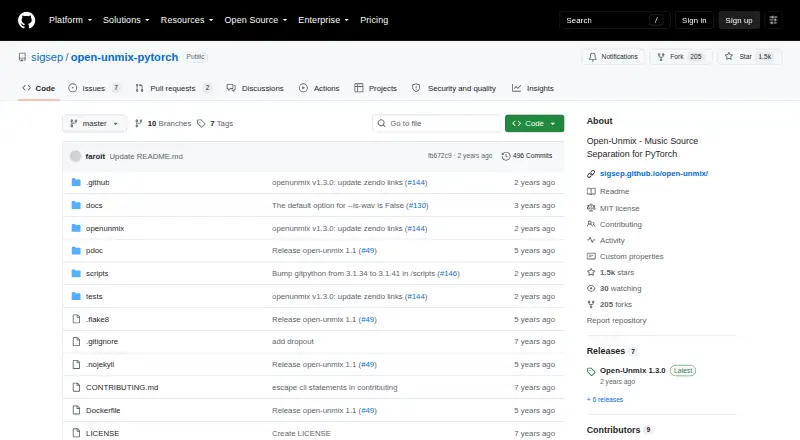
What Open-Unmix is
Open-Unmix is a free PyTorch reference implementation for music source separation aimed at researchers, audio engineers and artists. Its ready-to-use models split pop music into vocals, drums, bass and other instruments. The project also provides umxse, a speech enhancement model trained on the 28-speaker Voicebank+DEMAND corpus. Pre-trained choices include umxl, umxhq, umx and umxse, along with spectrogram variants. The code is intended for reproducing results, developing model architectures and adding data; training is documented separately from the package. Each source model uses a three-layer bidirectional LSTM, and the project says that design cannot run online or in real time. The Python package installs with pip, and a Docker container is available. Models can be loaded through Python or torch.hub, and a Google Colab notebook supports online experimentation without local setup. The command line accepts WAV, FLAC and OGG, but not MP3; stempeg can expand input and output support, including STEMS export. The software is MIT-licensed, while umxl weights are licensed for non-commercial use under CC BY-NC-SA 4.0.
Who it suits
Open-Unmix suits researchers, audio engineers and artists who want to work with source-separation models or reproduce results. It is also relevant to people experimenting with speech enhancement or custom model development.
What it does well
- Ready-to-use models separate four musical stem categories.
- Includes a speech enhancement model.
- Python, torch.hub and Colab access are documented.
- Free software under the MIT license.
What to know first
- The model design cannot run online or in real time.
- Command line does not support MP3.
- umxl model weights are restricted to non-commercial use.
Limits
The listed plan is free. The command line supports WAV, FLAC, and OGG but not MP3, and the model architecture cannot run online or in real time. The umxl weights are licensed for non-commercial use under CC BY-NC-SA 4.0.
Plans
| Plan | Billed and limits | Price |
|---|---|---|
| Open-Unmix | MIT-licensed software · umxl model weights are licensed for non-commercial use | Free |
As github.com lists them, read 8 Oct 2026. The maker's own page has the final word.
Getting started
- Open the project website on GitHub.
- Install the Python package with pip or use the Docker container.
- Load a pre-trained model from Python or torch.hub.
- Use the Google Colab notebook to experiment online without local setup.
- Provide WAV, FLAC, or OGG files to the command line; use stempeg for additional formats.
Verdict
Open-Unmix offers several source-separation models and pathways for experimentation or development. Note the real-time limitation, audio format support and separate non-commercial license on umxl weights.
Questions
How much does Open-Unmix cost?
The listed Open-Unmix plan is free. The software is MIT-licensed.
Which platforms does it support?
The listed platforms are Linux, macOS, self-hosted, and Windows.
What audio can the command line use?
It supports WAV, FLAC, and OGG files, but not MP3. Stempeg can expand supported formats, including STEMS export.
Which models are available?
Pre-trained options include umxl, umxhq, umx, and umxse, with spectrogram variants also available.
What licenses apply?
The repository lists the software under MIT. The umxl weights are licensed for non-commercial use under CC BY-NC-SA 4.0.
Where can I get technical support?
The project directs users to GitHub issues, Gitter chat, and Google Groups.
Facts from Open-Unmix's own pages
- Audio formats
- The command line supports WAV, FLAC, and OGG files but not MP3; stempeg can expand supported input and output formats, including STEMS export. · github.com, 8 Oct 2026
- Installation
- The Python package can be installed with pip, and the project also provides a Docker container. · github.com, 8 Oct 2026
- Integrations
- Pre-trained models can be loaded from Python or through torch.hub, and a Google Colab notebook offers online experimentation without local setup. · github.com, 8 Oct 2026
- Maker
- The SigSep GitHub organization describes itself as providing open resources for audio source separation. · github.com, 8 Oct 2026
- Model architecture
- Each source model uses a three-layer bidirectional LSTM, and the project states that this design cannot run online or in real time. · github.com, 8 Oct 2026
- Model options
- Pre-trained options include umxl, umxhq, umx, and umxse, with spectrogram variants also available. · github.com, 8 Oct 2026
- Model weights license
- The umxl weights are licensed for non-commercial use under CC BY-NC-SA 4.0. · github.com, 8 Oct 2026
- Music stems
- Its ready-to-use models separate pop music into vocals, drums, bass, and other instruments. · github.com, 8 Oct 2026
- Purpose
- Open-Unmix is a PyTorch reference implementation for music source separation aimed at researchers, audio engineers, and artists. · github.com, 8 Oct 2026
- Security and compliance
- The opened project pages state an MIT license but do not describe security controls or compliance certifications. · github.com, 8 Oct 2026
- Software license
- The repository lists the software license as MIT. · github.com, 8 Oct 2026
- Speech enhancement
- The project provides an umxse speech enhancement model trained on the 28-speaker Voicebank+DEMAND corpus. · github.com, 8 Oct 2026
- Support
- The project directs users to GitHub issues, Gitter chat, and Google Groups for technical help and support. · sigsep.github.io, 8 Oct 2026
- Training and extensibility
- The code is designed to let researchers reproduce results, develop architectures, and add their own data, while model training is documented separately from the package. · github.com, 8 Oct 2026
Where Open-Unmix stands on Freedom251
- Stem Separation Software#8 of 21