Freedom251 › Physics Simulation Software
Open Source Physics
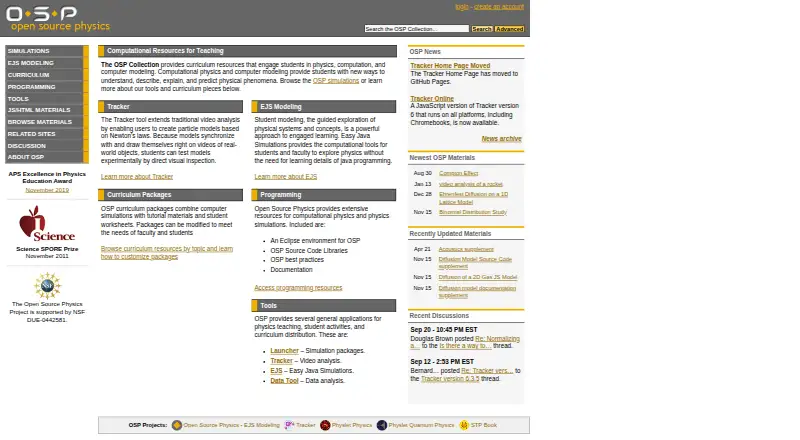
What Open Source Physics is
Open Source Physics (OSP) is a collection of curriculum resources for physics, computation, and computer modeling. It brings together lessons, authoring tools, simulations, and analysis software for students and educators. The collection contains well over 2,000 items and more than 1,000 Physlet pages, and serves over 200,000 users worldwide. OSP is free and open source, with web, Windows, macOS, Linux, iOS, and Android platforms; its delivery mode is hybrid, and offline access is included.
Its tools cover several parts of physics instruction. Tracker analyzes images and video, follows objects, and places dynamic particle models over video clips; it is designed for introductory college physics labs and lectures. OSP curriculum packages combine simulations with tutorials and student worksheets, which faculty and students can modify. Easy Java Simulations (EJS) supports creating Java programs with limited programming and making user interfaces without programming. DataTool plots and fits data, offers standard statistics, and includes user-defined fit and mathematical manipulation tools. The OSP library also provides plotting, field visualization, input and output components, ODE solvers, 3D drawing, and simulation recording. OSP source and compiled code may be used under GNU GPL version 2 or later, while curricular narratives may carry separate copyrights or licenses.
Who it suits
OSP is suited to physics educators and students looking for curriculum materials, simulations, and tools for analyzing experimental video or data. Its authoring and programming resources also suit faculty and learners who want to adapt materials or create simulations and interfaces.
What it does well
- Free and open source, with web, desktop, and mobile platforms.
- Includes a library of more than 2,000 collection items.
- Tracker analyzes video and tracks objects for physics instruction.
- Curriculum packages combine simulations, tutorials, and student worksheets.
- DataTool provides plotting, fitting, and statistics tools.
- Includes offline access, data export, and 3D visuals.
What to know first
- Curricular narratives may have copyrights or licenses separate from the OSP code.
- Launcher packages depend on a Java VM on the local machine.
- Tracker is designed for introductory college physics labs and lectures.
Limits
There is no free-plan quota or paid-plan limit listed. Launcher packages depend on a Java VM on the local machine, and curricular narratives may have separate copyrights or licenses from OSP source and compiled code.
Getting started
- Visit the Open Source Physics collection website.
- Choose a curriculum package, Tracker, EJS, DataTool, or another OSP resource.
- Use Tracker Online in a browser, or use the JavaScript version of Tracker 6 across platforms.
- Use Launcher to distribute OSP and EJS programs and curriculum in self-contained packages, with a local Java VM.
- Contact OSP through its feedback form or [email protected], or use its technical questions discussion link.
Verdict
Choose Open Source Physics if you want free physics curriculum resources alongside simulation, authoring, video-tracking, or data-analysis tools. Check the licensing of curricular narratives separately if you plan to reuse them, since their terms may differ from the source and compiled code.
Questions
How much does Open Source Physics cost?
It is free and open source. No free trial is offered.
Which platforms does OSP support?
The listed platforms are Android, iOS, Linux, macOS, web, and Windows. Tracker Online runs in a browser, and JavaScript Tracker 6 is described as running on all platforms, including Chromebooks.
What does Tracker do?
It analyzes images and video, tracks objects, and overlays dynamic particle models on video clips. It is designed for introductory college physics labs and lectures.
Can educators adapt the curriculum?
OSP curriculum packages combine simulations, tutorials, and student worksheets and can be modified by faculty and students.
What license applies to OSP?
OSP source and compiled code may be used under GNU GPL version 2 or any later version. Associated curricular narratives may have separate copyrights or licenses.
Who makes Open Source Physics?
The maker is Open Source Physics, founded in 2002.
Facts from Open Source Physics's own pages
- Audience
- OSP describes its project as a group of physicists and educators providing computer-based curricular resources for students. · compadre.org, 11 Oct 2026
- Authoring tools
- Yes · compadre.org, 20 Sept 2026
- Collection scale
- The About page says the OSP Collection contains well over 2,000 items and serves over 200,000 users worldwide. · compadre.org, 11 Oct 2026
- Collection size
- The About page says the OSP Collection contains well over 2,000 items and over 1,000 Physlet pages. · compadre.org, 11 Oct 2026
- Curriculum packages
- OSP curriculum packages combine computer simulations with tutorials and student worksheets, and can be modified for faculty and students. · compadre.org, 11 Oct 2026
- Data analysis
- DataTool plots and fits data, provides standard statistics, and includes tools for user-defined fits and mathematical manipulations. · compadre.org, 11 Oct 2026
- Data export
- Yes · compadre.org, 20 Sept 2026
- Delivery mode
- hybrid · compadre.org, 20 Sept 2026
- Desktop platforms
- The page says desktop Tracker traditionally ran on Windows, Mac, and Linux. · compadre.org, 11 Oct 2026
- EJS Modeling
- Easy Java Simulations lets users create Java programs with minimal programming and create user interfaces without programming. · compadre.org, 11 Oct 2026
- Founded
- 2002 · compadre.org, 28 Sept 2026
- Integration
- DataTool is integrated into many OSP and EJS simulations, which can send plot data to it through a right-click action. · compadre.org, 11 Oct 2026
- Launcher
- Launcher distributes OSP and EJS programs and curriculum in self-contained packages that depend on a Java VM on the local machine. · compadre.org, 11 Oct 2026
- Lesson library
- Yes · compadre.org, 20 Sept 2026
- License
- OSP source and compiled code may be used under GNU GPL version 2 or any later version; associated curricular narratives may have separate copyrights or licenses. · compadre.org, 11 Oct 2026
- Offline access
- Yes · compadre.org, 20 Sept 2026
- Platform note
- The site says a JavaScript version of Tracker version 6 runs on all platforms, including Chromebooks. · compadre.org, 11 Oct 2026
- Programming features
- The OSP library includes plotting, field visualization, input and output components, ODE solvers, 3D drawing, and simulation recording. · compadre.org, 11 Oct 2026
- Programming resources
- OSP programming resources include an Eclipse environment, source-code libraries, best practices, and documentation. · compadre.org, 11 Oct 2026
- Purpose
- The OSP Collection provides curriculum resources that engage students in physics, computation, and computer modeling. · compadre.org, 11 Oct 2026
- Support
- OSP directs users to its feedback form or [email protected] for staff contact, and lists a technical questions discussion link. · compadre.org, 11 Oct 2026
- 3D visuals
- Yes · compadre.org, 20 Sept 2026
- Tracker
- Tracker analyzes images and video, tracks objects, and overlays dynamic particle models on video clips. · compadre.org, 11 Oct 2026
- Tracker audience
- Tracker is designed for introductory college physics labs and lectures. · compadre.org, 11 Oct 2026
Where Open Source Physics stands on Freedom251
- Physics Simulation Software#10 of 89