Freedom251 › Mass Notification Software
Open Paging Server
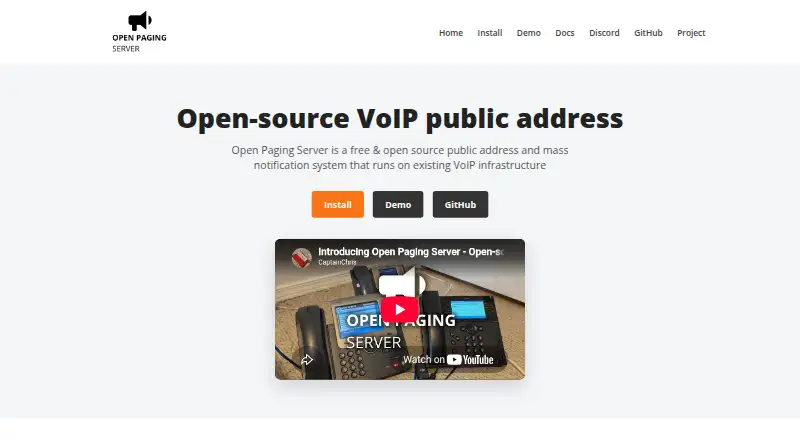
What Open Paging Server is
Open Paging Server is a self-hosted public address and mass notification system for existing VoIP infrastructure. It supports live paging, mass messaging, and bells, with SIP connections to VoIP PBX or ITSP systems and multicast broadcasts to IP phones or speakers. The project maintains modules for endpoint brands including Cisco, Polycom, Yealink, and Snom, and its SDK allows third parties to add modules. Listed compatibility includes Cisco Unified Communications Manager versions 11, 12, 14, and 15, plus Asterisk 18 through 23 and FreePBX 15 through 17 using chan_pjsip, all marked as working as intended. It runs on Linux; the automatic installer supports Debian 12 or later and Ubuntu 23.10 or later on x64 or ARM64. Docker Compose instructions are also available. The software is GPL 2.0 licensed and free for private, public, or commercial use. The maker says it remains in beta and is not ready for production. Community support and involvement are available through Discord and GitHub.
Who it suits
It is intended for small to medium enterprises familiar with system administration that want a self-hosted paging and notification system. Its beta status makes it unsuitable for production use, according to the maker.
What it does well
- Free for private, public, or commercial use
- Supports SIP and multicast broadcasts
- Official modules cover several endpoint brands
- Docker Compose installation instructions are available
What to know first
- Currently in beta and not production-ready
- Automatic installer requires Debian 12+ or Ubuntu 23.10+
Limits
The maker says Open Paging Server is in beta and not ready for production use. The automatic installer supports Debian 12 or later and Ubuntu 23.10 or later on x64 or ARM64.
Plans
| Plan | Billed and limits | Price |
|---|---|---|
| Open Paging Server | Private, public, or commercial use · self-hosted · GPL 2.0 | Free |
As openpagingserver.org lists them, read 14 Oct 2026. The maker's own page has the final word.
Getting started
- Visit the Open Paging Server website.
- Choose a Linux deployment route: the automatic installer or Docker Compose instructions.
- For the automatic installer, use Debian 12 or later or Ubuntu 23.10 or later on x64 or ARM64.
- Connect it to VoIP PBX or ITSP systems using SIP, or use multicast broadcasts to endpoints.
- Use Discord or GitHub for community involvement and support.
Open Paging Server is a self-hosted paging and notification system for organizations that already run VoIP infrastructure. It is best suited to smaller enterprises with Linux and systems-administration experience. Its broad endpoint support and free license are appealing, but the beta warning makes it unsuitable for production deployments.
Overview
The software adds live paging, mass messaging, and bells to existing VoIP environments rather than replacing a PBX or ITSP. Its GPL 2.0 license and self-hosted model let organizations retain control of their data without paying for the software. That control comes with responsibility: deployment and administration are the user's job, and the project says it is not ready for production use.
Key features
SIP connections to VoIP PBX or ITSP systems and multicast broadcasts to IP phones or speakers give the system two ways to reach endpoints. This is useful for organizations that already have compatible voice infrastructure; teams seeking a paging service independent of that infrastructure should look elsewhere.
First-party modules cover multiple major endpoint brands, including Cisco, Polycom, Yealink, and Snom, while an SDK supports third-party modules. The compatibility matrix marks Cisco Unified Communications Manager versions 11, 12, 14, and 15, Asterisk 18 through 23, and FreePBX 15 through 17 using chan_pjsip as working as intended. That gives teams using those systems a concrete starting point for assessing fit, though the beta status remains a significant operational risk.
Installation options include an automatic Linux installer and Docker Compose instructions. The automatic installer supports Debian 12 or later and Ubuntu 23.10 or later on x64 or ARM64, so organizations on other Linux distributions or architectures should expect to use a different route or assess their setup separately.
Pricing
The Open Paging Server plan costs nothing, billed Free. It permits private, public, or commercial use and is self-hosted, with no paid tier or usage cap described. That makes it a cost-conscious option for organizations able to supply their own hosting and administration. The trade-off is that there is no commercial production-readiness assurance: the maker explicitly says the software is in beta and not ready for production use.
Platforms
Open Paging Server supports Linux, self-hosted deployment, and web access. The automatic installer targets Debian 12 or later and Ubuntu 23.10 or later on x64 or ARM64; Docker Compose is another documented installation method. The project is community-driven and directs users to Discord and GitHub for support and involvement, rather than offering a stated commercial support channel.
Who it's for
This is a fit for small and medium enterprises familiar with system administration, already operating VoIP infrastructure, and looking to avoid software licensing costs while retaining data control. It is not a sound choice for organizations that need a production-ready system today, lack the technical capacity to self-host, or need paging to work independently of their PBX and endpoints.
Pros and cons
- Pros: Free for private, public, or commercial use, with GPL 2.0 licensing and self-hosting for organizations that want control of their data.
- Pros: SIP and multicast support, multiple first-party endpoint modules, and an SDK give VoIP-equipped teams flexibility across device estates.
- Cons: The maker says it is in beta and not ready for production use, a decisive drawback for operationally critical paging.
- Cons: Users need suitable VoIP infrastructure and the ability to manage a self-hosted Linux deployment.
- Cons: Support is community-based through Discord and GitHub, which may not meet organizations needing a formal support arrangement.
Alternatives
For a broader set of options, see Mass Notification Software. Text-Em-All (formerly Call-Em-All) may suit readers who want a freemium service with web, mobile, and API platforms: its free Starter plan offers 25 credits for testing voice broadcasts and test texting to your own number, while mass texting requires an upgrade. Choose EMMA Notify if a paid option with Linux, desktop, web, and mobile platform support better fits your requirements.
Honeywell Forge is a paid alternative with product-specific offerings; Advanced Process Control has term-based licensing and feature choices, with pricing available by contacting Honeywell. CrisisGo offers a freemium model and mobile, desktop, and web platforms; its Safety iResponse for Independent Schools plan costs $2,520 a year for up to 500 students, with a charge for each additional student. SA-Announce is a paid alternative with a free trial and self-hosted support.
AlertFind is a paid option with pricing provided on request and a demo offered. Alertable and EmReach are paid alternatives with web and mobile platforms.
Verdict
Open Paging Server is worth considering for technically capable smaller enterprises that already operate VoIP systems and want a free, self-hosted way to add paging, messages, and bells. Its endpoint breadth and open license are strong reasons to evaluate it, but the maker's beta warning is the overriding reason to look elsewhere for any production use.
Verdict
Open Paging Server combines live paging, messaging, and bells with broad VoIP and endpoint support. Its free, self-hosted model may suit technically capable smaller enterprises, but the beta warning is an important limitation.
Questions
How much does Open Paging Server cost?
The plan is free, for private, public, or commercial use.
Can I host it myself?
Yes. It is self-hosted Linux software licensed under GPL 2.0, and self-hosting lets users retain control of their data.
What does Open Paging Server do?
It provides live paging, mass messaging, and bells over existing VoIP infrastructure.
Which VoIP systems are listed as compatible?
The compatibility matrix lists Cisco Unified Communications Manager versions 11, 12, 14, and 15, plus Asterisk 18 through 23 and FreePBX 15 through 17 using chan_pjsip, as working as intended.
Which Linux systems does the automatic installer support?
It supports Debian 12 or later and Ubuntu 23.10 or later on x64 or ARM64. Docker Compose installation instructions are also provided.
Is it ready for production use?
No. The maker says it is currently in beta and not ready for production use.
Facts from Open Paging Server's own pages
- Bell scheduling
- The feature list includes bells for announcements or scheduled signals. · openpagingserver.org, 14 Oct 2026
- Beta status
- The maker says the software is currently in beta and not ready for production use. · openpagingserver.org, 4 Oct 2026
- Cisco integration
- Cisco Unified Communications Manager can synchronize phones through its AXL service and connect through a SIP trunk. · docs.openpagingserver.org, 14 Oct 2026
- Company location
- The GitHub organization profile lists the organization location as United States of America. · github.com, 14 Oct 2026
- Compatibility
- The compatibility matrix reports working tests for Cisco UCM 11, 12, 14, and 15, Grandstream UCM6301/2/4/8, Asterisk 18–23, and FreePBX 15–17. · docs.openpagingserver.org, 14 Oct 2026
- Database
- The documented deployments use MariaDB or MySQL for the application database. · docs.openpagingserver.org, 14 Oct 2026
- Deployment
- The maker provides an automatic Linux installer and Docker Compose installation instructions. · install.openpagingserver.org, 4 Oct 2026
- Docker deployment
- Docker Compose installation is supported, although the documentation marks it beta. · docs.openpagingserver.org, 14 Oct 2026
- Emergency notifications
- Cisco integration supports External Call Control Profiles that can trigger notifications for emergency-number calls. · docs.openpagingserver.org, 14 Oct 2026
- Endpoint ecosystem
- The project supplies first-party endpoint modules and allows third-party modules through an SDK. · openpagingserver.org, 14 Oct 2026
- Example endpoints
- The project lists Cisco, Polycom, Yealink, and Snom among its official endpoint modules. · github.com, 4 Oct 2026
- External API variable
- The `${api:URL}` variable fetches plain text from an external URL, while private and loopback addresses are blocked by default. · docs.openpagingserver.org, 14 Oct 2026
- Features
- It supports live paging, mass messaging, and bells. · openpagingserver.org, 4 Oct 2026
- Independent adoption
- As of August 3, 2026, that account estimated more than 50 installations, about 50 Discord users, and over 500 GitHub commits. · captainchris.me, 14 Oct 2026
- Independent deployment
- A personal telecom site reports running Open Paging Server on an HP mini desktop alongside Cisco Unified Communications Manager and Asterisk. · captainchris.me, 14 Oct 2026
- Independent development
- The project evolved from PHP and Python scripts with Asterisk into database-backed modular endpoints and a custom SIP stack. · captainchris.me, 14 Oct 2026
- Independent endpoint support
- The independent development account describes added Polycom, Yealink, generic multicast, outbound SIP dialing, and manageable endpoint groups. · captainchris.me, 14 Oct 2026
- Independent history
- The same independent account says the project began in January 2026 and was publicly unveiled on May 15, 2026. · captainchris.me, 14 Oct 2026
- Intended users
- The maker describes it as designed for small to medium enterprises familiar with system administration and seeking cost savings. · docs.openpagingserver.org, 4 Oct 2026
- Licence
- The project is released under GPL 2.0 and is free for private, public, and commercial use. · docs.openpagingserver.org, 14 Oct 2026
- License and hosting
- The software is licensed under GPL 2.0 and can be self-hosted, allowing users to retain control of their data. · docs.openpagingserver.org, 4 Oct 2026
- Limit: beta maturity
- The project warns that it is very early beta software, not tested or suitable for production, with incomplete documentation. · docs.openpagingserver.org, 14 Oct 2026
- Limit: Cisco networking
- Cisco enterprise phones require HTTP reachability from the server and multicast or unicast RTP paths, which commonly prevents use across NAT. · docs.openpagingserver.org, 14 Oct 2026
- Limit: demo privacy
- The public demo warns that users can receive messages sent by other users and should not remain connected long term. · docs.openpagingserver.org, 14 Oct 2026
Where Open Paging Server stands on Freedom251
- Mass Notification Software#1 of 34