Freedom251 › AI DevOps Assistants
Open DevOps Agent
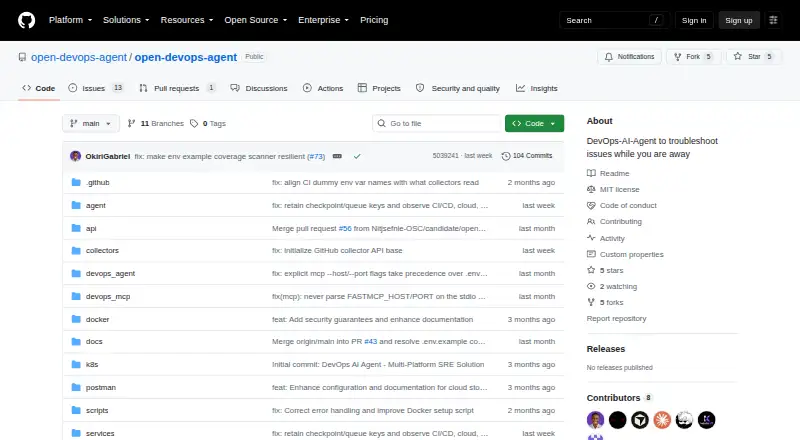
What Open DevOps Agent is
Open DevOps Agent is a free, open-source agent for SRE and DevOps teams that monitors, diagnoses, and fixes infrastructure incidents. It handles CI/CD failures, Kubernetes issues, cloud infrastructure, GitOps deployments, container builds, and server issues. Listed integrations cover CI systems such as GitHub Actions, GitLab CI, Jenkins, Azure DevOps, and Bamboo; infrastructure tools including Kubernetes, Docker, and ArgoCD; and AWS, GCP, and Azure. Alert and monitoring sources include Prometheus Alertmanager, CloudWatch, Azure Monitor, PagerDuty, and manual webhooks. The project describes Slack and email notifications, PagerDuty escalation, and Jira or Zoho ticket creation when the agent cannot resolve an incident. Organizations can supply their own credentials, and an MCP server lets compatible AI clients use DevOps tools. Deployment options include a Python package or Docker image, including Kubernetes deployment. Its safety controls include dry-run defaults, human approval gates for critical actions, command blocking, audit logging, and an emergency stop. The project also describes TLS, authentication, IP allowlisting, RBAC, encrypted credentials, and rate limiting. It says it validates against CIS benchmarks, SOC 2, PCI-DSS, HIPAA, and GDPR. Destructive operations such as deleting databases, formatting disks, and removing production files are blocked. The repository uses the MIT License.
Who it suits
This agent suits SRE and DevOps teams seeking automated incident monitoring and response across CI/CD, Kubernetes, cloud, and server environments. It may also fit organizations that want to deploy the agent themselves and provide their own credentials.
What it does well
- Free and open source under the MIT License.
- Handles incidents across CI/CD, Kubernetes, cloud, GitOps, containers, and servers.
- Integrates with AWS, GCP, Azure, and many listed DevOps tools.
- Dry-run defaults and approval gates help control critical actions.
- Offers Python package, Docker image, and Kubernetes deployment options.
What to know first
- Destructive operations such as deleting databases are permanently blocked.
- The Python package requires Python 3.9 or later.
- Kubernetes features require kubectl.
Limits
Destructive operations—including deleting databases, formatting disks, and removing production files—are permanently blocked. The Python package requires Python 3.9 or later, and Kubernetes features require kubectl.
Getting started
- Visit the project's GitHub repository.
- Choose a Python package or Docker image deployment.
- For the Python package, meet the Python 3.9 or later prerequisite.
- Install kubectl if you need Kubernetes features.
- Supply your organization's credentials and configure the integrations you use.
Verdict
Choose Open DevOps Agent if your team wants a free, self-deployable incident agent with broad infrastructure integrations and documented safety controls. Look elsewhere if your response workflow requires it to perform destructive operations, which the project says are blocked.
Questions
Does Open DevOps Agent cost anything?
It is listed as free and open source, under the MIT License.
Where can it be deployed?
The project documents a Python package or Docker image, including deployment to Kubernetes. Its listed platforms include Linux, macOS, Windows, API, and self-hosted.
Which cloud platforms does it support?
Its listed cloud platforms are AWS, GCP, and Azure.
What is required for Kubernetes features?
The project says Kubernetes features require kubectl.
Can it perform destructive operations?
No. The project says operations such as deleting databases, formatting disks, and removing production files are permanently blocked.
How can users get support?
The README directs users to GitHub Issues, GitHub Discussions, and a community Slack link.
Facts from Open DevOps Agent's own pages
- Compliance checks
- The project says it validates against CIS benchmarks, SOC 2, PCI-DSS, HIPAA, and GDPR. · github.com, 8 Oct 2026
- Deployment
- The project documents running the agent as a Python package or Docker image, including deployment to Kubernetes. · github.com, 8 Oct 2026
- Fix verification
- The agent documentation describes an immediate fix check followed by five minutes of stability monitoring. · github.com, 8 Oct 2026
- Incident response
- It handles CI/CD failures, Kubernetes issues, cloud infrastructure, GitOps deployments, container builds, and server issues. · github.com, 8 Oct 2026
- Incident types
- It lists CI/CD failures, Kubernetes issues, cloud infrastructure, GitOps deployments, container builds, and server issues among the incidents it handles. · github.com, 8 Oct 2026
- Integrations
- The listed integrations include GitHub Actions, GitLab CI, Jenkins, Azure DevOps, Bamboo, Kubernetes, Docker, ArgoCD, AWS, GCP, Azure, Prometheus Alertmanager, CloudWatch, Azure Monitor, Slack, and PagerDuty. · github.com, 8 Oct 2026
- License
- The repository states that the project is licensed under the MIT License. · github.com, 8 Oct 2026
- MCP and credentials
- An MCP server lets compatible AI clients use DevOps tools, and organizations can supply their own credentials. · github.com, 8 Oct 2026
- Monitoring and alerts
- The README lists Prometheus Alertmanager, CloudWatch, Azure Monitor, PagerDuty, and manual webhooks as alert or monitoring sources. · github.com, 8 Oct 2026
- Notable limit
- The project says destructive operations such as deleting databases, formatting disks, and removing production files are permanently blocked. · github.com, 8 Oct 2026
- Notifications
- The project describes Slack and email notifications, PagerDuty escalation, and Jira or Zoho ticket creation when the agent cannot resolve an incident. · github.com, 8 Oct 2026
- Operating systems
- The README lists Linux distributions, RHEL-family systems, and Windows Server 2016, 2019, and 2022 as supported operating systems. · github.com, 8 Oct 2026
- Prerequisites
- The quick start lists Python 3.9 or later as a prerequisite and says kubectl is needed for Kubernetes features. · github.com, 8 Oct 2026
- Purpose
- The agent monitors, diagnoses, and fixes infrastructure incidents for SRE and DevOps teams. · github.com, 8 Oct 2026
- Requirements
- The documented Python package requires Python 3.9 or later; Kubernetes features require kubectl. · github.com, 8 Oct 2026
- Safety controls
- The README describes dry-run defaults, human approval gates for critical actions, command blocking, audit logging, and an emergency stop. · github.com, 8 Oct 2026
- Security
- The security document lists TLS, webhook authentication, IP allowlisting, API-key authentication, RBAC, encrypted credentials, and rate limiting. · github.com, 8 Oct 2026
- Security controls
- Listed controls include API key and webhook authentication, IP allowlisting, TLS/SSL, RBAC, security scanning, and an emergency stop capability. · github.com, 8 Oct 2026
- Support
- The README directs users to GitHub Issues, GitHub Discussions, and a community Slack link. · github.com, 8 Oct 2026
Where Open DevOps Agent stands on Freedom251
- AI DevOps Assistants#13 of 26