Freedom251 › Cloud Governance Software
OmniGCloud
What OmniGCloud is
OmniGCloud is a multi-cloud control plane for governance, FinOps, deployment and automated compliance. It brings infrastructure evidence together for discovery, cost comparison, optimization and migration planning across sources such as AWS, Azure, GCP, VMware, Kubernetes, OpenShift, Cloudflare Edge and sovereign environments. Governance features include monitoring, executive summaries, cost and anomaly views, compliance and risk visibility, approvals, action journals and ledger-backed deployments. The platform names integrations and workflows involving GitHub, Spark, Kafka, F5 BIG-IP, VMware AVI/NSX, Envoy and Terraform-related tools. Developers can access a CLI, REST API, OpenAPI specification and SDKs. Its security descriptions include capability-based RBAC, scoped sessions, audit trails, encryption in transit by default and configurable storage posture. Deployment options vary by edition and include SaaS, private tenant, dedicated, private-cloud, sovereign, offline, air-gapped and partner-managed configurations. The free plan is limited to one connector and a single SaaS workspace, with basic support. The Team plan is $39/ seat / mo, billed annually; higher tiers offer more connectors and deployment options.
Who it suits
It is aimed at individual evaluators, product and platform teams, cross-functional operations teams, regulated enterprises and system integrators. The one-connector free plan is intended for individual evaluation and small pilots.
What it does well
- Combines infrastructure evidence for cost and migration planning.
- Lists sources across major clouds and hybrid environments.
- Provides CLI, REST API, OpenAPI specification and SDKs.
- Includes approvals, audit trails and ledger-backed deployments.
- Offers multiple deployment options across editions.
What to know first
- Free plan is limited to one connector.
- Free plan allows a single SaaS workspace.
- Free plan includes basic support.
Limits
The Free plan is limited to one connector and a single SaaS workspace, with basic CSV export and a basic audit trail. Team costs $39/seat/month billed annually and allows up to 10 connectors per workspace; its feature set includes shared SaaS workspaces and scheduled CSV/PDF exports.
Plans
| Plan | Billed and limits | Price |
|---|---|---|
| Free | $0 forever · 1 connector · single SaaS workspace · basic CSV export · basic audit trail · basic support | Free |
| Business | $239/ mo, billed annually · Up to 100 connectors · shared SaaS and private tenant deployments · full report export suite · compliance evidence packs with audit exports | $239 a month |
| Team | $39/ seat / mo, billed annually · Up to 10 connectors per workspace · shared SaaS workspaces · scheduled CSV/PDF exports · team review-ready evidence packs | $39 a month |
| Pro | $79/ mo, billed annually · Up to 20 connectors · shared SaaS workspaces · scheduled CSV/PDF exports · exportable evidence packs | $79 a month |
| Partner/SI | Custom contact sales · Custom or project-based connectors · partner-managed multi-tenant or private deployments · project and customer handoff exports · delivery evidence packs | On request |
| Platform | Custom contact sales · Custom connector packs · private control-plane deployments · white-label report bundles · signed evidence packages | On request |
| Enterprise | Custom contact sales · Custom or negotiated connectors · dedicated tenant or private deployment · full export suite plus API delivery · customer-defined evidence retention and export | On request |
| Government/Offline | Custom contact sales · Custom or air-gapped connectors · disconnected or sovereign deployment · offline export bundles · offline evidence archives and chain-of-custody | On request |
As omnigcloud.com lists them, read 15 Oct 2026. The maker's own page has the final word.
Getting started
- Visit the OmniGCloud website.
- Choose the Free plan for an individual evaluation or small pilot, or review paid plans.
- Connect infrastructure sources within the connector limit for the selected plan.
- Use the web workspace or developer access through the CLI, REST API, OpenAPI specification or SDKs.
- Select an available deployment option for the chosen edition.
OmniGCloud is a multi-cloud control plane for teams that need governance, financial-operations views and controlled deployment across varied infrastructure. It suits platform, operations and regulated-technology groups better than a single-cloud user. Its main appeal is a unified evidence-to-deployment workflow, while connector limits and custom-priced deployment editions make sizing important.
Overview
OmniGCloud brings discovery, cost comparison, optimization and migration planning into one workflow for hybrid environments. Supported sources include AWS, Azure, Google Cloud, VMware, Kubernetes, OpenShift, Cloudflare Edge and sovereign environments. That range is useful when infrastructure spans providers, private platforms or edge services; a narrowly scoped cloud estate may not need such breadth.
Governance covers monitoring, executive summaries, cost and anomaly views, compliance and risk visibility, approvals, action journals and ledger-backed deployments. Policy as code, compliance frameworks, drift detection and automated remediation extend it beyond a reporting dashboard. The trade-off is operational complexity: connector quotas and deployment choices vary substantially by edition.
Key features
Governance and evidence
Capability-based role controls, scoped sessions, audit trails and configurable storage posture support differentiated access and accountability. Encryption in transit is enabled by default. Approval, rollback and ledger history in deployment workflows give teams a record of decisions and changes, while continuous service-health monitoring supports ongoing operations.
Integrations and developer access
Named integrations cover AWS, Azure, Google Cloud, VMware, Kubernetes, OpenShift, Cloudflare, GitHub, Spark, Kafka, F5 BIG-IP, VMware AVI/NSX, Envoy and Terraform-related workflows. A CLI, REST API, OpenAPI specification and SDKs make the platform more suitable for automation and internal tooling than a closed, dashboard-only product.
Residency and regulated operation
Region-aware configurations address data-residency requirements per enterprise rollout. Higher editions include private, sovereign, offline and air-gapped deployment paths, which matters for organizations that cannot place control-plane data in a standard shared service. OmniGCloud avoids unsupported certification claims, so buyers should assess their own compliance obligations rather than infer a certification from the product.
Pricing
The Free plan costs nothing, billed $0 forever. It allows one connector and a single SaaS workspace, with basic CSV export, a basic audit trail and basic support. That is appropriate for an individual evaluator or a small pilot, not for a team comparing several environments.
Team costs $39/ seat / mo, billed annually. It raises capacity to up to 10 connectors per workspace and adds shared SaaS workspaces, scheduled CSV/PDF exports and team review-ready evidence packs. Pro costs $79/ mo, billed annually, supports up to 20 connectors and provides exportable evidence packs; it is the more suitable step when connector count and formal evidence output exceed Team's scope.
Business costs $239/ mo, billed annually, supports up to 100 connectors, shared SaaS or private-tenant deployment, the full report export suite and compliance evidence packs with audit exports. It fits larger cross-functional operations or compliance programs. Partner/SI, Platform, Enterprise and Government/Offline use custom pricing. They add partner-managed or private multi-tenant operation, custom connector packs, white-label or signed evidence packages, dedicated tenants, negotiated retention, API delivery, sovereign or disconnected deployment and offline chain-of-custody archives, depending on edition.
Platforms
OmniGCloud is offered through a web interface and API, with self-hosted deployment available. Edition-dependent options include SaaS, private tenant, dedicated, private-cloud, sovereign, offline, air-gapped and partner-managed installations.
Who it's for
Individual evaluators can start with the capped Free tier, while product and platform teams are better matched to Team or Pro. Cross-functional operations groups that need broad connector coverage and compliance exports should consider Business. Regulated enterprises, government users and system integrators are the audience for the custom private, sovereign, offline and partner editions.
Pros and cons
Pros
- Broad hybrid source coverage supports governance across public cloud, private infrastructure, Kubernetes and sovereign environments.
- Approvals, drift detection, automated remediation and ledger-backed deployment history connect policy to operational action.
- CLI, API, OpenAPI and SDK access supports integration into engineering workflows.
- Private, air-gapped and offline editions address deployment constraints that ordinary SaaS plans cannot.
Cons
- The Free plan's one-connector, single-workspace cap limits it to evaluation and very small pilots.
- Connector quotas and evidence capabilities differ by plan, so reporting needs can force an upgrade.
- Specialized deployment, retention and connector requirements move into custom pricing, making larger deployments harder to budget from the published tiers.
Alternatives
For a wider shortlist, see Cloud Governance Software.
- Powerpipe is a free open-source option for teams wanting a tool that runs on Linux, macOS, Windows, self-hosted environments or the web.
- Cloud Custodian is free for everyone under the Apache 2.0 license, making it a straightforward open-source alternative.
- Kyverno is a free Apache-licensed open-source project for teams seeking policy tooling across API, desktop and self-hosted platforms.
- AWS Control Tower suits an AWS-centered setup with no additional Control Tower charge, though underlying AWS services and optional controls incur usage charges.
- CGPulse offers a freemium cloud-operations path with a free allowance of two cloud accounts, 10 scans per month, one tracked initiative and five auto-fixes per month.
- CloudBolt is worth considering when a free cloud-management platform covering up to 100 resources is the priority.
- Google Cloud Organization Policy is the focused free choice for organizations that only need Google's Organization Policy Service API.
- Open Policy Agent Gatekeeper is a free Apache-2.0 Kubernetes policy controller for Linux and self-hosted deployments.
Verdict
Choose OmniGCloud if your organization needs one control plane for multi-cloud evidence, cost governance, policy enforcement and deployment records, especially with private or sovereign operating requirements. Look elsewhere if you only govern one provider, need broad capacity at no cost, or want transparent pricing for specialized deployment from the outset.
Verdict
OmniGCloud brings cloud governance, cost views and deployment workflows into one control plane, with access and deployment choices varying by edition. The free tier has narrow connector and workspace limits; the Team plan is $39/ seat / mo, billed annually.
Questions
Is OmniGCloud free?
Yes. The Free plan is billed at $0 forever and includes one connector, a single SaaS workspace, basic CSV export and a basic audit trail.
What do paid plans cost?
Team is $39/seat/month billed annually, Pro is $79/month billed annually and Business is $239/month billed annually. Partner/SI, Platform, Enterprise and Government/Offline have custom pricing.
Which infrastructure sources does it list?
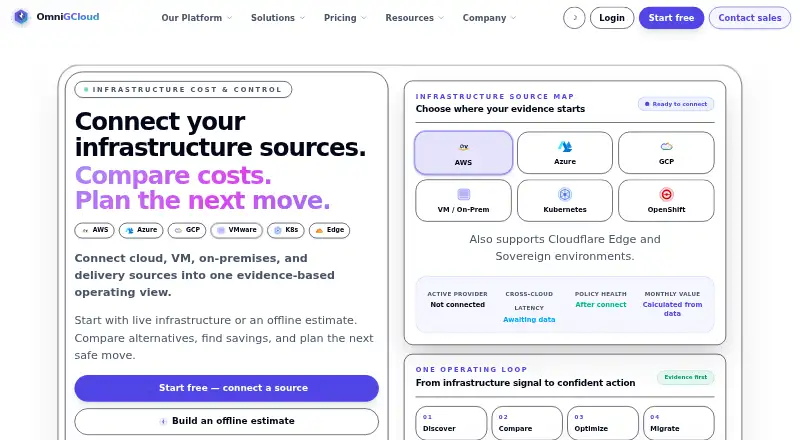
The homepage lists AWS, Azure, GCP, VMware, Kubernetes, OpenShift, Cloudflare Edge and sovereign environments.
Can OmniGCloud be self-hosted or run offline?
Deployment options across editions include private tenant, dedicated, private-cloud, sovereign, offline, air-gapped and partner-managed options.
What developer interfaces are available?
OmniGCloud provides documentation for a CLI, REST API, OpenAPI specification and SDKs.
What support comes with the Free plan?
The Free plan includes basic support. The pricing feature matrix lists priority support and dedicated support among higher-tier capabilities.
Facts from OmniGCloud's own pages
- Approval workflows
- Workflows include approvals, action journals, ledger-backed deployments, automations and webhooks. · omnigcloud.com, 15 Oct 2026
- Certification language
- The trust page explicitly says it makes no unsupported certification claims, despite marketing pages displaying examples such as FIPS 140-3 and SOC 2 Type II. · omnigcloud.com, 15 Oct 2026
- Changelog
- The changelog highlights platform stability, clearer navigation, simpler onboarding and more consistent product, documentation and marketing routes. · omnigcloud.com, 15 Oct 2026
- CLI
- The homepage displays an omnigcloud command-line interface at version 1.4.0. · omnigcloud.com, 15 Oct 2026
- Cloud and infrastructure sources
- The homepage lists AWS, Azure, GCP, VMware, Kubernetes, OpenShift, Cloudflare Edge, and sovereign environments as supported sources. · omnigcloud.com, 29 Sept 2026
- Cloud coverage
- Published infrastructure sources include AWS, Azure, Google Cloud, VMware, Kubernetes, OpenShift, Cloudflare Edge and sovereign environments. · omnigcloud.com, 15 Oct 2026
- Company identity
- The footer identifies the maker as OmniGCloud Platform. · omnigcloud.com, 15 Oct 2026
- Company mission
- The company page states a mission to make multi-cloud manageable without sacrificing security or speed. · omnigcloud.com, 15 Oct 2026
- Compliance claims
- The trust page says it makes no unsupported certification claims, and its launch path avoids unsupported claims about certified compliance. · omnigcloud.com, 29 Sept 2026
- Connector caps
- The listed Team, Pro and Business editions cap connectors at 10 per workspace, 20 and 100 respectively. · omnigcloud.com, 15 Oct 2026
- Core workflow
- The platform combines infrastructure discovery, cost comparison, optimization and migration planning in one workflow. · omnigcloud.com, 15 Oct 2026
- Custom pricing
- Enterprise, Platform, Government/Offline and Partner/SI editions use contact-sales pricing rather than published amounts. · omnigcloud.com, 15 Oct 2026
- Data handling
- The launch path is described as using read-only access, tenant-scoped lead capture and auditable handling, while avoiding unsupported certification claims. · omnigcloud.com, 15 Oct 2026
- Data residency
- Residency is handled per enterprise rollout with support for region-aware configurations. · omnigcloud.com, 15 Oct 2026
- Deployment choices
- Published editions span SaaS, shared workspaces, private tenants, dedicated tenants, private-cloud, sovereign, offline, air-gapped and partner-managed deployments. · omnigcloud.com, 15 Oct 2026
- Deployment options
- Pricing lists SaaS, private tenant, dedicated, private-cloud, sovereign, offline, air-gapped, and partner-managed deployment options across different editions. · omnigcloud.com, 29 Sept 2026
- Developer access
- OmniGCloud provides documentation for a CLI, REST API, OpenAPI specification, and SDKs. · omnigcloud.com, 29 Sept 2026
- Developer API
- Documentation navigation advertises a REST API, OpenAPI specification, CLI reference and SDK reference. · omnigcloud.com, 15 Oct 2026
- Documentation scope
- The documentation landing page lists getting-started guides, tutorials, API references, architecture diagrams, governance material, SDK references and whitepapers. · omnigcloud.com, 15 Oct 2026
- Encryption
- The trust page says encryption in transit is enabled by default and storage posture is configurable. · omnigcloud.com, 15 Oct 2026
- FinOps
- OmniGCloud says it can identify waste, explain spend, automate rightsizing and track cloud economics. · omnigcloud.com, 15 Oct 2026
- Free-tier limit
- The Free edition is limited to one connector and one SaaS workspace. · omnigcloud.com, 15 Oct 2026
- Governance
- The platform page lists monitoring and executive summaries, cost and anomaly views, compliance and risk visibility, approvals, action journals, and ledger-backed deployments. · omnigcloud.com, 29 Sept 2026
- Governance views
- The platform lists monitoring and executive summaries, cost posture, anomaly load, compliance visibility and risk visibility. · omnigcloud.com, 15 Oct 2026
Where OmniGCloud stands on Freedom251
- Cloud Governance Software#9 of 26