Freedom251 › Exposure Management Software

Obsonis Exposure Management Platform
Visit Obsonis Exposure Management Platform Alternatives Pricing
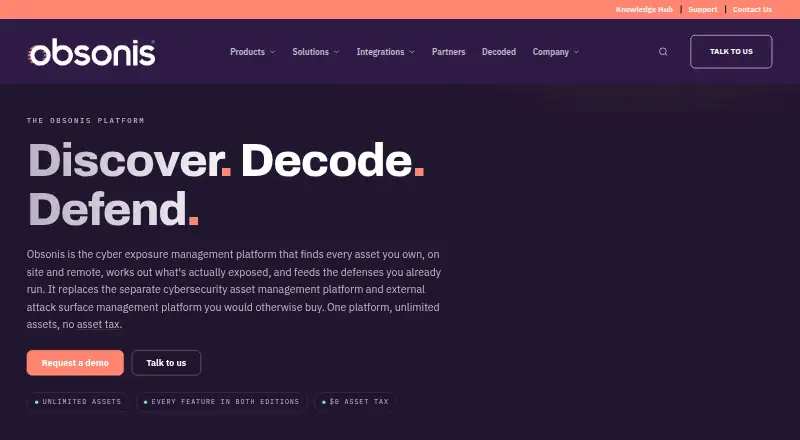
What Obsonis Exposure Management Platform is
Obsonis Exposure Management Platform finds on-site and remote assets, assesses their exposure, and sends risk signals to existing defenses. Its agentless discovery works across hybrid environments and fingerprints hardware and operating systems. The platform scores devices and users from 0 to 10 with a six-tier algorithm tied to the CISA Known Exploited Vulnerabilities catalog. It maps CVEs to discovered devices in real time, flags actively exploited vulnerabilities, and offers exportable reports. Obsonis also evaluates environments against more than 16 compliance frameworks, including CMMC, NIST, PCI-DSS, ISO 27001, FedRAMP, SOC 2, HIPAA, NIS2, and DORA. Integrations include Cisco Meraki, Tailscale, Twingate, Prisma Access, Splunk, Sumo Logic, ServiceNow, Ivanti, Jira, and MCP. Its MCP server connects compatible clients such as Claude, ChatGPT, and Copilot to live, tenant-scoped security data. Small Business Remote costs $25 a month per license; Small Business On-site costs $175 a month per license. A proof-of-concept trial runs in a customer’s environment for about two weeks, with first results within 48 hours.
Who it suits
Obsonis is positioned for organizations managing distributed workforces, unmanaged devices, hybrid or home networks, shadow IT, IoT, and other non-traditional endpoints. Its plans and security integrations may suit teams feeding exposure signals into existing defenses.
What it does well
- Agentless discovery spans hybrid environments.
- Scores devices and users on a 0-to-10 scale.
- Maps CVEs to discovered devices in real time.
- Evaluates environments against more than 16 frameworks.
- Proof-of-concept trial runs in the customer’s environment.
What to know first
- No free plan is listed.
- Small Business plans are billed per license.
- Cloud asset coverage is partial.
- SOC 2 is in audit; ISO 27001 awaits audit.
Limits
The lowest-priced plan, Small Business Remote, costs $25 a month per license and covers up to 50 licenses with unlimited assets. The optional WiFi Box hardware scanner costs 99.00 USD one-time and requires an on-site or remote license.
Plans
| Plan | Billed and limits | Price |
|---|---|---|
| Small Business On-site | per license · up to 10 licenses · unlimited assets · all 26+ capabilities and integrations | $175 a month |
| Small Business Remote | per license · up to 50 licenses · unlimited assets · all 26+ capabilities and integrations | $25 a month |
| WiFi Box hardware scanner | one-time hardware cost · optional add-on · requires an on-site or remote license | $99, paid once |
| Enterprise | unlimited on-site licenses · unlimited remote licenses · unlimited assets · dedicated account manager | On request |
As obsonis.com lists them, read 2 Oct 2026. The maker's own page has the final word.
Getting started
- Visit the Obsonis Exposure Management Platform website.
- Choose the Small Business Remote or Small Business On-site plan, or contact Obsonis about Enterprise.
- Start the proof-of-concept trial in your environment.
- Use the Pro App on Web, Windows, macOS, PWA, iOS, Android, or Linux, or the Individual App on Web, iOS, Android, or PWA.
Obsonis Exposure Management Platform is a hybrid-environment exposure service for discovering devices, users, and vulnerabilities beyond the traditional office network. It suits organizations with distributed staff, unmanaged endpoints, shadow IT, IoT, and home networks. The strongest case is broad, agentless visibility with contextual scoring; partial cloud coverage and per-license limits make careful sizing essential.
Overview
Agentless discovery identifies on-site and remote assets through hardware and operating-system fingerprinting. Obsonis scores devices and users from 0 to 10 with a six-tier algorithm linked to CISA’s Known Exploited Vulnerabilities catalog, giving security teams a consistent way to rank exposure by likely importance.
The service maps CVEs to discovered devices in real time, highlights actively exploited CVEs, and produces exportable reports. Attack path analysis, threat intelligence, contextual prioritization, and remediation workflows extend it beyond a basic inventory scanner. Cloud asset coverage is partial, so cloud-first teams should confirm that its visibility matches their environment before committing.
Key features
Obsonis connects discovery and risk signals to established security and IT workflows. Integrations include Cisco Meraki, Tailscale, Twingate, Prisma Access, Splunk, Sumo Logic, ServiceNow, Ivanti, Jira, and MCP. The Obsonis MCP server lets Claude, ChatGPT, Copilot, and other compatible clients query live, tenant-scoped security data, which can make investigative work more conversational without abandoning current systems.
The Pro App runs on web, Windows, macOS, PWA, iOS, Android, and Linux. The Individual App covers web, iOS, Android, and PWA. A software scanner supports Windows, macOS, Linux, and Docker, while the hardware scanner is supplied as an appliance. That mix is useful when agents cannot be installed everywhere, although the hardware option adds a separate purchase and still requires a license.
Continuous compliance evaluation covers more than 16 frameworks, including CMMC, NIST, PCI-DSS, ISO 27001, FedRAMP, SOC 2, HIPAA, NIS2, and DORA. Obsonis runs on Microsoft Azure with dedicated databases, AES-256 encryption at rest, TLS 1.3 in transit, Azure Key Vault, private virtual networks, and Azure Firewall. Its trust center states that SOC 2 is in audit, ISO 27001 is awaiting audit, and UK GDPR and EU GDPR are compliant; organizations requiring completed certifications should account for those statuses.
Pricing
Small Business Remote costs $25 a month, billed per license, with up to 50 licenses. It includes unlimited assets and all 26+ capabilities and integrations, making it the most economical fit for remote-heavy teams that can stay within the seat cap.
Small Business On-site costs $175 a month per license and allows up to 10 licenses. Assets remain unlimited and the feature set is complete, but the higher per-license price and smaller license allowance suit a compact on-premises security or operations group rather than a broad field workforce.
The WiFi Box hardware scanner is a $99.00 USD one-time optional add-on. It requires an on-site or remote license, so it is an equipment supplement rather than a standalone entry plan. Enterprise has custom pricing, unlimited on-site and remote licenses, unlimited assets, a dedicated account manager, and priority support; it is the sensible route for larger or more complex deployments.
Small Business plans include online, ticketing, and phone support. Enterprise adds dedicated account management and priority handling. The proof of concept is the trial: it runs in the customer’s real environment for about two weeks and produces first results within 48 hours. There is no free plan, so evaluation depends on that trial and a subsequent paid license.
Platforms
Coverage spans Android, iOS, Linux, macOS, Windows, web, and API access. The Pro App offers the broadest client choice, while the Individual App omits desktop-native Windows, macOS, and Linux applications. Scanner support covers Windows, macOS, Linux, and Docker, with an appliance available for hardware-based collection.
Who it's for
Obsonis is well matched to organizations securing distributed workforces, home and hybrid networks, unmanaged devices, shadow IT, IoT, and other non-traditional endpoints. Its unlimited-asset small-business plans are attractive when the number of discovered assets is high but the operator count is modest. It is less compelling as a sole answer for organizations needing comprehensive cloud-asset coverage or more than 50 remote or 10 on-site licenses without moving to Enterprise.
Pros and cons
- Pro: Agentless hybrid discovery and fingerprinting can reveal assets that are difficult to manage with installed agents.
- Pro: CISA-linked, six-tier scoring and real-time CVE mapping turn inventory into prioritized exposure decisions.
- Pro: More than 16 compliance frameworks, exportable reports, remediation workflows, and broad integrations support operational follow-through.
- Pro: Unlimited assets on both Small Business plans avoid a separate asset-count surcharge.
- Con: Cloud coverage is only partial, limiting its fit for cloud-dominant estates.
- Con: Small Business license caps are 50 remote or 10 on-site, and Enterprise pricing is custom.
- Con: SOC 2 and ISO 27001 are not yet completed certifications according to the stated status.
Alternatives
Mondoo CSPM is the better starting point when a free, open-source-oriented option with cloud, Kubernetes, OS, SaaS, and API scanning is the priority.
Choose runZero instead if a free Community Edition, self-hosting, 100 assets, and 30-day data retention provide enough initial scale.
AttackIQ Platform suits teams seeking free testing packages and adversary research, with pay-as-you-go credits available.
ZEST Security is an alternative for a 14-day cloud-project trial focused on configuration drift and limited AI prioritization.
Qualys Enterprise TruRisk Platform is another paid exposure-management option with a free plan and trial.
XM Cyber Exposure Management is a subscription SaaS alternative.
Outpost24 Attack Surface Management offers packages customized to cybersecurity goals, teams, and timelines.
Zscaler Private Access is the alternative when the primary requirement is private application access rather than full exposure management.
Verdict
Choose Obsonis for a distributed organization that needs agentless discovery, contextual risk ranking, vulnerability-to-device mapping, and compliance workflows across unconventional endpoints. Its unlimited-asset Remote plan and two-week proof of concept lower the barrier to evaluating a broad environment. Look elsewhere if complete cloud visibility, uncapped small-business licensing, or already-completed SOC 2 and ISO 27001 certifications are non-negotiable.
Verdict
Obsonis combines asset discovery, contextual risk scoring, vulnerability intelligence, and compliance evaluation for varied endpoints. Review its per-license plans and stated security status against your organization’s requirements.
Questions
How much does Obsonis cost?
Small Business Remote costs $25 a month per license, and Small Business On-site costs $175 a month per license. The optional WiFi Box hardware scanner costs 99.00 USD one-time.
Is there a free plan or trial?
There is no free plan. The proof-of-concept trial runs in the customer’s environment for about two weeks, with first results within 48 hours.
Which platforms are available?
The Pro App is available on Web, Windows, macOS, PWA, iOS, Android, and Linux. The Individual App is available on Web, iOS, Android, and PWA; software scanners support Windows, macOS, Linux, and Docker.
Which integrations are listed?
Integrations include Cisco Meraki, Tailscale, Twingate, Prisma Access, Splunk, Sumo Logic, ServiceNow, Ivanti, Jira, and MCP.
Where is Obsonis based?
Obsonis is headquartered in Mesa, Arizona, United States. It was founded in 2025.
Facts from Obsonis Exposure Management Platform's own pages
- AI access
- The Obsonis MCP server connects Claude, ChatGPT, Copilot, and other MCP-compatible clients to live tenant-scoped security data. · obsonis.com, 2 Oct 2026
- Applications
- The Pro App is available on Web, Windows, macOS, PWA, iOS, Android, and Linux, while the Individual App is available on Web, iOS, Android, and PWA. · obsonis.com, 2 Oct 2026
- Company history
- The founding team has more than 70 years of combined agency and technology experience, and Obsonis was founded in 2025. · obsonis.com, 2 Oct 2026
- Compliance
- Obsonis continuously evaluates environments against more than 16 frameworks, including CMMC, NIST, PCI-DSS, ISO 27001, FedRAMP, SOC 2, HIPAA, NIS2, and DORA. · obsonis.com, 2 Oct 2026
- Discovery
- The platform provides agentless discovery across hybrid environments with hardware and operating-system fingerprinting. · obsonis.com, 2 Oct 2026
- Headquarters
- Mesa, Arizona, United States · obsonis.com, 28 Sept 2026
- Infrastructure security
- Obsonis runs on Microsoft Azure with dedicated databases, AES-256 encryption at rest, TLS 1.3 in transit, Azure Key Vault, private virtual networks, and Azure Firewall. · obsonis.com, 2 Oct 2026
- Integrations
- Listed integrations include Cisco Meraki, Tailscale, Twingate, Prisma Access, Splunk, Sumo Logic, ServiceNow, Ivanti, Jira, and MCP. · obsonis.com, 2 Oct 2026
- Purpose
- Obsonis finds on-site and remote assets, determines their exposure, and feeds risk signals into existing defenses. · obsonis.com, 2 Oct 2026
- Risk scoring
- Obsonis scores devices and users from 0 to 10 using a published six-tier algorithm tied to the CISA Known Exploited Vulnerabilities catalog. · obsonis.com, 2 Oct 2026
- Scanners
- The Software Scanner supports Windows, macOS, Linux, and Docker, and the Hardware Scanner is available as a hardware appliance. · obsonis.com, 2 Oct 2026
- Security status
- The trust center states that SOC 2 is in audit, ISO 27001 is awaiting audit, and UK GDPR and EU GDPR are compliant. · obsonis.com, 2 Oct 2026
- Support
- Small Business includes online, ticketing, and phone support, while Enterprise adds a dedicated account manager and priority support. · obsonis.com, 2 Oct 2026
- Target customers
- Obsonis is positioned for organizations with distributed workforces, unmanaged devices, home and hybrid networks, shadow IT, IoT, and other non-traditional endpoints. · obsonis.com, 2 Oct 2026
- Trial
- The proof of concept is the trial, runs in the customer’s real environment for about two weeks, and shows first results within 48 hours. · obsonis.com, 2 Oct 2026
- Vulnerability intelligence
- The platform maps CVEs to discovered devices in real time, flags actively exploited CVEs, and provides exportable reports. · obsonis.com, 2 Oct 2026
Where Obsonis Exposure Management Platform stands on Freedom251
- Exposure Management Software#7 of 20