Freedom251 › Game Networking Middleware
Netcode for GameObjects
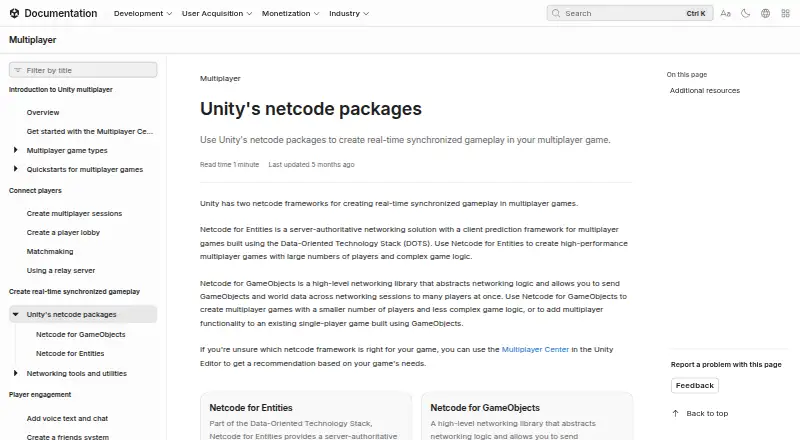
What Netcode for GameObjects is
Netcode for GameObjects is a Unity networking library for synchronizing GameObjects and world data in multiplayer sessions. Unity describes it as suited to games with smaller player counts and less complex game logic, including adding multiplayer to an existing GameObject-based single-player game. Networking can use client- or server-authoritative models. NetworkBehaviour components use NetworkVariables to synchronize state and RPCs to send messages over the network. Integrated scene management is enabled by default and synchronizes scenes among connected clients. Unity Transport is the default transport. Unity Relay works with the package for Relay networking in GameObject and MonoBehaviour workflows; Unity Multiplayer Services sessions are also compatible, with the package handling gameplay state replication after players connect. It is free, but installation requires an active Unity account with a valid license, a supported Unity version, and an existing Unity project. The installation guide lists Windows, macOS, Linux, iOS, Android, XR platforms on those systems, most closed platforms, and WebGL with specified package versions. The package has no matchmaking functionality, and a full client-side prediction and reconciliation system must be built by the developer.
Who it suits
It suits Unity developers adding multiplayer to GameObject-based games with smaller player counts and less complex game logic. Developers who need matchmaking or full client-side prediction and reconciliation must build or use other solutions.
What it does well
- Supports client- or server-authoritative networking
- Synchronizes scenes across connected clients
- Uses Unity Transport by default
- Free Unity package
What to know first
- Requires a valid Unity account and license
- Does not include matchmaking
- Full prediction and reconciliation must be built
Limits
The free package requires a valid Unity account and license, an existing project, and a supported Unity version; the listed plan specifies Unity Editor 2021.3 or later. It has no matchmaking functionality, and full client-side prediction and reconciliation must be built by the developer.
Plans
| Plan | Billed and limits | Price |
|---|---|---|
| Netcode for GameObjects | Unity package; requires a valid Unity account and license · Unity Editor 2021.3 or later | Free |
As docs.unity.com lists them, read 7 Oct 2026. The maker's own page has the final word.
Getting started
- Create or use an existing Unity project.
- Use an active Unity account with a valid license.
- Use a supported Unity version; the listed package plan requires Unity Editor 2021.3 or later.
- Install Netcode for GameObjects in the Unity project.
- Use Unity Transport by default, or configure a compatible workflow such as Unity Relay.
Verdict
Netcode for GameObjects provides synchronization and scene management for Unity multiplayer projects. Its intended scope is smaller-player-count games, and developers must supply matchmaking and a full prediction-and-reconciliation system themselves.
Questions
How much does Netcode for GameObjects cost?
The listed plan is free. It requires a valid Unity account and license and Unity Editor 2021.3 or later.
What does the package do?
It synchronizes GameObjects and world data across multiplayer sessions. NetworkBehaviour components use NetworkVariables for state and RPCs for messages.
Which platforms are supported?
The installation guide lists Windows, macOS, Linux, iOS, Android, XR platforms on those systems, most closed platforms, and WebGL with specified package versions.
Does it include matchmaking?
No. Unity’s FAQ says matchmaking must be implemented using third-party services.
Does it support Unity Relay?
Yes. Unity Relay works with Netcode for GameObjects for Relay networking in GameObject and MonoBehaviour workflows.
Does it provide full client-side prediction?
The documented anticipation components provide building blocks, but developers must build a full client-side prediction and reconciliation system.
Facts from Netcode for GameObjects's own pages
- Company
- Unity’s SEC filing states that Unity was founded in Denmark in 2004 and has principal corporate offices in San Francisco, California. · sec.gov, 7 Oct 2026
- Core synchronization
- NetworkBehaviour components use NetworkVariables to synchronize state and RPCs to send messages over the network. · docs-multiplayer.unity3d.com, 7 Oct 2026
- Default transport
- Netcode for GameObjects uses Unity Transport by default. · docs-multiplayer.unity3d.com, 7 Oct 2026
- Headquarters
- San Francisco, California, United States · docs.unity.com, 28 Sept 2026
- Install requirements
- Installation requires an active Unity account with a valid license, a supported Unity version, and an existing Unity project. · docs-multiplayer.unity3d.com, 7 Oct 2026
- Intended games
- Unity describes it as suited to games with smaller player counts and less complex game logic, including adding multiplayer to an existing GameObject-based single-player game. · docs.unity.com, 7 Oct 2026
- Matchmaking limit
- Netcode for GameObjects has no matchmaking functionality; Unity’s FAQ says matchmaking must be implemented using third-party services. · docs-multiplayer.unity3d.com, 7 Oct 2026
- Network model
- Its networking can use client- or server-authoritative models. · unity.com, 7 Oct 2026
- Prediction limit
- The documented anticipation components provide building blocks, but a full client-side prediction and reconciliation system must be built by the developer. · docs-multiplayer.unity3d.com, 7 Oct 2026
- Purpose
- Netcode for GameObjects is a high-level networking library for synchronizing GameObjects and world data across multiplayer sessions. · docs.unity.com, 7 Oct 2026
- Scene management
- The package includes integrated scene management that is enabled by default and synchronizes scenes across connected clients. · docs-multiplayer.unity3d.com, 7 Oct 2026
- Security and trust
- Unity’s Trust Center lists a SOC 2 Type II badge, a PCI badge, and a vulnerability reporting and bug bounty program; these are Unity-level disclosures, not a Netcode-specific certification claim. · trust.unity.com, 7 Oct 2026
- Service integration
- Unity Relay works with Netcode for GameObjects to provide Relay networking for GameObject and MonoBehaviour workflows. · docs.unity.com, 7 Oct 2026
- Session integration
- Unity Multiplayer Services sessions are compatible with Netcode for GameObjects, which handles gameplay state replication after players connect. · docs.unity.com, 7 Oct 2026
- Supported platforms
- The installation guide lists Windows, macOS, Linux, iOS, Android, XR platforms on those systems, most closed platforms, and WebGL with specified package versions. · docs-multiplayer.unity3d.com, 7 Oct 2026
Where Netcode for GameObjects stands on Freedom251
- Game Networking Middleware#8 of 29