Freedom251 › Game Networking Middleware
GameNetworkingSockets
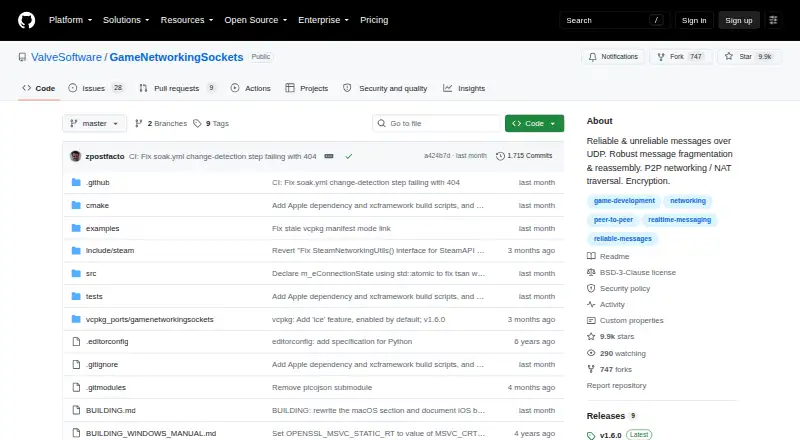
What GameNetworkingSockets is
GameNetworkingSockets is an open-source transport library for games, carrying reliable and unreliable messages over UDP. It can split messages that exceed the underlying MTU, reassemble them at the other end, and retransmit reliable messages. For packet protection, it uses AES-GCM-256; Curve25519 handles key exchange and certificate signatures. Peer-to-peer connections can use NAT traversal through Google WebRTC ICE, with an option to connect a signaling service. Multiple message lanes can share a connection, using strict priorities or weighted bandwidth allocation. The library also includes tools to simulate packet latency and loss and to measure detailed statistics.
The code is written in C++ and offers a plain C interface for bindings to other languages. Third-party bindings are listed for C#, Go, and Rust. Build instructions cover Linux, Windows, macOS, and iOS, and the supported platform list also includes an API and self-hosted use. Steam is not required for the open-source library; authentication, signaling, and Steam Datagram Relay are Steam-only services. Higher-level entity serialization, delta encoding of state variables, and compression are outside the library’s scope. Its listed plan is Open-source library at no cost under the BSD-3-Clause license, with Steam Datagram Relay access restricted.
Who it suits
GameNetworkingSockets suits game developers who need UDP transport with reliable and unreliable messaging, peer-to-peer networking, or traffic diagnostics. Its C++ implementation, C interface, and listed language bindings give teams several ways to connect it to their code.
What it does well
- Carries reliable and unreliable messages over UDP.
- Handles oversized messages with fragmentation and reassembly.
- Offers AES-GCM-256 packet encryption and Curve25519 key exchange.
- Supports NAT traversal through Google WebRTC ICE.
- Includes latency and packet-loss simulation tools.
- Lists bindings for C#, Go, and Rust.
What to know first
- Does not include entity serialization, state delta encoding, or compression.
- Steam Datagram Relay access is restricted.
- Console and mobile code access requires contacting Valve.
Limits
The free Open-source library plan is listed as free under the BSD-3-Clause license, with Steam Datagram Relay access restricted. Higher-level entity serialization, delta encoding of state variables, and compression are not included.
Plans
| Plan | Billed and limits | Price |
|---|---|---|
| Open-source library | BSD-3-Clause license · Steam Datagram Relay access is restricted | Free |
As github.com lists them, read 7 Oct 2026. The maker's own page has the final word.
Getting started
- Open the project repository at https://github.com/ValveSoftware/GameNetworkingSockets.
- Choose the build instructions for Linux, Windows, macOS, or iOS.
- Use the C++ library or its plain C interface for bindings.
- Consider the listed C#, Go, or Rust third-party bindings.
- Contact Valve for access to console and mobile code.
Verdict
Choose GameNetworkingSockets when a game needs a cross-platform UDP transport layer, peer-to-peer options, or built-in network diagnostics. Look elsewhere if the project needs higher-level entity serialization, delta encoding, or compression included in the library. Steam-only services such as authentication, signaling, and Steam Datagram Relay also depend on Steam.
Questions
How much does GameNetworkingSockets cost?
The Open-source library plan is listed as free under the BSD-3-Clause license.
Is GameNetworkingSockets open source?
Yes. The repository identifies the license as BSD-3-Clause.
Does it require Steam?
Steam is not required for the open-source library. Authentication, signaling, and Steam Datagram Relay are Steam-only services.
Which platforms are covered?
Build instructions cover Linux, Windows, macOS, and iOS. Valve says the library has shipped on consoles and mobile platforms, but access to that code requires contacting Valve.
Which languages can use it?
The library is written in C++ and also provides a plain C interface. Third-party bindings are listed for C#, Go, and Rust.
What does the library leave to other tools?
It does not provide higher-level entity serialization, delta encoding of state variables, or compression.
Facts from GameNetworkingSockets's own pages
- Build targets
- The project’s build instructions cover Linux, Windows, macOS, and iOS. · github.com, 7 Oct 2026
- Connection controls
- It supports multiple message lanes on one connection, with strict priorities or weights for sharing bandwidth. · github.com, 7 Oct 2026
- Cross-platform availability
- Valve says the library has shipped on consoles and mobile platforms, but states that access to that code requires contacting Valve because it cannot be distributed in this repository. · github.com, 7 Oct 2026
- Diagnostics
- The library includes tools for simulating packet latency and loss, plus detailed statistics measurement. · github.com, 7 Oct 2026
- Encryption
- It uses AES-GCM-256 per packet and Curve25519 for key exchange and certificate signatures. · github.com, 7 Oct 2026
- Integrations
- Third-party language bindings are listed for C#, Go, and Rust. · github.com, 7 Oct 2026
- Language interfaces
- The library is written in C++ and also provides a plain C interface for bindings to other languages. · github.com, 7 Oct 2026
- License
- The repository identifies its license as BSD-3-Clause. · github.com, 7 Oct 2026
- Message handling
- It supports messages larger than the underlying MTU through fragmentation, reassembly, and retransmission for reliable messages. · github.com, 7 Oct 2026
- Not included
- The library does not provide higher-level entity serialization, delta encoding of state variables, or compression. · github.com, 7 Oct 2026
- Peer-to-peer
- Its P2P features include NAT traversal through Google WebRTC ICE and support for plugging in a signaling service. · github.com, 7 Oct 2026
- Purpose
- GameNetworkingSockets is a basic transport layer for games that sends reliable and unreliable messages over UDP. · github.com, 7 Oct 2026
- Security reporting
- The security policy asks researchers to report vulnerabilities privately through HackerOne rather than as public issues or pull requests. · github.com, 7 Oct 2026
- Steam dependency
- Steam is not required to use the open-source library, though Steam-only services include authentication, signaling, and Steam Datagram Relay. · github.com, 7 Oct 2026
Where GameNetworkingSockets stands on Freedom251
- Game Networking Middleware#4 of 29