
nano SIEM
What nano SIEM is
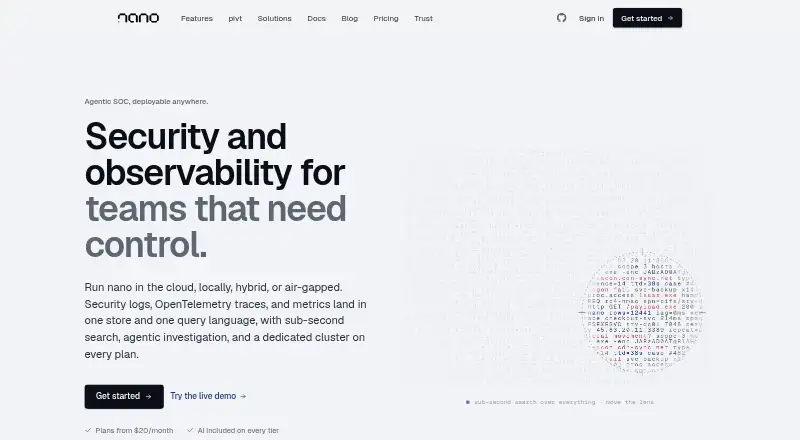
nano SIEM is a security information and event management platform for teams handling detection, alerting, investigation, and response. It stores security logs, OpenTelemetry traces, and metrics together for queries in nPL, its query language. The maker says searches can return in under a second across billions of events using ClickHouse. Its pivt assistant can create parsers, queries, detection rules, and investigation summaries from natural-language requests. Detection rules include MITRE ATT&CK mapping, entity risk scoring, and tracking rare or first-seen indicators. Data can be ingested through HTTP, Syslog, HEC, or Vector, and listed parsers cover tools including Palo Alto, CrowdStrike, Okta, AWS CloudTrail, Microsoft Defender, and Zeek. Deployment options include a managed service and BYOC; Enterprise lists cloud, on-premises, or air-gapped deployment. The nano engine is open source under AGPL-3.0 and can be self-hosted without an account or bill. Hobby includes 2 GB/day of ingest, 10 data sources, 300 AI requests per month, and three team members.
Who it suits
nano SIEM is for security teams that need to search logs and coordinate detection, alerting, investigation, and response. Its self-hosted engine may suit teams that want to run open-source software without an account or bill.
What it does well
- Stores logs, traces, and metrics together
- Natural-language assistant generates queries and detection rules
- Detection rules include MITRE ATT&CK mapping
- Engine can be self-hosted without an account or bill
What to know first
- Hobby allows 2 GB/day of ingest
- Hobby includes 10 data sources and three team members
- Hobby limits AI requests to 300 per month
Limits
Hobby includes 2 GB/day of ingest, 10 data sources, 300 pivt AI requests per month, and three team members. Its listed annual price is $26 a month, billed at $204/yr; paid plans are also listed from $29/mo.
Plans
| Plan | Billed and limits | Price |
|---|---|---|
| Startup | $1,392/yr · save $156; annual pricing shown · 5 GB/day · 365+ days retention · 20 data sources · 1k AI requests/mo · 8 team members | $116 a month |
| Business | $17,280/yr · save $1,920; annual pricing shown · 50 GB/day · 365 days retention · unlimited data sources and team members · 15k AI requests/mo · SSO/SAML · priority support | $1,440 a month |
| Hobby | $204/yr · save $24; annual pricing shown · 2 GB/day · 365+ days retention · 10 data sources · 300 AI requests/mo · 3 team members | $26 a month |
| Growth | $3,228/yr · save $360; annual pricing shown · 10 GB/day · 365+ days retention · 30 data sources · 2.5k AI requests/mo · 12 team members | $269 a month |
| Pro | $52,920/yr · save $5,880; annual pricing shown · 100 GB/day · 365 days retention · unlimited data sources and team members · 40k AI requests/mo · high availability · SSO/SAML · priority support | $4,410 a month |
| Team | $6,468/yr · save $720; annual pricing shown · 25 GB/day · 365 days retention · unlimited data sources · 5k AI requests/mo · high availability · 15 team members | $539 a month |
| Enterprise | Custom · 200 TB+/day · unlimited retention, sources and seats · SSO/SAML and audit logs · cloud, on-prem or air-gapped · dedicated support and SLA | On request |
As nano.rs lists them, read 29 Sept 2026. The maker's own page has the final word.
Getting started
- Visit https://nano.rs/ to explore the service and plans.
- Choose a managed service, BYOC deployment, or self-host the open-source engine.
- Select a plan; the Hobby plan includes 2 GB/day of ingest, 10 data sources, and three team members.
- Connect data through HTTP, Syslog, HEC, or Vector ingestion.
- Use nPL to query data and pivt to generate parsers, queries, rules, or investigation summaries.
nano SIEM is a security analytics platform for teams that want logs, traces, and metrics in one investigative workflow. It is particularly suitable for organizations that value an open-source engine and flexible deployment, while its hosted tiers fit teams willing to work within defined ingest, source, AI-request, and seat allowances. The strongest case is unified telemetry with natural-language assistance; the main caution is that meaningful hosted capacity becomes expensive as requirements grow.
Overview
nano combines security information and event management functions across detection, alerting, investigation, and response. Security logs, OpenTelemetry traces, and metrics share a store and the nano Pipe Language (nPL), so analysts can query different telemetry types without switching systems.
The maker says ClickHouse supports sub-second searches across billions of events. That is a strong proposition for large investigations, although the practical result will depend on workload and deployment. The AGPL-3.0 engine can run self-hosted without an account or bill, while managed and bring-your-own-cloud options serve teams that prefer vendor-operated infrastructure.
Key features
- Unified telemetry: One store and query language can reduce the friction of correlating logs, traces, and metrics during an incident.
- Detection context: Custom rules support MITRE ATT&CK mapping, entity risk scoring, and prevalence tracking for rare or first-seen indicators. Real-time alerting is included.
- Natural-language assistance: pivt can create parsers, queries, detection rules, and investigation summaries. This targets repetitive analyst work, but monthly AI-request quotas matter on every paid tier.
- Ingestion and parsing: HTTP, Syslog, HEC, and native Vector protocol are supported. Highlighted parsers cover Palo Alto, CrowdStrike, Okta, AWS CloudTrail, Microsoft Defender, and Zeek.
- Security controls: Connections use TLS 1.2 or newer and data at rest uses AES-256-GCM. GDPR is active, while the SOC 2 Type II audit is in progress.
Pricing
A free self-hosted engine is the clearest low-cost route. Hosted pricing is shown annually, despite monthly-equivalent figures.
| Plan | Price and allowance | Best fit |
|---|---|---|
| Hobby | $26 a month, billed $204/yr (save $24); 2 GB/day, 365+ days retention, 10 sources, 300 AI requests/month, 3 members | Small teams and trials of the hosted workflow; the low ingest, source, AI, and seat caps constrain expansion. |
| Startup | $116 a month, billed $1,392/yr (save $156); 5 GB/day, 20 sources, 1k AI requests/month, 8 members | A growing team needing more headroom and email support. |
| Growth | $269 a month, billed $3,228/yr (save $360); 10 GB/day, 30 sources, 2.5k AI requests/month, 12 members | Mid-sized deployments with broader telemetry and analyst usage. |
| Team | $539 a month, billed $6,468/yr (save $720); 25 GB/day, 365 days, unlimited sources, 5k AI requests/month, high availability, 15 members | Teams needing high availability and no source cap. |
| Business | $1,440 a month, billed $17,280/yr (save $1,920); 50 GB/day, unlimited sources and members, 15k AI requests/month, SSO/SAML | Larger organizations requiring identity controls and priority support. |
| Pro | $4,410 a month, billed $52,920/yr (save $5,880); 100 GB/day, unlimited sources and members, 40k AI requests/month, high availability, SSO/SAML | High-volume operations with substantial AI use. |
| Enterprise | Custom pricing; 200 TB+/day, unlimited retention, sources, and seats, SSO/SAML, audit logs, cloud, on-premises, or air-gapped deployment | Very large or tightly controlled environments needing dedicated support and an SLA. |
Hobby has community support; Startup through Team have email support, and Business and Pro have priority support. Enterprise adds dedicated support and an SLA. The published paid entry point is $29/mo, while the annual Hobby figure is $26 a month.
Platforms
nano supports API, Linux, macOS, self-hosted, web, and Windows deployments. pivt Desktop provides signed native installers for macOS and Windows, but requires a nano instance and a locally installed coding agent. Enterprise can run in cloud, on-premises, or air-gapped environments.
Who it's for
Choose nano for security teams consolidating heterogeneous telemetry, organizations that need custom detections with ATT&CK context, or engineers who want an AGPL-3.0 engine they can self-host. The deployment range also suits teams moving between managed, BYOC, and tightly isolated infrastructure. It is less suitable when a small hosted budget must cover high ingest, many sources, or many AI-assisted investigations.
Pros and cons
Pros
- Open-source engine enables self-hosting without an account or bill.
- Logs, traces, and metrics use one store and query language.
- Detection rules combine ATT&CK mapping, risk scoring, and prevalence tracking.
- Deployment extends from managed service and BYOC to air-gapped Enterprise installations.
Cons
- Hosted tiers cap ingest, sources, AI requests, and seats until higher-priced plans.
- Business and Pro pricing is substantial for organizations that need unlimited sources and members.
- pivt Desktop depends on both a nano instance and a local coding agent.
- SOC 2 Type II is still in progress rather than completed.
Alternatives
Blumira is a paid option with a $12.00-per-month Detect plan, cloud and local-network visibility, pre-tuned detections, and one-year retention; choose it when those packaged capabilities matter more than nano's open-source engine.
Vigil offers a free, open-source plan with unlimited ClickHouse events, Sigma rules, threat hunting, and multi-endpoint support, making it the stronger starting point for a no-cost open-source deployment.
Wazuh provides a free self-hosted open-source plan alongside paid Small deployments; consider it when its established free-to-paid structure fits your operating model.
Elastic Security is a freemium platform with free trials and API, Linux, self-hosted, and web support; it is an alternative for teams already aligned with Elastic's ecosystem.
Sumo Logic has a free tier with 20 daily credits, seven-day log retention, and up to three users; choose it for a small, short-retention starting point.
MaxPatrol SIEM is a paid product with consultation-based pricing and a vendor pilot.
LogSentinel SIEM offers paid, volume-based Enterprise SaaS with unlimited connected applications and extended active and archive retention.
Devo Analytics Cloud provides paid cloud analytics plans with interactive visualizations, multitenancy, advanced analytics, and open APIs.
Verdict
nano SIEM is a strong choice for teams that want unified telemetry, context-rich detections, and the freedom to self-host or select a controlled deployment. Its main reason to look elsewhere is cost and capacity: hosted ingest, AI, source, and seat limits push growing organizations toward expensive tiers, while smaller teams may prefer a simpler free alternative.
Verdict
nano SIEM combines event search and detection features with several deployment choices, including a self-hosted open-source engine. Hobby has specific ingest, source, AI request, and team limits; paid plans are listed from $29/mo.
Questions
Is nano SIEM free?
nano SIEM has a free plan. The Hobby plan lists 2 GB/day of ingest, 10 data sources, 300 AI requests per month, and three team members.
How much does nano SIEM cost?
Paid plans are listed from $29/mo. The Hobby plan is listed at $26 a month when billed annually at $204/yr; Enterprise pricing is custom.
Which platforms does nano SIEM support?
The listed platforms are API, Linux, macOS, self-hosted, web, and Windows.
Is nano SIEM open source?
The nano engine is open source under AGPL-3.0 and can be self-hosted without an account or bill.
What can connect to nano SIEM?
The listed ingestion options are HTTP, Syslog, HEC, and native Vector protocol. Parsers are listed for Palo Alto, CrowdStrike, Okta, AWS CloudTrail, Microsoft Defender, and Zeek.
What deployment options are available?
nano offers a managed service and BYOC deployment. Enterprise also lists cloud, on-premises, and air-gapped deployment.
Facts from nano SIEM's own pages
- AI assistant
- pivt can generate parsers, queries, detection rules, and investigation summaries from natural language. · nano.rs, 29 Sept 2026
- Compliance
- The trust page labels GDPR active and SOC 2 Type II planned, stating the SOC 2 audit is in progress. · nano.rs, 29 Sept 2026
- Deployment
- nano offers managed service and BYOC deployment, and the Enterprise plan lists cloud, on-prem, or air-gapped deployment. · nano.rs, 29 Sept 2026
- Desktop availability
- pivt desktop offers native signed installers for macOS and Windows and requires a nano instance plus a locally installed coding agent. · nano.rs, 29 Sept 2026
- Detection
- Detection rules support MITRE ATT&CK mapping, entity risk scoring, and prevalence tracking for rare or first-seen indicators. · nano.rs, 29 Sept 2026
- Headquarters
- Danbury, Connecticut, United States · nano.rs, 28 Sept 2026
- Integrations
- The docs list HTTP, Syslog, HEC, and native Vector protocol for ingestion; the feature page highlights parsers for Palo Alto, CrowdStrike, Okta, AWS CloudTrail, Microsoft Defender, and Zeek. · nano.rs, 29 Sept 2026
- Notable limits
- The Hobby plan includes 2 GB/day ingest, 10 data sources, 300 pivt AI requests per month, and 3 team members. · nano.rs, 29 Sept 2026
- Open source
- The nano engine is open source under AGPL-3.0 and can be self-hosted without an account or bill. · nano.rs, 29 Sept 2026
- Product
- nano describes itself as an AI-powered SIEM for security teams that need fast log analytics and covers detection, alerting, investigation, and response. · nano.rs, 29 Sept 2026
- Search
- The maker says nano supports sub-second queries across billions of events using ClickHouse. · nano.rs, 29 Sept 2026
- Security
- The trust page says connections use TLS 1.2+ and sensitive data is encrypted at rest using AES-256-GCM. · nano.rs, 29 Sept 2026
- Support
- Pricing lists community support for Hobby, email support for Startup through Team, priority support for Business and Pro, and dedicated support plus SLA for Enterprise. · nano.rs, 29 Sept 2026
- Unified data
- It stores security logs, OpenTelemetry traces, and metrics in one store with one query language. · nano.rs, 29 Sept 2026
Where nano SIEM stands on Freedom251
- SIEM Software#6 of 29