Freedom251 › Endpoint Security Software

Elastic Security
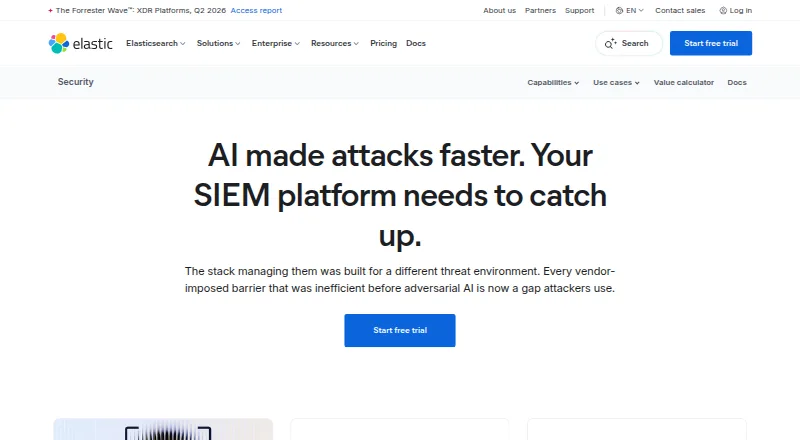
What Elastic Security is
Elastic Security combines SIEM, XDR, endpoint security, and cloud security capabilities for detecting, preventing, and responding to cyber threats. Detection tools include prebuilt and customizable rules, machine-learning anomaly detection, and threat hunting. Elastic Defend applies machine learning, behavioral analysis, and prebuilt rules to endpoint threats. Cloud features cover cloud and Kubernetes security posture management, workload protection, and vulnerability management. Elastic Workflows can automate triage, enrichment, response, notifications, and case management. Elastic lists 400+ prebuilt integrations and up to 1,000 total security and data-source integrations, with native OpenTelemetry support. It runs on Elastic Cloud or self-managed infrastructure. The free Basic plan includes SIEM, XDR, and host security analysis; Elastic Cloud Hosted and Serverless offer a 14-day trial. Security Analytics Essentials is listed at $0.09 a month, with retention priced separately at as low as $0.017 per retained GB per month. Elastic Cloud protects communications with HTTPS and encrypts cluster data at rest. Query languages include KQL, Lucene, and ES|QL. Elastic was founded in 2012 and has headquarters in Amsterdam and Mountain View, California.
Who it suits
Elastic Security suits security teams seeking SIEM, endpoint, and cloud security capabilities across Elastic Cloud or self-managed infrastructure. Its listed query languages include KQL, Lucene, and ES|QL.
What it does well
- Includes prebuilt and customizable detection rules.
- Elastic Workflows can automate response-related tasks.
- Lists 400+ prebuilt integrations.
- Free Basic plan includes SIEM and XDR.
What to know first
- Essentials retention is priced separately.
- Serverless endpoint and cloud protection cost extra per asset.
- Self-managed subscription pricing requires contacting sales.
Limits
The free Basic plan covers SIEM, XDR, and host security analysis. Security Analytics Essentials prices retention separately, starting as low as $0.017 per retained GB per month; Serverless Security charges extra per asset for optional endpoint and cloud protection.
Plans
| Plan | Billed and limits | Price |
|---|---|---|
| Security Analytics Essentials | billed monthly · Ad hoc analytics and machine learning · Prebuilt detection rules · Triage, investigation, and hunting · Threat intelligence integration · Endpoint protection · Retention priced separately at as low as $0.017 per retained GB per month | $0.09 a month |
| Security Analytics Complete | billed monthly · Everything in Security Analytics Essentials · Entity analytics and UEBA · Threat intelligence management · Elastic AI Assistant · Advanced endpoint protection · Private connectivity and IP filtering | $0.11 a month |
| Free and open - Basic | SIEM · XDR · host security analysis | Free |
| Elastic Cloud Serverless Security | SIEM and security analytics billed based on usage; optional endpoint and cloud protection costs extra per asset · Usage-based pricing · optional endpoint and cloud protection at additional per-asset price | On request |
| Elastic self-managed subscriptions | Contact sales for pricing information · License-based pricing based on number of nodes and used RAM | On request |
As elastic.co lists them, read 19 Sept 2026. The maker's own page has the final word.
Getting started
- Visit the Elastic Security website.
- Choose Elastic Cloud or self-managed infrastructure.
- For Elastic Cloud Hosted or Serverless, start the 14-day free trial.
- Alternatively, begin with the free Basic plan for SIEM, XDR, and host security analysis.
- Select a paid plan if you need its additional capabilities.
Elastic Security brings security information and event management (SIEM), extended detection and response (XDR), endpoint defense, and cloud security into one platform. It is best for teams that want to connect threat detection and response across varied environments and have the capacity to tune rules and manage their deployment. Its breadth is a strength for those teams, but buyers seeking a narrowly focused SIEM may not need the extra scope.
Overview
Elastic Security can run on Elastic Cloud or self-managed infrastructure, giving organizations a choice between a hosted service and operating their own deployment. Its free Basic option provides SIEM, XDR, and host security analysis; the paid tiers add progressively more analytics and protection capabilities. Cloud use brings HTTPS protection for internet-facing and inter-node communications and encryption for cluster data at rest. Elastic Cloud also has support levels ranging from Limited to Premium, with target response times varying by level.
Key features
Detection combines prebuilt and customizable rules, machine-learning anomaly detection, threat hunting, and real-time alerts. Analysts can investigate using KQL, Lucene, or ES|QL. That range supports different query workflows, but makes Elastic Security a better fit for teams prepared to work with detection logic and queries than for buyers seeking a minimal, hands-off alerting tool.
Elastic Defend uses machine learning, behavioral analysis, and prebuilt rules to detect, prevent, and respond to endpoint threats. Cloud capabilities cover posture management for cloud and Kubernetes environments, workload protection, and vulnerability management. These functions give security teams room to address several threat surfaces in one platform; they may be more than a small team needs if its priority is only log analysis.
Elastic Workflows automates triage, enrichment, response, notifications, and case management. Elastic supports more than 400 prebuilt integrations and up to 1,000 total security and data-source integrations, along with native OpenTelemetry data support. This breadth helps connect varied systems, though teams will still need to choose the integrations relevant to their environment.
Pricing
The free and open Basic plan costs nothing and includes SIEM, XDR, and host security analysis. It is a sensible starting point for teams assessing those core functions, but does not include the paid tiers' broader capabilities.
Security Analytics Essentials costs $0.09 a month, billed monthly. It includes ad hoc analytics and machine learning, prebuilt detection rules, triage, investigation and hunting, threat intelligence integration, and endpoint protection. Retention is priced separately, at as low as $0.017 per retained GB per month, so teams should account for data storage when estimating the total cost.
Security Analytics Complete costs $0.11 a month, billed monthly. It adds entity analytics and UEBA, threat intelligence management, Elastic AI Assistant, advanced endpoint protection, private connectivity, and IP filtering to Essentials. It suits buyers who need those added capabilities; teams that do not should weigh them against the separately priced retention.
Elastic Cloud Serverless Security uses usage-based pricing for SIEM and security analytics, with endpoint and cloud protection available at an additional per-asset price. Elastic self-managed subscriptions use license-based pricing according to node count and RAM usage; pricing is custom. Elastic Cloud Hosted and Serverless include a 14-day free trial. These models give customers deployment and billing choices, but actual costs depend on usage or infrastructure, and optional protections can add further charges.
Platforms
Elastic Security supports API, Linux, self-hosted, and web environments. The combination of hosted and self-managed deployment makes it suitable for organizations with different infrastructure preferences, while the self-managed option brings node and RAM costs into the subscription calculation.
Who it's for
Elastic Security is a strong fit for security teams that want SIEM and XDR alongside endpoint and cloud protection, need customizable detections, or value a broad integration catalog. Organizations that want to keep operations on their own infrastructure can choose self-management; those preferring hosted deployment can use Elastic Cloud. A team looking only for a simple SIEM or a fixed, predictable bill may find the platform's breadth and usage- or retention-linked charges harder to justify.
Pros and cons
- Pros: A free Basic plan includes SIEM, XDR, and host security analysis, offering a way to start without a paid subscription.
- Pros: Detection, endpoint defense, cloud security, and workflow automation cover several security operations in one platform.
- Pros: Hosted and self-managed deployment options, plus broad integrations and three query languages, accommodate varied environments and workflows.
- Cons: Retention is a separate charge, and the per-GB rate can affect the cost of paid analytics plans.
- Cons: Serverless charges depend on usage, while optional endpoint and cloud protection add per-asset costs; self-managed subscription pricing also depends on nodes and RAM.
- Cons: Its feature breadth and query-based detection workflows are less compelling for buyers seeking only a narrow SIEM.
Alternatives
SIEM Software is a broader category to compare if you are still deciding what kind of SIEM fits your needs. For a specific alternative, Blumira is worth considering if you want a paid SIEM with a free trial and one-year log retention in its Detect plan, priced at $12 a month, rather than Elastic's separately priced retention.
Vigil may suit teams looking for a free open-source option with unlimited events on ClickHouse, Sigma detection rules, and HQL threat hunting. Wazuh is another free and open-source choice for self-hosted users, with a paid Small plan starting at $571 a month.
Sumo Logic offers a free plan with 20 daily credits for logs, metrics, and traces, seven-day log retention, and up to three users, making it a fit when those caps suit your workload. nano SIEM may appeal if you want an open-source engine under AGPL-3.0 that can be self-hosted without an account or bill.
LogSentinel SIEM is a paid alternative with pay-per-volume pricing, unlimited connected applications, and at least six months of active retention and twelve months of archive retention. Devo Analytics Cloud offers interactive visualizations, self-service multitenancy, advanced data analytics, and open APIs. NetWitness Platform is another paid option for Linux, self-hosted, and web environments.
File Integrity Monitoring Software is a separate category to explore if file integrity monitoring is your primary need.
Verdict
Choose Elastic Security if your team wants detection, endpoint and cloud protection, and automation in a platform that can be hosted or self-managed. The free Basic plan and wide feature set make it a flexible starting point, but separately priced retention and usage- or asset-based charges can complicate budgeting. Look elsewhere if you need only a focused SIEM or a simpler cost model.
Verdict
Elastic Security combines threat detection, endpoint and cloud capabilities, and workflow automation, with both free and paid options. Check retention and add-on charges alongside the plan details when evaluating costs.
Questions
Is Elastic Security free?
Yes. The Free and open - Basic plan costs nothing and includes SIEM, XDR, and host security analysis.
Is there a free trial?
Yes. Elastic Cloud Hosted and Serverless offer a 14-day free trial.
How much do the paid plans cost?
Security Analytics Essentials is $0.09 a month, billed monthly. Security Analytics Complete is $0.11 a month, billed monthly; retention on Essentials is priced separately.
What platforms does it support?
The listed platforms are API, Linux, self-hosted, and web. It can be installed on Elastic Cloud deployments or self-managed infrastructure.
What integrations and query languages are supported?
Elastic lists more than 400 prebuilt integrations, up to 1,000 total security and data-source integrations, and native OpenTelemetry support. Query options include KQL, Lucene, and ES|QL.
Who makes Elastic Security?
Elastic says it was founded in 2012 and has headquarters in Amsterdam, Netherlands, and Mountain View, California.
Facts from Elastic Security's own pages
- Automation
- Elastic Workflows automates triage, enrichment, response, notifications, and case management within Elastic Security. · elastic.co, 29 Sept 2026
- Cloud security
- Cloud capabilities include cloud and Kubernetes security posture management, workload protection, and vulnerability management. · elastic.co, 29 Sept 2026
- Compliance
- Elastic says its Elastic Cloud service and Information Security Management System have undergone compliance audits and certifications. · elastic.co, 29 Sept 2026
- Deployment
- Elastic Security can be installed on Elastic Cloud deployments or self-managed infrastructure. · elastic.co, 29 Sept 2026
- Endpoint protection
- Elastic Defend uses machine learning, behavioral analysis, and prebuilt rules to detect, prevent, and respond to endpoint threats. · elastic.co, 29 Sept 2026
- Founded
- 2012 · elastic.co, 23 Sept 2026
- Headquarters
- Amsterdam, Netherlands and Mountain View, California · elastic.co, 23 Sept 2026
- Integrations
- Elastic says it supports 400+ prebuilt integrations and up to 1,000 total security and data-source integrations, with native OpenTelemetry data support. · elastic.co, 29 Sept 2026
- Maker
- Elastic says it was founded in 2012 and has headquarters in Amsterdam and Mountain View, California. · elastic.co, 29 Sept 2026
- Pricing model
- Serverless SIEM and security analytics are billed based on usage, while optional endpoint and cloud protection carry an additional per-asset price. · elastic.co, 29 Sept 2026
- Purpose
- Elastic Security unifies SIEM, XDR, endpoint security, and cloud security to detect, prevent, and respond to cyber threats. · elastic.co, 29 Sept 2026
- Security
- Elastic Cloud automatically secures internet-facing and inter-node communications with HTTPS and encrypts cluster data at rest. · elastic.co, 29 Sept 2026
- Support
- Elastic Cloud support levels include Limited, Base, Enhanced, and Premium, with target response times that vary by level. · elastic.co, 29 Sept 2026
- Threat detection
- It provides prebuilt and customizable detection rules, machine-learning anomaly detection, and threat-hunting tools. · elastic.co, 29 Sept 2026
- Trial
- Elastic Cloud Hosted and Serverless offer a 14-day free trial. · elastic.co, 29 Sept 2026
Where Elastic Security stands on Freedom251
- Endpoint Security Software#2 of 41
- Threat Hunting Software#2 of 29
- Security Monitoring#2 of 23
- Security Analytics#2 of 23
- Security Information and Event Management#3 of 29
- SIEM Software#4 of 29
- File Integrity Monitoring Software#5 of 34