Freedom251 › Plagiarism Checkers
MOSS
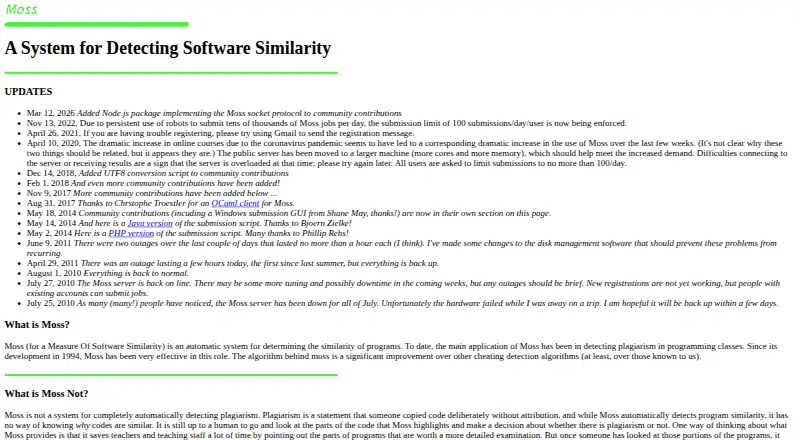
What MOSS is
MOSS measures similarity between programs and has primarily been used to identify possible plagiarism in programming classes. It returns HTML pages that pair similar submissions and highlight matching passages, and it can exclude expected shared code such as libraries or instructor-provided material. MOSS analyzes 24 programming languages, including C, C++, Java, C#, Python, JavaScript, Haskell, and Matlab. Similarity is not a decision about plagiarism: the service cannot say why programs resemble one another, so a person must review the highlighted code. Anyone may request an account by emailing the specified registration message to [email protected]. Use is non-commercial and limited to 100 submissions per day per user. Submitted code appears in results accessible to anyone with the result URL. Stanford says the URL is sent only to the submitter, uses a random integer, and the results directory cannot be browsed or indexed by robots. Results are typically deleted after 14 days, but may be removed earlier if server disk space is constrained. The page says connection or results delays can indicate server overload and advises trying again later. Community interfaces and clients include AutoMoss and tools for multiple programming languages.
Who it suits
MOSS suits instructors or others who need to compare programming submissions for similarities, provided a person can review the results. It is limited to non-commercial use and may be unsuitable when submitted code must not be accessible to anyone with a result URL.
What it does well
- Highlights matching code passages in HTML results
- Can exclude expected shared code
- Analyzes 24 programming languages
- Free for non-commercial use
What to know first
- Limited to 100 submissions per day per user
- Requires human review to assess similarity
- Results are accessible to anyone with the result URL
- Results are typically deleted after 14 days
Limits
The free plan is for non-commercial use and permits up to 100 submissions per day per user. Results are typically deleted after 14 days and may be deleted earlier if server disk space is constrained.
Plans
| Plan | Billed and limits | Price |
|---|---|---|
| Free | Non-commercial use · 100 submissions/day/user | Free |
As theory.stanford.edu lists them, read 7 Oct 2026. The maker's own page has the final word.
Getting started
- Email the specified registration message to [email protected] to request an account.
- Use the web service after obtaining an account.
- Submit programs for comparison, keeping within the 100-submission daily limit per user.
- Review the HTML results and highlighted passages yourself before deciding whether plagiarism occurred.
- Use a community-contributed interface or client if one suits your workflow.
MOSS is a free code-similarity service built for instructors and other non-commercial reviewers comparing programming submissions. It is strongest when you need side-by-side evidence across many languages and are prepared to interpret the matches yourself. The 100-submission daily cap, non-commercial terms, and URL-based report access shape whether it fits your process.
Overview
MOSS (Measure Of Software Similarity) compares programs and presents pairs of similar submissions in HTML pages with matching passages highlighted. Its primary use has been detecting possible plagiarism in programming classes, but the report is evidence for a reviewer, not a final finding. Similar code can result from legitimate collaboration, assignment structure, or shared components, and MOSS cannot explain the reason for a match.
You can remove expected common material before comparison, including libraries and instructor-supplied code. That makes the remaining overlaps more relevant when a course template or starter repository is used. Results are typically deleted after 14 days, and they can disappear sooner when server storage is constrained, so reports should be reviewed and preserved within that window.
Key features
Broad code-language coverage
MOSS analyzes 24 languages: C, C++, Java, C#, Python, Visual Basic, JavaScript, FORTRAN, ML, Haskell, Lisp, Scheme, Pascal, Modula2, Ada, Perl, TCL, Matlab, VHDL, Verilog, Spice, MIPS assembly, a8086 assembly, and HCL2. That range suits mixed-language courses and organizations with legacy or hardware-oriented assignments, rather than teams seeking a general document checker.
Reviewable similarity reports
HTML reports show the comparable program pairs and highlight matching sections. This gives an instructor a practical shortlist for closer reading, but it still requires code knowledge and contextual judgment. There is no automated explanation of intent and no plagiarism verdict.
Submission controls and integrations
Each user may submit up to 100 submissions per day. That is ample for many classes but can constrain large cohorts, repeated reruns, or centralized departmental workflows. Community-built clients include a Node.js implementation of the MOSS socket protocol, AutoMoss, and tools for Nim, Python, OCaml, Common Lisp, Java, and PHP, which can reduce custom integration work for technical users.
Confidentiality and availability
Anyone who has a result URL can view the submitted code in that report. Stanford says URLs are sent only to the submitter, use a random integer, and are not browsable or indexed by robots, but forwarding a link still exposes the material. Connection or report delays can signal server overload; the service advises trying again later.
Pricing
| Plan | Price | Includes |
|---|---|---|
| Free | free | Non-commercial use; 100 submissions/day/user |
The free plan is the only plan and has no trial because access is already free. Anyone can request an account by emailing the specified registration message to [email protected]. It is a strong fit for educators, students’ academic reviewers, and nonprofit research or teaching work. Commercial users should not adopt it under these terms; the service directs commercial inquiries to Similix Corporation. There are no paid tiers or extra seats described, so institutions needing commercial rights or a higher quota should look elsewhere.
Platforms
MOSS is offered through the web and supports Linux workflows. Its socket protocol and community clients make command-line or automated submission practical for Linux-based teaching infrastructure, while the HTML result pages remain accessible in a browser.
Who it's for
MOSS suits instructors handling programming assignments, academic integrity staff, and non-commercial technical reviewers who can inspect source code and explain context. It is particularly useful when submissions span several languages or include known starter code that should be excluded. It is a poor fit for commercial code screening, users needing permanent hosted reports, or anyone expecting an automatic plagiarism decision.
Pros and cons
Pros
- Free for non-commercial use: there is no subscription cost for eligible academic and other non-commercial workflows.
- 24 programming languages: coverage extends from mainstream languages to HDL and assembly, supporting varied curricula.
- Expected-code exclusion: removing libraries and instructor code helps focus review on meaningful overlap.
- Actionable HTML comparisons: highlighted passages and paired files direct a human reviewer to specific evidence.
Cons
- Human interpretation is mandatory: MOSS identifies similarity but cannot establish intent or plagiarism.
- 100 submissions per day per user: high-volume programs may need multiple accounts or another service.
- Result URLs expose submissions: anyone with a link can access the code, despite random, non-indexed URLs.
- Short, variable retention: reports usually last 14 days and may be removed earlier under storage pressure.
- Non-commercial restriction: businesses cannot use the free service for production screening.
Alternatives
Choose Dolos when you want an open-source MIT-licensed option with web, API, self-hosted, Linux, and Windows access; its web app is free but ZIP uploads are limited to 10 MB.
Noplag is a better match for users who need freemium access across web, desktop, API, or self-hosted deployments, with three free checks per month and 2,500 words per check.
Pick Plagiarism Detector for a Windows or web tool whose free demo allows 10 checks, limited to the first 700 words and one document per session.
Copyscape fits web-oriented plagiarism checking with API and self-hosted options, while its free URL scans and results per search are limited.
Consider Crossref Similarity Check for paid organizational checking with API and web access, including the first 100 documents per year free under its invoiced annual arrangement.
Originality.ai is an alternative for users seeking freemium web, API, and browser-extension access.
PlagAware offers freemium web and API plans for document and monitored-URL workflows.
Plagiarism Checker X is a Windows alternative with a free forever tier and a paid perpetual license.
Browse broader Plagiarism Checkers or Plagiarism Detection Software lists when you need options beyond code-focused comparison.
Verdict
Choose MOSS if you teach or review code in a non-commercial setting and want free, language-flexible similarity evidence with starter-code exclusions. Look elsewhere if you need commercial rights, larger daily throughput, durable report storage, or an automated conclusion about plagiarism.
Verdict
MOSS can surface similar passages across programming submissions, but it does not determine whether plagiarism occurred. Consider its submission limit, non-commercial restriction, and result-link accessibility before sending code.
Questions
How much does MOSS cost?
The listed Free plan costs nothing.
Can MOSS be used commercially?
No. MOSS is for non-commercial use; the service page directs people interested in commercial use to Similix Corporation.
How do I get a MOSS account?
Anyone may request an account by emailing the specified registration message to [email protected].
What languages does MOSS analyze?
MOSS supports 24 languages, including C, C++, Java, C#, Python, JavaScript, FORTRAN, Haskell, Matlab and others.
Does a similarity result prove plagiarism?
No. MOSS identifies similar code but cannot determine why programs match or whether plagiarism occurred. A person must review the highlighted passages.
Who can see submitted code and how long are results kept?
Anyone with the result URL can access submitted code in results. Stanford says the URL is sent only to the submitter; results are typically deleted after 14 days and may be removed sooner when disk space is constrained.
Facts from MOSS's own pages
- Commercial use
- MOSS is for non-commercial use; the page directs people interested in commercial use to Similix Corporation. · theory.stanford.edu, 7 Oct 2026
- Community integrations
- Community-contributed interfaces and clients include a Node.js package implementing the MOSS socket protocol, AutoMoss web UI, and Nim, Python, OCaml, Common Lisp, Java, and PHP tools. · theory.stanford.edu, 7 Oct 2026
- Confidentiality
- Submitted code appears in results accessible to anyone with the result URL; Stanford says the URL is sent only to the submitter, contains a random integer, and the results directory cannot be browsed or indexed by robots. · theory.stanford.edu, 7 Oct 2026
- Founded
- 1994 · theory.stanford.edu, 28 Sept 2026
- Human review
- MOSS identifies similar code but cannot determine why programs are similar, so a person must review highlighted passages before deciding whether plagiarism occurred. · theory.stanford.edu, 7 Oct 2026
- Languages
- It analyzes C, C++, Java, C#, Python, Visual Basic, JavaScript, FORTRAN, ML, Haskell, Lisp, Scheme, Pascal, Modula2, Ada, Perl, TCL, Matlab, VHDL, Verilog, Spice, MIPS assembly, a8086 assembly, and HCL2. · theory.stanford.edu, 7 Oct 2026
- Purpose
- MOSS automatically measures program similarity and has primarily been used to detect plagiarism in programming classes. · theory.stanford.edu, 7 Oct 2026
- Results
- The service returns HTML pages showing pairs of similar programs and highlights matching passages. · theory.stanford.edu, 7 Oct 2026
- Retention
- Results are typically deleted after 14 days and may be deleted earlier when server disk space is constrained. · theory.stanford.edu, 7 Oct 2026
- Shared code
- MOSS can exclude matches to expected shared code, such as libraries or instructor-supplied code. · theory.stanford.edu, 7 Oct 2026
- Submission limit
- The submission limit is 100 submissions per day per user. · theory.stanford.edu, 7 Oct 2026
- Support and availability
- The page says connection or results delays can indicate server overload and advises users to try again later. · theory.stanford.edu, 7 Oct 2026
- Who can use it
- Anyone may obtain an account by emailing the specified registration message to [email protected]. · theory.stanford.edu, 7 Oct 2026
Where MOSS stands on Freedom251
- Plagiarism Checkers#9 of 31
- Plagiarism Detection Software#11 of 28