Freedom251 › Plagiarism Checkers
Crossref Similarity Check
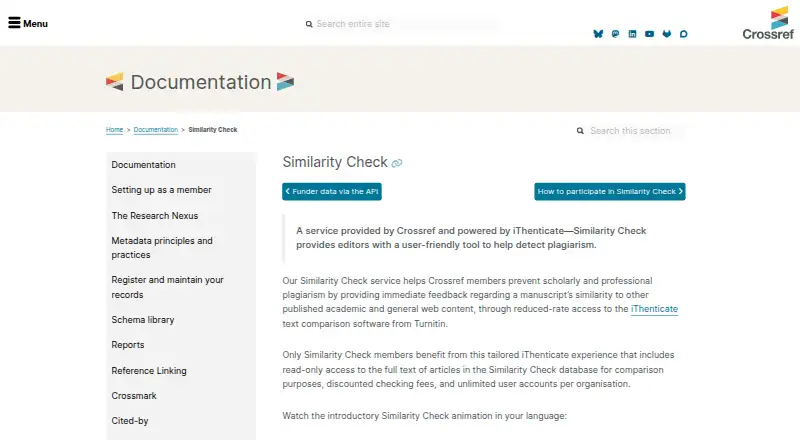
What Crossref Similarity Check is
Crossref Similarity Check helps eligible members identify potential plagiarism by comparing manuscripts with published academic and general web content. Turnitin’s iThenticate software powers the service, producing a Similarity Score and highlighting matching text for editorial review. Crossref says the comparison database contains over 78 million full-text scholarly content items. Users can submit manuscripts through iThenticate or through a manuscript submission system using an API; editors can receive reports showing potential matches and overlap. Members get read-only access to full text in the database, discounted checking fees, unlimited organizational user accounts, and enhanced text matches in Document Viewer. Participation requires Crossref membership, active publication of DOI-assigned content, and full-text URLs in metadata. The annual service fee is 20% of the Crossref membership fee and depends on membership tier. The first 100 documents per year are free to check, for documents up to 25,000 words; subsequent per-document charges vary by volume tier and are invoiced annually. Crossref states that the service is no longer available to members based in Russia.
Who it suits
Similarity Check is for Crossref members actively publishing DOI-assigned content who include full-text URLs in metadata. It is aimed at editors checking manuscripts for potential text overlap.
What it does well
- Compares manuscripts with academic and general web content.
- Reports highlight matching text and provide a Similarity Score.
- Manuscripts can be submitted through an API.
- First 100 yearly checks are free, up to 25,000 words each.
What to know first
- Participation requires Crossref membership and qualifying publishing activity.
- Annual service fee depends on the membership fee tier.
- Unavailable to members based in Russia.
Limits
The annual service fee is 20% of the Crossref membership fee, with the amount determined by membership tier. The first 100 documents per year are free for documents up to 25,000 words; subsequent per-document charges depend on annual volume tier. Crossref says members based in Russia cannot use the service.
Plans
| Plan | Billed and limits | Price |
|---|---|---|
| Similarity Check per-document checking | Invoiced annually in January for the previous year’s usage. · First 100 documents per year free · up to 25,000 words per document · subsequent rates are $0.75, $0.65, $0.55, $0.45, $0.30, or $0.25 per document by annual volume tier | Free |
| Similarity Check annual service fee | Included in the annual membership fee invoice; prorated for the remainder of the calendar year when first joining. · 20% of annual Crossref membership fee · fee depends on membership tier | $40 a year |
As crossref.org lists them, read 9 Oct 2026. The maker's own page has the final word.
Getting started
- Join Crossref and actively publish content assigned DOIs.
- Include full-text URLs in publication metadata.
- Submit manuscripts through iThenticate or an API-connected manuscript submission system.
- Review the Similarity Score and highlighted matches in the resulting report.
Crossref Similarity Check is a manuscript-screening service for publishers and editorial teams. It suits organizations that publish DOI-assigned content and want similarity reports within their editorial process. Its large scholarly comparison database and API support are useful, but access depends on Crossref membership and costs scale with use.
Overview
Editors can submit manuscripts through iThenticate or a manuscript system connected by API, then receive an immediate report with a Similarity Score and highlighted matching text. The report helps editors examine overlap; it does not decide whether plagiarism occurred. PDF export provides a shareable record for review.
The service uses Turnitin’s iThenticate software and compares submissions with academic and general web content. Crossref says the database includes more than 78 million full-text scholarly content items. Turnitin’s Content Intake System checks Crossref metadata daily to find participating members’ full-text URLs and index linked content. This broad scholarly reach is valuable for academic publishing, though matching passages still need editorial context.
Key features
- Flexible submission: Editors can use the iThenticate tool directly, while publishers can connect a submission system through the API. The API route is the better fit for teams integrating checks into an existing workflow.
- Member benefits: Members receive read-only access to full text in the comparison database, discounted checking fees, unlimited organizational user accounts, and enhanced text matches in Document Viewer. Unlimited accounts suit larger editorial organizations, while read-only access does not imply broader reuse rights.
- Editorial workflow: An immediate report showing potential matches can help editors triage submissions promptly. Similarity scores and highlights are evidence to assess, not a substitute for editorial judgment.
Pricing
Similarity Check has no free plan. The annual service fee is $40 a year, billed within the annual membership fee invoice and prorated for the remainder of the calendar year when first joining. The fee is 20% of the annual Crossref membership fee, so the amount depends on membership tier.
Per-document checking is free for the first 100 documents each year. Crossref invoices usage annually in January for the previous year. After the first 100, rates are $0.75, $0.65, $0.55, $0.45, $0.30, or $0.25 per document depending on annual volume tier; the published schedule applies to documents up to 25,000 words. Volume discounts help frequent users, but the annual membership-linked fee and per-document charges make costs less attractive for occasional checks. The stated starting price is $40/yr, but the service fee varies with membership tier and checking charges depend on volume.
Participation requires Crossref membership, active publication of DOI-assigned content, and full-text URLs in metadata. Members based in Russia cannot use the service. Those requirements rule it out for independent authors and publishers that do not meet Crossref’s criteria.
Platforms
The service is available on web and through an API. The web route supports direct submission; API access lets publishers connect manuscript systems. Crossref directs users to Turnitin’s service status page for real-time performance updates.
Who it's for
Similarity Check is best for qualifying scholarly publishers that screen manuscripts regularly, especially teams that can use the API, benefit from unlimited organizational accounts, or reach higher-volume checking tiers. It is a poor fit for individual writers, organizations without active DOI publication, or anyone seeking a free checker.
Pros and cons
- Pros
- More than 78 million full-text scholarly items plus general web content provide a substantial basis for manuscript comparison.
- Direct submission and API integration accommodate both smaller editorial workflows and connected submission systems.
- The first 100 documents per year have no per-document charge, and subsequent rates fall by volume tier.
- Unlimited organizational accounts avoid a per-seat restriction for member teams.
- Cons
- Crossref membership, DOI-assigned publishing, and metadata requirements exclude many potential users.
- The annual service fee is tied to membership tier, with additional charges after the first 100 documents.
- Members based in Russia are excluded.
- Reports surface matching text but leave interpretation and plagiarism decisions to editors.
Alternatives
For a broader set of options, see Plagiarism Checkers.
Choose Noplag if a freemium tool with web, desktop, self-hosted, or API platforms better suits your workflow: its free plan allows 3 checks per month of up to 2,500 words against public web and Common Crawl.
Dolos is a free, MIT-licensed open-source option with a web app and ZIP uploads limited to 10 MB.
Plagiarism Detector is a freemium alternative with web and Windows access; its free demo allows 10 checks total, covering the first 700 words per document and one document per session.
Choose Copyscape for freemium web, API, or self-hosted access, including limited free URL scans and Copysentry weekly protection at $4.95 a month.
MOSS is a free alternative for non-commercial use, with 100 submissions per day per user.
Originality.ai offers API, extension, and web access; its free Basic plan focuses on AI detection, with 3 scans per day and 2,000 words per scan.
PlagAware is a freemium web and API alternative, with a free plan covering 10 pages per month and up to 30 monitored URLs.
Plagiarism Checker X is a Windows-only freemium option with a free plan that has limited words and daily searches, plus a one-time Professional license.
Verdict
Choose Crossref Similarity Check if you are an eligible scholarly publisher that needs editorial comparison against a substantial academic corpus, particularly when API integration or high-volume checking matters. The main reason to choose it is the combination of scholarly coverage, editorial reports, and member-scale access; look elsewhere if you lack qualifying Crossref membership or need a free, standalone checker.
Verdict
Similarity Check offers manuscript comparison and editorial reports for qualifying Crossref members. Its membership and metadata requirements, annual fee, and regional restriction matter when assessing eligibility.
Questions
What does Similarity Check cost?
The annual service fee is 20% of the annual Crossref membership fee and depends on membership tier. The first 100 documents per year are free; subsequent checking fees depend on annual volume tier.
Is there a free plan?
There is no free plan listed. The per-document schedule gives the first 100 documents each year free, while an annual service fee applies.
Who can participate?
Organizations must be Crossref members, actively publish DOI-assigned content, and include full-text URLs in their metadata.
Can Similarity Check be used through an API?
Yes. Manuscripts can be submitted through a manuscript submission system using an API.
Who powers Similarity Check?
The service is powered by Turnitin’s iThenticate text comparison software.
Where is it available?
Crossref says it can no longer offer Similarity Check to members based in Russia.
Facts from Crossref Similarity Check's own pages
- Access methods
- Users can submit manuscripts through the iThenticate tool or through a manuscript submission system using an API. · crossref.org, 9 Oct 2026
- Database
- Crossref says the iThenticate database contains over 78 million full-text scholarly content items. · crossref.org, 9 Oct 2026
- Eligibility
- Participation requires Crossref membership, actively publishing DOI-assigned content, and including full-text URLs in metadata for Similarity Check. · crossref.org, 9 Oct 2026
- Fee structure
- The service charges an annual fee equal to 20% of the Crossref membership fee plus per-document checking fees, with volume discounts. · crossref.org, 9 Oct 2026
- Founded
- 2000 · crossref.org, 28 Sept 2026
- Indexing
- Turnitin’s Content Intake System accesses Crossref metadata daily to collect members’ full-text URLs and index the linked content. · crossref.org, 9 Oct 2026
- Member features
- Similarity Check members receive read-only access to full text in the comparison database, discounted checking fees, unlimited organizational user accounts, and enhanced text matches in Document Viewer. · crossref.org, 9 Oct 2026
- Powered by
- The service is powered by iThenticate text comparison software from Turnitin. · crossref.org, 9 Oct 2026
- Provider
- Crossref describes itself as a not-for-profit membership organisation that began in January 2000. · crossref.org, 9 Oct 2026
- Purpose
- Similarity Check helps Crossref members detect potential plagiarism by comparing manuscripts with published academic and general web content. · crossref.org, 9 Oct 2026
- Regional availability
- Crossref states that it can no longer offer Similarity Check to members based in Russia. · crossref.org, 9 Oct 2026
- Service status
- Crossref directs users to Turnitin’s service status page for real-time updates about performance and ongoing issues. · crossref.org, 9 Oct 2026
- Similarity reports
- iThenticate reports a Similarity Score and highlights matching text for editors to review. · crossref.org, 9 Oct 2026
- Word limit
- The published per-document price schedule applies to documents up to 25,000 words. · crossref.org, 9 Oct 2026
- Workflow
- Editors can upload a manuscript and receive an immediate report showing potential matches and how the paper overlaps with other work. · crossref.org, 9 Oct 2026
Where Crossref Similarity Check stands on Freedom251
- Plagiarism Checkers#25 of 31