Freedom251 › Translation Software
Moses Statistical Machine Translation
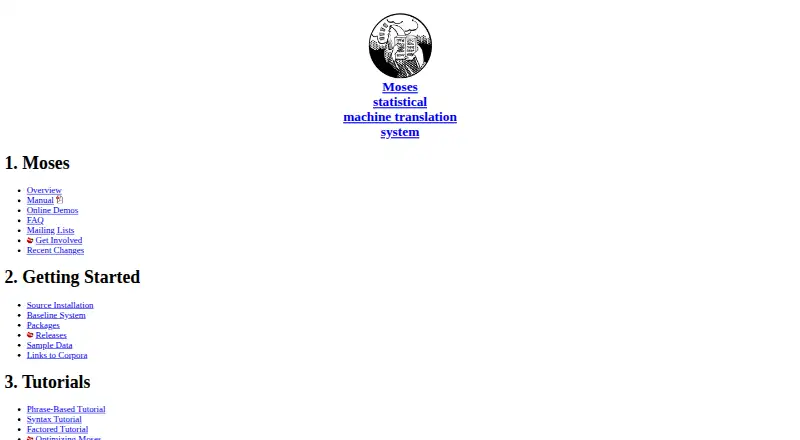
What Moses Statistical Machine Translation is
Moses Statistical Machine Translation is a free, open translation system from Moses Statistical Machine Translation, founded in 2005. It trains translation models for any language pair when given a parallel corpus, then uses a command-line decoder to search available alternatives for the highest-probability result. Model choices include phrase-based and tree-based translation, plus factored models that add linguistic or other word-level information. Moses can decode confusion networks and word lattices, allowing connections to upstream tools such as speech recognizers and morphological analyzers. Its documented workflow covers data preparation, word alignment, phrase extraction and scoring, reordering-model construction, and tuning. The package includes KenLM for language-model creation, while documentation also describes IRSTLM and SRILM. An XML-RPC server accepts translation sentences from clients using XML-RPC libraries. Perl scripts can translate website text while preserving layout. Linux is the recommended development environment; Mac OS X is supported, and Windows use is through the Ubuntu subsystem.
Who it suits
Moses suits developers and researchers building self-hosted translation workflows from parallel corpora. It is also relevant to teams integrating translation with speech, morphological, or web-processing tools.
What it does well
- Free plan and LGPL license
- Phrase-based, tree-based, and factored models
- Command-line decoder included
- XML-RPC serving interface
- Website translation scripts preserve layout
What to know first
- Linux is the recommended platform
- Windows use requires the Ubuntu subsystem
- Requires a word-alignment tool
- Document translation is not supported
Verdict
Moses provides a configurable statistical translation workflow with command-line, server, and website options. Its setup requires alignment tools and language-model components, so it suits users comfortable managing a self-hosted system.
Facts from Moses Statistical Machine Translation's own pages
- Ambiguous input
- It can decode confusion networks and word lattices, which can support integration with upstream tools such as speech recognizers or morphological analyzers. · www2.statmt.org, 12 Oct 2026
- API access
- Yes · www2.statmt.org, 20 Sept 2026
- Command line
- The released software includes a command-line executable for decoding, and the decoder source is available from GitHub. · www2.statmt.org, 12 Oct 2026
- Decoding
- Its search algorithm finds the highest probability translation among the available choices, and the released software includes a command-line decoder. · www2.statmt.org, 12 Oct 2026
- Dependencies
- The guide says Moses requires a word-alignment tool such as GIZA++, MGIZA, or Fast Align, and includes KenLM for language-model creation. · www2.statmt.org, 12 Oct 2026
- Document translation
- No · www2.statmt.org, 20 Sept 2026
- Experiment management
- The site lists an Experiment Management System as a tool for using Moses. · www2.statmt.org, 12 Oct 2026
- External tools
- Moses requires a word alignment tool, with GIZA++, MGIZA, and Fast Align listed as examples. · www2.statmt.org, 12 Oct 2026
- Factored models
- Factored translation models let users integrate linguistic and other information at the word level. · www2.statmt.org, 12 Oct 2026
- Founded
- 2005 · www2.statmt.org, 28 Sept 2026
- Free plan
- Yes · www2.statmt.org, 20 Sept 2026
- Input integration
- Moses can decode confusion networks and word lattices, supporting integration with upstream tools such as speech recognizers and morphological analyzers. · www2.statmt.org, 12 Oct 2026
- Language models
- The setup documentation says Moses includes KenLM's lmplz program and also describes using IRSTLM or SRILM to create language models. · www2.statmt.org, 12 Oct 2026
- License
- Moses is licensed under the LGPL. · www2.statmt.org, 12 Oct 2026
- Model types
- Moses offers phrase-based and tree-based translation models. · www2.statmt.org, 12 Oct 2026
- Package caveat
- The site says the packaged Moses versions it lists are not maintained or endorsed by the core Moses developers. · www2.statmt.org, 12 Oct 2026
- Platforms
- The documentation names Linux as the primary and recommended development platform, says macOS is widely used by developers, and describes running on Windows 10 through the Ubuntu subsystem. · www2.statmt.org, 12 Oct 2026
- Purpose
- Moses is a statistical machine translation system that can automatically train translation models for any language pair from a parallel corpus. · www2.statmt.org, 12 Oct 2026
- Security and compliance
- The opened maker pages provide no security or compliance claims. · www2.statmt.org, 12 Oct 2026
- Server interface
- The Moses server can accept translation sentences through XML-RPC, with clients written in languages including Java, Perl, Python, and PHP. · www2.statmt.org, 12 Oct 2026
- Server requirements
- Building the server requires xmlrpc-c and a multi-threaded Moses build. · www2.statmt.org, 12 Oct 2026
- Serving interface
- The Moses server can accept translation sentences through XML-RPC, with clients written in languages that have XML-RPC libraries; building it requires xmlrpc-c. · www2.statmt.org, 12 Oct 2026
- Support
- The site directs questions to the moses-support mailing list and asks users to search documentation and mailing-list archives first. · www2.statmt.org, 12 Oct 2026
- Supported environments
- The getting-started guide identifies Linux as the primary and recommended development platform, describes Mac OS X support, and says Windows use is through the Ubuntu subsystem. · www2.statmt.org, 12 Oct 2026
Where Moses Statistical Machine Translation stands on Freedom251
- Translation Software#53 of 156
- Translation apps#77 of 158