Minitest
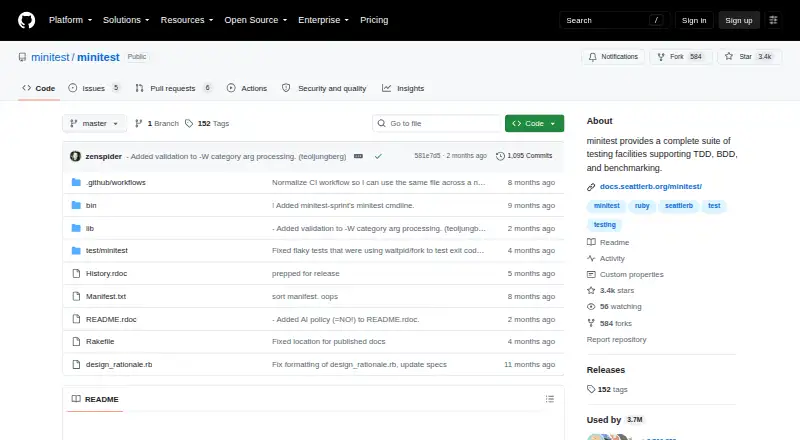
What Minitest is
Minitest is free Ruby software for test-driven development, behavior-driven development, and benchmarking on Linux and Windows. The minitest/test component supplies a compact unit-testing framework with assertions for readable tests, while minitest/spec connects those assertions to spec-style expectations. Minitest/benchmark supports repeatable checks that assert algorithm performance. Optional components add colored output through minitest/pride and provide an explicit all-tests runner through minitest/autorun. Projects using Rake can use minitest/test_task to generate a task that runs tests, prints the command, isolates failures, and identifies slow tests. Plugins can register command-line options and initialize during startup. The README lists Rails, Rake, Nokogiri, and RDoc among projects using Minitest. Ruby 3.2 or newer is required, and installation is provided through `sudo gem install minitest`. The project uses the MIT License, permitting use, modification, distribution, and sale under its conditions; that license also provides the software without warranty. GitHub Issues is linked for bug reports. Its runner is described as small and fast, without extra bells and whistles.
Who it suits
Minitest fits Ruby developers building unit tests, specification-style tests, or repeatable performance benchmarks. Teams using Rake can use its task generator, while projects needing customization can add startup plugins and command-line options.
What it does well
- Supports TDD, BDD, and benchmarking
- Provides unit and spec testing styles
- Runs repeatable performance benchmarks
- Generates Rake test tasks
- Allows command-line plugins
- Uses the MIT License
What to know first
- Requires Ruby 3.2 or newer
- Runner intentionally has no bells and whistles
- Listed platforms are Linux and Windows
Limits
Minitest requires Ruby 3.2 or newer. Its runner is described as small and fast with no bells and whistles, so the toolkit intentionally provides a limited set of extras.
Plans
| Plan | Billed and limits | Price |
|---|---|---|
| Minitest | MIT-licensed software | Free |
As github.com lists them, read 9 Oct 2026. The maker's own page has the final word.
Getting started
- Install Ruby 3.2 or newer
- Run `sudo gem install minitest`
- Add Minitest components to your Ruby project
- Use minitest/test or minitest/spec for tests
- Add minitest/benchmark for performance checks
- Generate a Rake task with minitest/test_task if using Rake
Verdict
Choose Minitest for a compact Ruby testing toolkit covering assertions, specs, benchmarks, and Rake workflows. Its MIT license and plugin support suit projects that want a small, extensible foundation. Consider another runner if you need a broad set of built-in extras beyond its deliberately minimal design.
Questions
How much does Minitest cost?
Minitest is free software under the MIT License, with the listed plan priced at $0.
Which platforms and language does it support?
The listed platforms are Linux and Windows, and the supported language is Ruby.
What testing styles are included?
Minitest provides unit testing through minitest/test, spec-style expectations through minitest/spec, and benchmarking through minitest/benchmark.
Can Minitest work with Rake?
Yes. minitest/test_task generates a Rake task that runs tests, prints the command, isolates failures, and lists slow tests.
What license does it use?
It uses the MIT License, which permits use, modification, distribution, and sale under its stated conditions. The license provides the software without warranty.
Facts from Minitest's own pages
- Benchmarking
- minitest/benchmark lets users assert algorithm performance in repeatable benchmarks. · github.com, 9 Oct 2026
- Extensibility
- Projects can add plugins that register command-line options and initialize during startup. · github.com, 9 Oct 2026
- Installation
- The README gives `sudo gem install minitest` as the installation command. · github.com, 9 Oct 2026
- Integrations
- The README lists Rails, Rake, Nokogiri, and RDoc among projects using Minitest. · github.com, 9 Oct 2026
- License
- The README includes the MIT License, which permits use, modification, distribution, and sale subject to its stated conditions. · github.com, 9 Oct 2026
- License and warranty
- Minitest uses the MIT License, which states the software is provided as is without warranty. · github.com, 9 Oct 2026
- Limit
- The README describes the runner as small and fast, but says it has no bells and whistles. · github.com, 9 Oct 2026
- Maintainer testing scope
- The README says the maintainer locally tests and develops against the three currently supported non-EOL Ruby versions and will not maintain more builds. · github.com, 9 Oct 2026
- Purpose
- Minitest provides testing facilities for TDD, BDD, and benchmarking. · github.com, 9 Oct 2026
- Rake support
- minitest/test_task generates a Rake task for running tests, printing the command, isolating failures, and listing slow tests. · github.com, 9 Oct 2026
- Requirements
- The README lists Ruby 3.2 or later as a requirement. · github.com, 9 Oct 2026
- Ruby requirement
- The listed requirement is Ruby 3.2 or newer. · github.com, 9 Oct 2026
- Runner
- minitest/autorun provides an explicit way to run all tests, and the project describes its runner as small and fast with no bells and whistles. · github.com, 9 Oct 2026
- Security
- The opened project page does not state a security certification or compliance standard. · github.com, 9 Oct 2026
- Spec testing
- minitest/spec provides a spec engine that bridges test assertions to spec expectations. · github.com, 9 Oct 2026
- Support
- The repository links to GitHub Issues for bug reports. · github.com, 9 Oct 2026
- Task support
- minitest/test_task provides a Rake task generator for running tests, isolating failures, and finding slow tests. · github.com, 9 Oct 2026
- Test output
- minitest/pride adds coloring to test output. · github.com, 9 Oct 2026
- Unit testing
- minitest/test is a small unit testing framework with assertions for writing readable tests. · github.com, 9 Oct 2026
Where Minitest stands on Freedom251
- Unit Testing#16 of 32
- Unit Testing Frameworks#19 of 32