Freedom251 › Membership Management Software

Memship
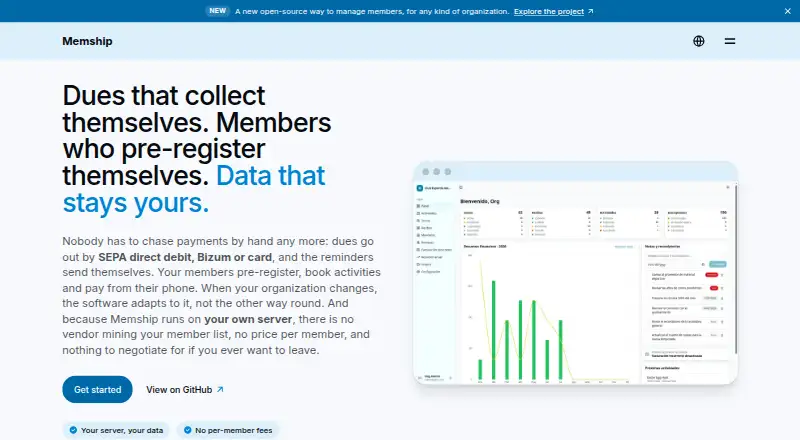
What Memship is
Memship is a self-hosted web application that brings membership management, activities, and payments together for associations, sports clubs, cultural organizations, and other member-based groups. Its membership tools cover types, groups, pricing, age restrictions, guardians and minors, role-based access, and organization settings. Organizations can offer activities with pricing tiers, registration, eligibility checks, waiting lists, discount codes, legal consents, and file uploads. Listed payment options include SEPA direct debit, Redsys, Bizum, and Stripe Checkout, with recurring billing, automatic overdue reminders, and PDF receipts that show VAT breakdowns. The software supports group announcements and automatic emails about registrations, cancellations, and waiting lists. Email campaigns and direct messaging are marked as planned. Members can register, book activities, and pay using a phone browser; a dedicated mobile app is in development. The member-facing software supports Spanish, Catalan, and English, with the option to extend it to other languages. It is single-tenant, keeping member data on the organization’s own server by default. Connecting an outside service can send data to that service. The Free core plan costs nothing, with no subscriptions or per-member fees.
Who it suits
Memship is aimed at associations, sports clubs, and cultural organizations with a few hundred to a few thousand members, run by volunteers or small staff. It suits groups able to manage a self-hosted application.
What it does well
- Full application listed as free
- No subscriptions or per-member fees
- Member data stays on the organization's server by default
- Supports activity registration, waiting lists, and payments
- Members can use a phone browser to book and pay
What to know first
- Quick start requires Docker and Docker Compose
- Dedicated mobile app is still in development
- Email campaigns and direct messaging are planned, not current
Plans
| Plan | Billed and limits | Price |
|---|---|---|
| Free core | permanently · full application · self-hosted deployment · no subscriptions · no per-member fees | Free |
| Memship core | Full application · self-hosted · no subscriptions · no per-member fees | Free |
As openmemship.com lists them, read 21 Oct 2026. The maker's own page has the final word.
Getting started
- Open the Memship website.
- Prepare a self-hosted environment with Docker and Docker Compose.
- Use the quick start to run the application.
- Open the application in a browser on port 8081.
- Configure memberships, activities, and payment options for your organization.
Memship is a self-hosted membership system for associations, clubs, and other member-led organizations that need records, activities, and payments in one place. It suits volunteer teams and small staffs managing a few hundred to a few thousand members. Its strongest case is control over member data without subscription or per-member charges; its main trade-off is the technical responsibility that comes with running it yourself.
Overview
Memship combines membership administration, activity registration, and payment collection in a single-tenant deployment on an organization’s own server. Membership types, groups, pricing, age rules, guardians, minors, role-based access, and organization settings cover the administrative structure that clubs and associations commonly need. A member portal lets people manage their own interactions instead of routing every change through staff.
The self-hosted model keeps member data on the organization’s infrastructure by default. That is a meaningful privacy and control advantage for groups that do not want a vendor cloud holding their records, although any connected outside service can receive data sent to it.
Key features
Membership and activities
Activity tools go beyond a simple sign-up form. Organizations can set price tiers, check eligibility, maintain waiting lists, issue discount codes, collect legal consents, and accept file uploads. Those controls are useful for clubs with age-dependent programs, capacity limits, or documentation requirements.
Payments and communication
Payment support includes SEPA direct debit, Redsys, Bizum, and Stripe Checkout, plus recurring billing, automatic overdue reminders, and PDF receipts with VAT breakdowns. Automated dunning and self-service renewals reduce repetitive collection work, while card and bank payment options cover different member preferences. Group announcements and automatic registration, cancellation, and waiting-list emails can run through SMTP or Resend. Email campaigns and direct messaging are marked as planned, so this is not yet a full outbound communications suite.
Language and access
The member-facing interface includes Spanish, Catalan, and English, with the option to extend it to other languages. Members can register, book activities, and pay from a phone browser. A dedicated member mobile app is still in development, which matters for organizations expecting a native app experience.
Pricing
Memship is free. The Free core plan costs free and includes the full application, self-hosted deployment, no subscriptions, and no per-member fees. The Memship core plan is also free with the same full-application, self-hosted, subscription-free, per-member-free terms. Since both published plans offer the same stated package, the attraction is straightforward: organizations keep the software without a recurring license bill. They must still provide the server and handle deployment and maintenance.
Platforms
Memship runs as self-hosted web software. The quick start requires Docker and Docker Compose, and the application is opened in a browser on port 8081. This fits organizations with technical support or a volunteer comfortable managing containers; it is a poor match for teams seeking a hosted, ready-to-use service. Community help is available through GitHub issues or email on a best-effort basis, while contributors may separately offer paid setup, hosting, or custom development.
Who it's for
Memship is aimed at associations, sports clubs, and cultural organizations with a few hundred to a few thousand members, especially those run by volunteers or small staffs. It is a sensible choice when data ownership, flexible activity rules, and integrated collection matter more than a polished native mobile app or vendor-managed hosting.
Pros and cons
- Pro: Full functionality is free, with no subscription or per-member fees, making ongoing software costs predictable.
- Pro: Self-hosting keeps member data on the organization’s server by default and supports a single-tenant setup.
- Pro: Eligibility checks, waiting lists, consent capture, recurring billing, dunning, and VAT-aware receipts address operational tasks in one system.
- Con: Docker and Docker Compose are required, so deployment and upkeep are the organization’s responsibility.
- Con: Members currently use a phone browser rather than a dedicated mobile app.
- Con: Email campaigns and direct messaging are planned rather than current communication features, and support is best-effort.
Alternatives
Choose Raklet instead if native Android and iOS apps and a freemium hosted model matter more than self-hosting; its free tier is limited to 100 contacts, one admin seat, and 1,250 emails per month.
memberplanet is a better fit for organizations wanting web, Android, and iOS access, with a Basic plan offering unlimited members and admins.
Pick MembershipWorks for a web service with account-based tiers, including a free allowance of 50 accounts and paid limits of 300 or 600 accounts.
PushPress suits groups prioritizing native mobile apps and unlimited leads, admins, members, and staff on its free tier, with transaction fees instead of monthly fees.
Use membermojo when a web-only service with annual, member-count pricing and a free trial is preferable.
GrowthZone is the alternative for organizations seeking a paid platform with mobile, API, and web access and plans built around unlimited members and contacts.
Mybers offers native apps, a free-forever starter tier with unlimited members and 500 emails per month, and paid upgrades.
Pelcro is another hosted option with mobile and API support, including a free tier for 100 customers.
For broader comparisons, see Membership Management Software and Membership Billing Software.
Verdict
Choose Memship if your association or club wants a capable membership, activity, and payment system without license fees and is prepared to operate Docker-based self-hosting. Look elsewhere if you need vendor-managed infrastructure, a native member app today, or mature campaign and direct-messaging tools.
Verdict
Memship covers membership records, activities, payment collection, and member self-service in a self-hosted application. Organizations should account for the Docker and Docker Compose requirement and the current reliance on a phone browser rather than a dedicated mobile app.
Questions
How much does Memship cost?
The Free core and Memship core plans are each listed as free. The plans include the full application, self-hosted deployment, no subscriptions, and no per-member fees.
Which platforms does Memship support?
Memship is listed for self-hosted use and the web. Members can register, book activities, and pay from a phone browser.
What payment methods are supported?
Listed options are SEPA direct debit, Redsys, Bizum, and Stripe Checkout. The platform also supports recurring billing and automatic overdue reminders.
Does Memship have a mobile app?
A member-focused mobile app is in development. Members can currently use a phone browser to register, book activities, and pay.
Where is member data hosted?
Memship is single-tenant and keeps member data on the organization’s own server by default. Connecting an outside service can send data to that service.
What support is available?
Community help is available through GitHub issues or email on a best-effort basis. Contributors may separately take paid work for complex setup, hosting, or custom development.
Facts from Memship's own pages
- Activities
- Activities support modalities, tiered pricing, online registration, eligibility checks, capacity limits, waiting lists and discount codes. · openmemship.com, 21 Oct 2026
- API
- A REST API is exposed under /api/v1 and uses FastAPI; payment webhooks use POST /webhooks/{provider}. · github.com, 21 Oct 2026
- Backup requirement
- Backups must include the data-root directory and the .env file because encryption keys and persistent service data are stored there. · github.com, 21 Oct 2026
- Communications
- Administrators can send announcements to all members, groups or membership types. · openmemship.com, 21 Oct 2026
- Consents and files
- Activities can require legal consents and uploaded attachments through the member portal. · openmemship.com, 21 Oct 2026
- Data hosting
- The application is single-tenant and stores member data on the organization’s own server by default. · openmemship.com, 21 Oct 2026
- Deployment requirements
- The quick start requires Docker and Docker Compose and runs the application in a browser on port 8081. · openmemship.com, 8 Oct 2026
- Email delivery
- Automatic registration, cancellation and wait-list emails can use SMTP or Resend. · openmemship.com, 21 Oct 2026
- Email SDK options
- Email integrations use either self-hosted SMTP or the Resend API. · github.com, 21 Oct 2026
- Free plan
- Yes · openmemship.com, 20 Sept 2026
- Guardian and minor support
- Membership records support guardians and minors. · openmemship.com, 21 Oct 2026
- Hosting and data
- The software is self-hosted and single-tenant, with member data kept on the organization’s own server by default. · openmemship.com, 8 Oct 2026
- Installation model
- The production installer uses vps-bootstrap.sh and install.sh, generates secrets, pins a release version and stores persistent data under one data root. · github.com, 21 Oct 2026
- Intended organizations
- Memship says it is built for associations, sports clubs, and cultural organizations with a few hundred to a few thousand members, run by volunteers or small staff. · openmemship.com, 8 Oct 2026
- Languages
- The interface supports Spanish, Catalan and English and can be extended through contributions. · github.com, 21 Oct 2026
- Limit: hosting responsibility
- Organizations normally operate their own server, while hosted management is available only as separately arranged paid contributor work. · openmemship.com, 21 Oct 2026
- Limit: mobile app
- A member mobile app is still in development; current member access works through the browser. · openmemship.com, 21 Oct 2026
- Limit: one instance per host
- The installation documentation states that container naming means a second Memship instance cannot run on the same Docker host without using another host or virtual machine. · github.com, 21 Oct 2026
- Limit: quick-start security
- The quick-start deployment is for evaluation because it uses throwaway volumes and a signing key published in the repository. · github.com, 21 Oct 2026
- Maker facts
- The project identifies Marc Andreu and Eder Villar as maintainers; it states there is no company or investor behind the project. · openmemship.com, 21 Oct 2026
- Maker founding year
- No founding year is stated on the reviewed official pages. · openmemship.com, 21 Oct 2026
- Maker headquarters
- No headquarters or legal entity is stated on the reviewed official pages. · openmemship.com, 21 Oct 2026
- Member lifecycle
- Administrators can handle registration, onboarding, status changes, cancellation, membership types, groups, prices and age restrictions. · github.com, 21 Oct 2026
- Member portal
- Yes · openmemship.com, 20 Sept 2026
Where Memship stands on Freedom251
- Membership Management Software#1 of 106
- Membership Billing Software#2 of 34
- Membership & Association Management#2 of 29
- Nonprofit Membership Management Software#4 of 30