Freedom251 › AI Music Playlist Generators
MediaSage
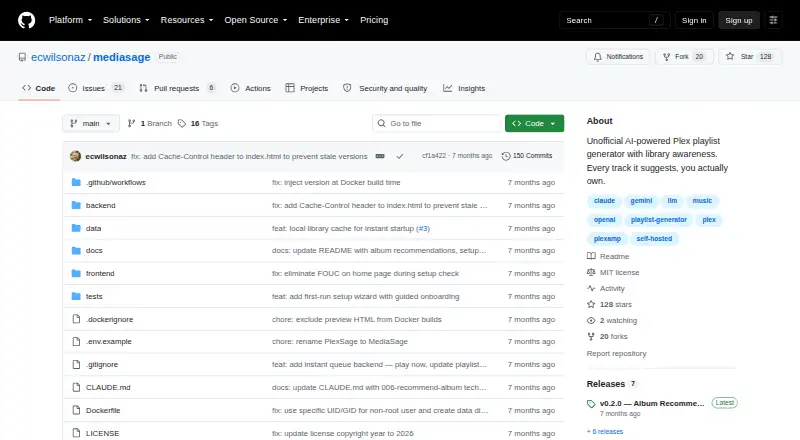
What MediaSage is
MediaSage is a free, self-hosted web app for creating Plex playlists and getting album recommendations from a music library. Users can describe a playlist with a natural-language prompt or choose a seed song; prompts can cover mood, era, instrumentation, genre, and production style. Album suggestions come in library mode for albums already owned and discovery mode for albums not owned. Filters include genres, decades, minimum rating, and excluding live recordings. Users can preview tracks, create or update playlists, and send tracks to active Plex clients. MediaSage works with Google Gemini, Anthropic Claude, OpenAI GPT, Ollama, and custom OpenAI-compatible APIs, syncing library details to a local SQLite database for filtering and track selection. It shows an estimated provider cost before generation. Setup requires Docker or Python 3.11+, a Plex server containing music, a Plex token, and an AI provider API key or local model. The README gives approximate maximum track counts of 18,000 for Gemini, 3,500 for Claude, and 2,300 for OpenAI; local model support is experimental. The project is MIT licensed and describes Linux, macOS, Windows, and NAS installation options.
Who it suits
MediaSage suits Plex users who want library-aware playlists, album suggestions, and controls for filtering or previewing tracks. It is for people able to provide the listed server, setup, and AI provider or local model requirements.
What it does well
- Builds playlists from prompts or a selected song.
- Offers owned-album and discovery recommendation modes.
- Filters by genre, decade, rating, and live status.
- Previews tracks and sends them to active Plex clients.
- Displays estimated provider cost before generation.
What to know first
- Requires a Plex server with music and a Plex token.
- Requires Docker or Python 3.11+.
- Requires an AI provider key or local model.
- Local model support is experimental.
Limits
The README gives approximate maximum track counts of 18,000 for Gemini, 3,500 for Claude, and 2,300 for OpenAI. Local model support is experimental.
Getting started
- Open the MediaSage project website on GitHub.
- Prepare a Plex server containing music and obtain a Plex token.
- Choose Docker or Python 3.11 or later for setup.
- Connect an AI provider API key or a local model.
- Run MediaSage in a supported Linux, macOS, or Windows environment.
Verdict
MediaSage combines playlist creation and album recommendations with Plex playback and filtering. Setup requirements and the experimental status of local models are important considerations.
Questions
How much does MediaSage cost?
MediaSage is free and open source under the MIT license. It displays an estimated provider cost before generation; the README describes the Gemini API free tier and Ollama as free.
Which AI providers does it support?
It supports Google Gemini, Anthropic Claude, OpenAI GPT, Ollama, and custom OpenAI-compatible APIs.
What do I need to set it up?
Setup requires Docker or Python 3.11 or later, a Plex server with music, a Plex token, and an AI provider API key or local model.
Which platforms are supported?
The listed platforms are API, Linux, macOS, self-hosted, web, and Windows. The README also describes NAS installation for Synology, Unraid, and TrueNAS SCALE.
Does it connect to Plex?
Yes. It uses the Plex music library, can create or update playlists, and can send tracks to active Plex clients.
How many tracks can it handle?
The README lists approximate maximums of 18,000 tracks for Gemini, 3,500 for Claude, and 2,300 for OpenAI.
Facts from MediaSage's own pages
- AI integrations
- It supports Google Gemini, Anthropic Claude, OpenAI GPT, Ollama, and custom OpenAI-compatible APIs. · github.com, 9 Oct 2026
- Album recommendations
- It recommends albums in library mode or discovery mode and offers familiarity controls, a written pitch, and secondary picks. · github.com, 9 Oct 2026
- Cost disclosure
- The app displays estimated provider cost before generation; the README lists a free Gemini API tier and describes Ollama as free. · github.com, 4 Oct 2026
- Deployment
- The maker documents Docker installation and direct Python installation on Linux, macOS, and Windows, including NAS examples. · github.com, 9 Oct 2026
- Filtering
- Users can filter by their library’s genre tags, decade, minimum rating, and whether to exclude live recordings. · github.com, 9 Oct 2026
- Library-aware playlists
- It offers natural-language playlist prompts and playlists based on a seed track’s mood, era, instrumentation, genre, or production style. · github.com, 9 Oct 2026
- License
- The repository identifies the software as MIT licensed. · github.com, 9 Oct 2026
- Limits
- The page lists approximate provider track capacities of 18,000 for Gemini, 3,500 for Claude, and 2,300 for OpenAI. · github.com, 9 Oct 2026
- Local data
- It syncs the Plex music library to a local SQLite database for filtering and track selection. · github.com, 4 Oct 2026
- Local processing
- A local SQLite cache supports library filtering and counting, and local language models are available for privacy and zero API costs. · github.com, 9 Oct 2026
- Maker
- The repository owner is identified on GitHub as Eric Wilson; no headquarters or founding date is stated on the maker pages opened. · github.com, 9 Oct 2026
- Plex integration
- MediaSage syncs a Plex music library and can create, replace, or append playlists and send tracks to active Plex devices. · github.com, 9 Oct 2026
- Plex playback
- Users can send tracks to active Plex clients, create or update playlists, and preview tracks before saving. · github.com, 4 Oct 2026
- Provider limits
- The README lists approximate maximum track counts of 18,000 for Gemini, 3,500 for Claude, and 2,300 for OpenAI, and says local model support is experimental. · github.com, 4 Oct 2026
- Purpose
- MediaSage is a self-hosted web app that generates Plex playlists and album recommendations using music in the user’s library. · github.com, 9 Oct 2026
- Requirements
- Setup requires Docker or Python 3.11+, a Plex server with music, a Plex token, and an AI provider API key or local model. · github.com, 9 Oct 2026
- Security and privacy
- The maker describes local-model support as experimental and says it enables privacy and zero API costs; no security certification is stated on the page. · github.com, 9 Oct 2026
- Supported environments
- The README describes running it on Linux, macOS, or Windows, and gives NAS installation instructions for Synology, Unraid, and TrueNAS SCALE. · github.com, 4 Oct 2026
- Usage costs
- The app page lists estimated typical AI costs by provider and says Google Gemini has a free API tier for personal use. · github.com, 9 Oct 2026
Where MediaSage stands on Freedom251
- AI Music Playlist Generators#7 of 23