
Maxima
What Maxima is
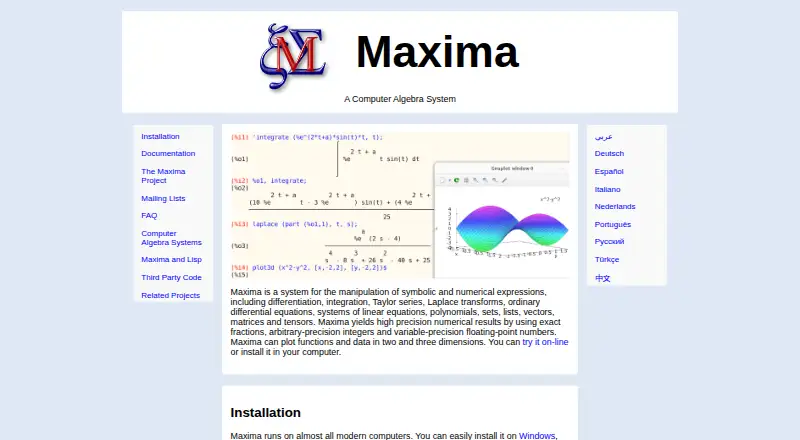
Maxima is a free computer algebra system for working with symbolic and numerical expressions. It can differentiate and integrate, calculate Taylor series and Laplace transforms, solve ordinary differential equations and linear equation systems, and work with polynomials, vectors, matrices, and tensors. For numerical work, it supports exact fractions, arbitrary-precision integers, and variable-precision floating-point values. It can plot functions and data in two or three dimensions. Downloads include the wxMaxima and XMaxima notebook interfaces, which provide formatted mathematical output, as well as a terminal program. The project homepage also links to an online version users can try in a browser. Maxima is distributed under the GNU General Public License, with some U.S. Department of Energy export restrictions. On Linux, Gnuplot is required to create plots. The project notes that a computer algebra system cannot be complete or proven correct for every problem. A discussion mailing list accepts questions from beginners and developers.
Who it suits
Maxima suits people who need symbolic or numerical mathematics tools across Linux, macOS, Windows, or a browser. It may be useful to students, researchers, and developers working with equations, matrices, or plots.
What it does well
- Free under the GNU General Public License.
- Supports symbolic and numerical operations.
- Offers formatted notebook and terminal interfaces.
- Can plot functions and data in two or three dimensions.
- An online browser version is available to try.
What to know first
- Linux plotting requires Gnuplot.
- The project cautions that results are not guaranteed correct for every problem.
- Some U.S. Department of Energy export restrictions apply.
Limits
Maxima is free under the GNU General Public License, with some U.S. Department of Energy export restrictions. On Linux, plotting requires Gnuplot. The project cautions that a computer algebra system is never complete or proven correct for all problems.
Plans
| Plan | Billed and limits | Price |
|---|---|---|
| Maxima | GNU GPL; some U.S. Department of Energy export restrictions | Free |
As maxima.sourceforge.io lists them, read 11 Oct 2026. The maker's own page has the final word.
Getting started
- Open the Maxima website.
- Choose a download for Linux, macOS, or Windows, or try the linked online version in a browser.
- Use wxMaxima or XMaxima for formatted notebook output, or use the terminal program.
- On Linux, install Gnuplot for plotting as described by Maxima's plotting instructions.
- Use the discussion mailing list for questions.
Verdict
Maxima covers a wide range of algebra and numerical work, with notebook, terminal, and browser access. Its own documentation warns that computer algebra results are not proven correct for every problem.
Questions
How much does Maxima cost?
The listed Maxima plan is free.
Which platforms does Maxima support?
It is listed for Linux, macOS, web, and Windows.
Is Maxima open source?
It is distributed under the GNU General Public License, with some U.S. Department of Energy export restrictions.
What interfaces does it offer?
Downloads include wxMaxima and XMaxima notebook interfaces with formatted mathematical output, as well as a terminal program. The homepage also links to an online version.
What mathematical work can Maxima do?
Its listed capabilities include differentiation, integration, Taylor series, Laplace transforms, ordinary differential equations, linear equation systems, polynomials, vectors, matrices, and tensors.
How can users get help?
The Maxima discussion mailing list accepts questions from beginners as well as development ideas.
Facts from Maxima's own pages
- History
- Maxima descends from Macsyma, which originated at MIT in the late 1960s. · maxima.sourceforge.io, 11 Oct 2026
- Integrations
- On Linux, Maxima's plotting instructions require Gnuplot to create plots. · maxima.sourceforge.io, 11 Oct 2026
- Interfaces
- The downloads include wxMaxima and XMaxima notebook interfaces with formatted mathematical output, alongside the terminal program. · maxima.sourceforge.io, 11 Oct 2026
- License
- Maxima is distributed under the GNU General Public License, with some U.S. Department of Energy export restrictions. · maxima.sourceforge.io, 11 Oct 2026
- Limitations
- The installation page cautions that a computer algebra system such as Maxima is never complete or proven to give correct answers in all problems. · maxima.sourceforge.io, 11 Oct 2026
- Lisp implementations
- The FAQ lists Clisp, SBCL, CCL, GCL, CMUCL, ECL, Scieneer Common Lisp, Allegro Common Lisp, and ABCL as supported Lisp implementations. · maxima.sourceforge.io, 11 Oct 2026
- Maintenance
- The project page says its source code and documentation are maintained by 27 volunteers from around the world. · maxima.sourceforge.io, 11 Oct 2026
- Math operations
- Its listed capabilities include differentiation, integration, Taylor series, Laplace transforms, ordinary differential equations, linear equation systems, polynomials, vectors, matrices, and tensors. · maxima.sourceforge.io, 11 Oct 2026
- Online access
- The homepage links to an online version that users can try in a browser. · maxima.sourceforge.io, 11 Oct 2026
- Platforms
- The maker provides installation instructions for Windows, Macintosh, and Linux. · maxima.sourceforge.io, 11 Oct 2026
- Plotting
- Maxima can plot functions and data in two and three dimensions. · maxima.sourceforge.io, 11 Oct 2026
- Precision
- Maxima produces high precision numerical results using exact fractions, arbitrary-precision integers, and variable-precision floating-point numbers. · maxima.sourceforge.io, 11 Oct 2026
- Purpose
- Maxima is a computer algebra system for manipulating symbolic and numerical expressions. · maxima.sourceforge.io, 11 Oct 2026
- Support
- The Maxima discussion mailing list accepts questions ranging from beginner issues to development ideas. · maxima.sourceforge.io, 11 Oct 2026
Where Maxima stands on Freedom251
- Math Solver Apps#26 of 68