Freedom251 › Loyalty Program Software
Loyalty Interchange Protocol
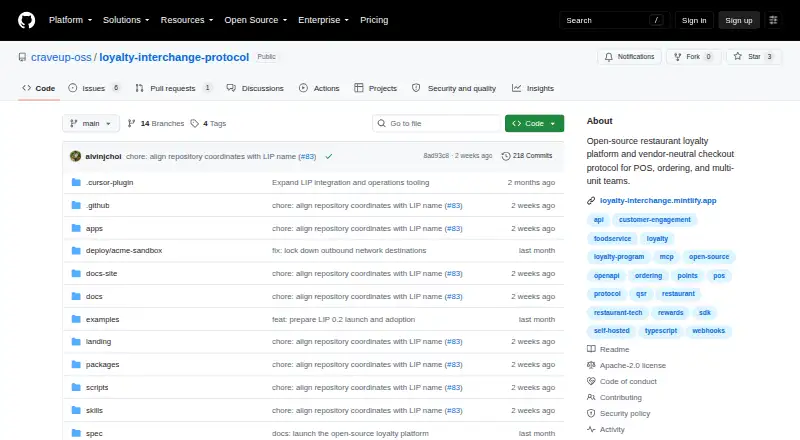
What Loyalty Interchange Protocol is
Loyalty Interchange Protocol (LIP) is an open-source loyalty platform and transaction protocol for restaurant technology teams that handle integrations. It supports the checkout lifecycle from member lookup and enrollment through balances, order evaluation, accrual, redemption, reversals, and refund-safe adjustments. Its restaurant order model covers items, modifiers, discounts, fees, taxes, tips, tenders, and totals across channels such as drive-thru, kiosk, web, mobile, pickup, delivery, and catering. Programs can use points, visits or stamps, wallet credit, paid membership, or hybrid multi-account models. The `/platform/v1` API includes customer profiles, consent, behavioral events, segments, campaigns, connectors, imports, analytics, and attribution. The maker provides a free Apache-2.0 reference stack for self-hosting with Docker Compose or Node.js 22 and newer. Storage options described are SQLite-backed local storage and normalized, tenant-scoped PostgreSQL for multi-instance use. Customer sign-in remains external: a backend validates OIDC and maps identities to opaque member IDs. LIP 0.2.0 is described as pre-1.0 infrastructure, not a turnkey no-code marketing service. CSV member imports through the platform API are limited to 1 MiB and 1,000 rows.
Who it suits
LIP is aimed at POS and ordering products, multi-unit technical teams, and restaurant integrators that own integration work. It is not positioned as a no-code marketing service for restaurants without an integration team.
What it does well
- Covers loyalty checkout lifecycle tasks
- Supports multiple loyalty program models
- Restaurant order model spans many channels
- Free Apache-2.0 self-hosted reference stack
- SQLite and PostgreSQL storage options
What to know first
- Pre-1.0 infrastructure
- CSV imports capped at 1 MiB and 1,000 rows
- Customer sign-in remains external
- Requires an integration team
Limits
The free Apache-2.0 stack is self-hosted. Platform API CSV member imports are limited to 1 MiB and 1,000 rows.
Plans
| Plan | Billed and limits | Price |
|---|---|---|
| Loyalty Interchange Protocol | Apache-2.0 open-source stack; self-hosted | Free |
As github.com lists them, read 8 Oct 2026. The maker's own page has the final word.
Getting started
- Open the project website on GitHub.
- Choose Docker Compose or Node.js 22 and newer with npm for the self-hosted reference stack.
- Start the reference stack using the selected route.
- Connect customer sign-in through a BFF that validates OIDC and maps identities to LIP member IDs.
Loyalty Interchange Protocol (LIP) is open-source loyalty infrastructure for restaurant technology teams. It best suits POS and ordering providers, multi-unit technical teams, and integrators prepared to build and run the connections themselves. Its restaurant-focused transaction model is substantial, but it is not a turnkey marketing product.
Overview
LIP covers the loyalty flow from enrolling or finding a member through evaluating an order, updating balances, earning or redeeming rewards, and handling reversals and refunds. Keeping these steps within one protocol can help a team align reward accounting with changes to restaurant orders, rather than treating loyalty as a separate points counter.
The order model spans items, modifiers, discounts, fees, taxes, tips, tenders, and totals, across channels such as drive-thru, kiosk, web, mobile, pickup, delivery, and catering. That makes LIP relevant to products that need consistent loyalty rules across varied restaurant orders. The trade-off is ownership: adopters must integrate those channels and operate the resulting system.
Key features
Programs can use points, visits or stamps, wallet credit, paid membership, or hybrid multi-account models. The checkout lifecycle includes ledger history and refund-safe adjustments, useful for teams that need a record of how balances change when transactions are reversed or corrected.
The /platform/v1 API extends beyond checkout to profiles, marketing consent, behavioral events, segments, campaigns, connectors, imports, analytics, and attribution. This gives an integration team a broad foundation for loyalty and engagement workflows, though the product's pre-1.0 status makes it a less suitable choice for operators expecting a finished marketing suite.
A typed Square Orders adapter includes webhook signature verification and synthetic certification fixtures. It offers a concrete starting point for Square integrations, but does not remove the need to validate and maintain an implementation in the adopter's own environment.
The reference guest wallet uses a responsive backend-for-frontend with OIDC Authorization Code and PKCE; access tokens and merchant credentials stay server-side. Customer sign-in itself remains external: a BFF must validate OIDC and map the identity to an opaque LIP member ID. Teams therefore need to supply identity and application integration rather than expecting LIP to provide a complete sign-in service.
Pricing
LIP's plan, Loyalty Interchange Protocol, costs nothing. It is an Apache-2.0 open-source stack intended for self-hosting, with tiered rewards, lifecycle automation, a customer portal, and API access. There is no paid tier described; the price does not remove the engineering and operating work involved in deployment and integration.
For local storage, the repository describes SQLite; multi-instance use can use normalized, tenant-scoped PostgreSQL storage. The reference stack can be started with Docker or Node.js 22 and newer. CSV member imports through the platform API are limited to 1 MiB and 1,000 rows, a constraint to account for when moving larger member lists.
Platforms
LIP supports API, Linux, self-hosted, and web use. Its documented deployment options—Docker Compose or Node.js 22 and newer with npm—favor teams comfortable managing infrastructure. The security policy calls for TLS, authentication on non-health endpoints, avoiding direct customer identifiers in logs and idempotency keys, and encryption of sensitive identity claims at rest; adopters need to implement those safeguards in their deployment.
Who it's for
LIP is a strong candidate for POS and ordering products, restaurant integrators, and multi-unit technical teams that want to embed loyalty across restaurant-specific channels and have developers to own the work. It is a poor fit for restaurants looking for a no-code way to launch campaigns without an integration team. LIP 0.2.0 is pre-1.0, and repository tests and fixtures do not establish independent adoption or production service-level performance.
Pros and cons
- Pros: The transaction lifecycle covers accrual, redemption, reversals, and refund adjustments, giving integrators tools to account for order changes.
- Pros: Multiple program models and a restaurant-specific order schema suit teams building loyalty across several ordering channels.
- Pros: The open-source self-hosted stack and documented SQLite and PostgreSQL options let teams choose a deployment suited to local development or multi-instance use.
- Cons: External identity and adopter-owned integrations require development capacity; LIP is not a ready-to-run restaurant marketing service.
- Cons: Pre-1.0 maturity and the absence of evidence establishing independent adoption or production SLOs may deter teams seeking an established production foundation.
- Cons: CSV imports cap at 1 MiB and 1,000 rows, which can complicate larger imports.
Alternatives
For teams that would rather use a freemium product than self-host restaurant loyalty infrastructure, meed offers Android, iOS, and web apps, with a free plan capped at 50 members and a Pro plan at $59 a month. LoyaltyLion may suit stores seeking a commerce-oriented option: its free plan is recommended for stores processing 400 orders or fewer per month, and it also offers a free trial.
Smile.io is another freemium option, with a free plan covering 200 monthly orders, 10 specialized reports, points, referrals, and discount and free-shipping rewards. Yotpo Loyalty has a free plan for basic points campaigns and referrals, with program awareness tools and Support Center tutorials.
ChatWhale offers a web-based freemium option with a 100-subscriber, one-Facebook-Page starting plan and a paid plan at $29 a month for up to 500 subscribers and three Facebook Pages. For an enterprise-ready SaaS approach, Annex Cloud Loyalty Experience Platform uses custom pricing. Comarch Accounts Payable Automation is another paid product with custom pricing, while Como is a paid alternative.
Browse more options in Loyalty Program Software and Restaurant Loyalty Software.
Verdict
Choose LIP if your team can self-host software and integrate loyalty into restaurant POS or ordering workflows; its breadth across transaction handling and program types is the central advantage. Look elsewhere if you need a turnkey marketing service, external identity management, or an established prebuilt product without an integration team.
Verdict
LIP offers a broad restaurant loyalty and transaction foundation for teams prepared to integrate and operate it. Its pre-1.0 status and integration requirements make it a poor fit for restaurants seeking a turnkey no-code marketing service.
Questions
How much does LIP cost?
The listed plan is free. The Apache-2.0 reference stack is self-hosted.
Can a team use LIP without an integration team?
The maker describes it as infrastructure for teams that own integration work, not a turnkey no-code marketing service.
Which loyalty program types does it support?
Supported models include points, visits or stamps, wallet credit, paid membership, and hybrid multi-account programs.
How is customer sign-in handled?
Sign-in remains external. A BFF validates OIDC and maps the identity to an opaque LIP member ID.
What are the CSV import limits?
Platform API CSV member imports are limited to 1 MiB and 1,000 rows.
How can the reference stack be run?
The maker documents Docker Compose or Node.js 22 and newer with npm.
Facts from Loyalty Interchange Protocol's own pages
- Checkout lifecycle
- It supports member lookup and enrollment, balances and ledger history, order evaluation, accrual, redemption, reversal, and refund-safe adjustments. · loyalty-interchange.mintlify.app, 8 Oct 2026
- Deployment
- The maker documents self-hosting with Docker Compose or Node.js 22 and newer with npm. · loyalty-interchange.mintlify.app, 8 Oct 2026
- Engagement
- The platform API supports customer profiles, marketing consent, behavioral events, imports, segments, campaigns, connectors, and attribution analytics. · github.com, 8 Oct 2026
- Engagement tools
- The `/platform/v1` API covers customer profiles, consent, behavioral events, segments, campaigns, connectors, imports, analytics, and attribution. · loyalty-interchange.mintlify.app, 8 Oct 2026
- Guest wallet
- The reference guest wallet is a responsive BFF using OIDC Authorization Code with PKCE, with access tokens and merchant credentials kept server-side. · github.com, 8 Oct 2026
- Identity
- Customer sign-in remains external; a BFF validates OIDC and maps the identity to an opaque LIP member ID. · loyalty-interchange.mintlify.app, 8 Oct 2026
- Integration
- The repository describes a typed Square Orders adapter with webhook signature verification and synthetic certification fixtures. · github.com, 8 Oct 2026
- Intended users
- The maker describes the product for POS and ordering platforms, restaurant integrators, and multi-unit technical teams. · github.com, 8 Oct 2026
- Limits
- Platform API CSV member imports are limited to 1 MiB and 1,000 rows. · loyalty-interchange.mintlify.app, 8 Oct 2026
- Loyalty lifecycle
- It supports member lookup and enrollment, balances and ledger history, order evaluation, accrual, redemption, reversal, and refund-safe adjustments. · loyalty-interchange.mintlify.app, 8 Oct 2026
- Maturity
- The maker describes LIP 0.2.0 as pre-1.0 infrastructure and says repository tests and fixtures do not establish independent adoption or production SLO attainment. · opensource-loyalty.vercel.app, 8 Oct 2026
- Maturity limit
- The README says LIP is not yet a turnkey no-code marketing service for restaurants without an integration team. · github.com, 8 Oct 2026
- Order model
- Its foodservice order model includes items, modifiers, discounts, fees, taxes, tips, tenders, totals, and rules for restaurant ordering channels. · github.com, 8 Oct 2026
- Product
- LIP is an open-source loyalty platform and vendor-neutral transaction protocol for restaurant technology teams. · github.com, 8 Oct 2026
- Program types
- Supported program models include points, visits or stamps, wallet credit, paid membership, and hybrid multi-account programs. · loyalty-interchange.mintlify.app, 8 Oct 2026
- Purpose
- LIP is an open-source loyalty platform and vendor-neutral transaction protocol for restaurant technology teams. · github.com, 8 Oct 2026
- Restaurant orders
- Its foodservice order model covers items, modifiers, discounts, fees, taxes, tips, tenders, and totals across channels including drive-thru, kiosk, web, mobile, pickup, delivery, and catering. · loyalty-interchange.mintlify.app, 8 Oct 2026
- Security
- The security policy says implementations must use TLS, authenticate non-health endpoints, avoid direct customer identifiers in logs or idempotency keys, and encrypt sensitive identity claims at rest. · github.com, 8 Oct 2026
- Security requirements
- The security policy says implementations must use TLS, authenticate non-health endpoints, avoid direct customer identifiers in logs or idempotency keys, and encrypt sensitive identity claims at rest. · github.com, 8 Oct 2026
- Self-hosting
- The maker offers an Apache-2.0 reference stack that can be started with Docker or Node.js 22 and newer. · loyalty-interchange.mintlify.app, 8 Oct 2026
- Storage
- The repository describes SQLite-backed local storage and normalized, tenant-scoped PostgreSQL storage for multi-instance use. · github.com, 8 Oct 2026
- Support
- The repository directs users to its support guidance and asks security vulnerability reports to be sent privately to maintainers. · github.com, 8 Oct 2026
Where Loyalty Interchange Protocol stands on Freedom251
- Loyalty Program Software#1 of 39
- Restaurant Loyalty Software#2 of 25