Freedom251 › Load Balancing Software
Linux Virtual Server
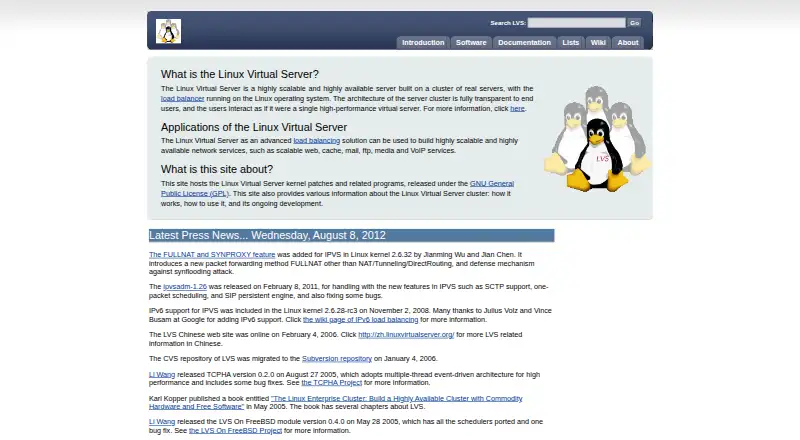
What Linux Virtual Server is
Linux Virtual Server (LVS) combines real servers into a cluster presented to users as one virtual server. Its IPVS component performs transport-layer load balancing in the Linux kernel, directing TCP and UDP requests sent to a virtual service IP toward real servers. Forwarding options include NAT, FULLNAT, tunneling, and direct routing. The project lists web, cache, mail, FTP, media, and VoIP services as applications. Capacity can be changed by adding or removing cluster nodes; availability comes from detecting node or daemon failures and reconfiguring the system. Keepalived checks server-pool state at layers 3, 4, and 5 and informs the kernel when a server is down. KTCPVS provides application-level balancing but is described as under development. The project provides guides for configuration and high availability, and directs administrators to ipvsadm for managing IPVS. It is free, GPL-licensed software for Linux and self-hosted use. The listed IPVS stable version for kernel 2.6 is dated 2004, and the listed ipvsadm 1.26 download is dated 2011.
Who it suits
It suits Linux administrators building self-hosted clusters for services such as web, mail, or FTP. Its documentation describes both transport-layer balancing and an application-level component that remains under development.
What it does well
- Free and GPL-licensed
- Balances TCP and UDP traffic in the Linux kernel
- Supports NAT, FULLNAT, tunneling, and direct routing
- Keepalived checks server-pool state at multiple layers
What to know first
- KTCPVS is under development
- Listed kernel 2.6 stable version dates to 2004
- Listed ipvsadm 1.26 download dates to 2011
- Runs on Linux
Limits
KTCPVS, the layer 7 component, is described as under development. The listed kernel 2.6 stable IPVS version is dated 2004, and the listed ipvsadm download is dated 2011.
Plans
| Plan | Billed and limits | Price |
|---|---|---|
| Linux Virtual Server | GPL-licensed software · runs on Linux | Free |
As linuxvirtualserver.org lists them, read 9 Oct 2026. The maker's own page has the final word.
Getting started
- Visit the Linux Virtual Server website.
- Use the documentation links to choose a NAT, tunneling, or direct-routing configuration guide.
- Install and configure IPVS on Linux, then administer it with ipvsadm.
- Consult the high-availability and scheduling documents as needed.
- Use the project mailing lists for questions or problem reports.
Linux Virtual Server (LVS) is a free, GPL-licensed Linux project that turns a cluster of physical servers into one virtual service endpoint. It is best suited to administrators who want self-hosted, kernel-level TCP and UDP distribution with failover control. Choose it for mature layer 4 infrastructure; look elsewhere if application-aware routing is central to your design.
Overview
LVS spreads service requests across real machines while presenting clients with a single virtual server. Its stated applications include web, cache, mail, FTP, media, and VoIP services. Capacity can be adjusted by adding or removing cluster nodes, and failure detection can trigger reconfiguration when a node or daemon stops responding.
This is infrastructure software rather than a hosted load-balancing product. It runs on Linux, with IPVS administered through ipvsadm. Keepalived checks pool health at layers 3, 4, and 5 and can tell the kernel to remove a failed server. That combination gives operators direct control, but also makes network design, configuration, and ongoing maintenance their responsibility.
Key features
Layer 4 balancing
IPVS operates inside the Linux kernel and routes TCP and UDP requests sent to a virtual service IP. This is a strong fit for predictable transport-level distribution across a server pool, with less suitability for decisions based on application content.
Forwarding choices
Administrators can use NAT, tunneling, direct routing, or FULLNAT. The range accommodates different network topologies: direct routing can avoid rewriting every response, while NAT and tunneling offer alternatives when backend placement or addressing makes that impractical.
Availability and monitoring
Cluster capacity is elastic at the node level, and Keepalived’s multi-layer checks can remove an unhealthy server from service. These mechanisms support resilient pools, provided the operator builds and maintains the surrounding failover configuration.
Layer 7 status and IPv6
KTCPVS is intended for application-level balancing, but it remains under development, so it should not be treated as the project’s dependable answer for content-aware routing. IPVS includes IPv6 support, identified as part of Linux kernel 2.6.28-rc3.
Documentation and support
Guides cover NAT, tunneling, direct routing, scheduling, high availability, and denial-of-service defense. User and development mailing lists handle questions, problem reports, assistance, and release notifications. The project site dates to 1998, while the IPVS page labels version 1.2.1 as a 2004 stable release for kernel 2.6 and lists ipvsadm 1.26 with a 2011 download date; that age warrants careful compatibility planning.
Pricing
| Plan | Price | Includes |
|---|---|---|
| Linux Virtual Server | free | GPL-licensed software that runs on Linux |
There is no trial or paid tier: the complete project is free. That suits teams able to supply Linux hosts and operational expertise. It does not include a managed service, so infrastructure and administration remain with you.
Platforms
LVS supports Linux and self-hosted deployment. Its kernel integration makes it appropriate for Linux-controlled clusters, not for readers seeking a cross-platform hosted control plane.
Who it's for
Choose LVS for Linux operations teams balancing web, cache, mail, FTP, media, or VoIP workloads across real servers, especially when transport-layer performance and configurable forwarding matter. It is a poor match when you need a finished layer 7 feature set, managed operations, or a current release cadence without taking on compatibility work.
Pros and cons
Pros
- Kernel-level IPVS: TCP and UDP balancing is built into Linux rather than dependent on a separate user-space appliance.
- Multiple forwarding methods: NAT, tunneling, direct routing, and FULLNAT support varied network layouts.
- Failure handling: Keepalived health checks can remove failed servers, while node changes support capacity adjustments.
- No license cost: The GPL project has no paid plan or subscription.
Cons
- Layer 7 uncertainty: KTCPVS is still under development, limiting confidence for application-aware routing.
- Aged release references: The cited stable IPVS release is from 2004 and the listed ipvsadm download from 2011, creating a compatibility concern.
- Operational burden: Self-hosting and ipvsadm administration require Linux and networking expertise.
Alternatives
Browse Load Balancing Software for a broader comparison. Pick HAProxy Community Edition when you want a free Linux self-hosted balancer explicitly covering TCP and HTTP proxying. Choose AWS Elastic Load Balancing when an API- and web-based managed service, including a new-customer free tier, is preferable. MetalLB is the more direct choice for open-source load balancing in Kubernetes. VMware Workstation Pro is free Linux self-hosted software, but serves a different virtualization role. Array APV is a paid option. PureLB is a free Linux, macOS, and self-hosted alternative. F5 BIG-IP APM is a paid product with a trial and broad platform coverage. kube-vip is a free Linux self-hosted option.
Verdict
LVS is a compelling choice for experienced Linux administrators who need free, self-hosted layer 4 balancing, flexible packet-forwarding methods, and kernel-integrated failover. Its principal reason to look elsewhere is the dated release trail and the unfinished layer 7 component, which make newer or application-aware requirements better served by another product.
Verdict
LVS provides Linux kernel-based layer 4 balancing and cluster failover functions, with several forwarding methods. The project’s listed download dates are old, and its layer 7 component remains under development.
Questions
How much does Linux Virtual Server cost?
It is free software, listed as free.
Which platforms does it support?
The listed platforms are Linux and self-hosted.
Does it support layer 4 and layer 7 routing?
Yes. IPVS provides layer 4 balancing; KTCPVS provides layer 7 balancing and is under development.
What license does it use?
The project says its kernel patches and related programs are released under the GNU General Public License.
How do administrators manage IPVS?
The IPVS page directs administrators to ipvsadm for managing IPVS in the Linux kernel.
What support channels are available?
The project lists user and development mailing lists for questions, problem reports, user help, and release notifications.
Facts from Linux Virtual Server's own pages
- Administration
- The IPVS page directs users to ipvsadm to administer IPVS in the Linux kernel. · linuxvirtualserver.org, 9 Oct 2026
- Community support
- The project lists user and development mailing lists for questions, problem reports, user help, and release notifications. · linuxvirtualserver.org, 9 Oct 2026
- Forwarding methods
- The home page says IPVS supports FULLNAT in addition to NAT, tunneling, and direct routing. · linuxvirtualserver.org, 9 Oct 2026
- Guides
- The documentation page links instructions for NAT, tunneling, and direct-routing configurations, along with scheduling, high-availability, and DoS-defense documents. · linuxvirtualserver.org, 9 Oct 2026
- Health monitoring
- The software page says Keepalived checks server-pool state at layers 3, 4, and 5, and informs the kernel to remove a server when it is down. · linuxvirtualserver.org, 9 Oct 2026
- IPv6
- The IPVS page says IPv6 support was included in Linux kernel 2.6.28-rc3. · linuxvirtualserver.org, 9 Oct 2026
- Layer 4 balancing
- IPVS performs transport-layer load balancing inside the Linux kernel and directs TCP/UDP service requests to real servers behind a virtual service IP. · linuxvirtualserver.org, 9 Oct 2026
- Layer 7 component
- KTCPVS implements application-level load balancing inside the Linux kernel and is described as under development. · linuxvirtualserver.org, 9 Oct 2026
- License
- The site says its kernel patches and related programs are released under the GNU General Public License. · linuxvirtualserver.org, 9 Oct 2026
- Notable age of downloads
- The IPVS page labels version 1.2.1 as the latest stable version for kernel 2.6 and dates it to 2004; its listed ipvsadm 1.26 download is dated 2011. · linuxvirtualserver.org, 9 Oct 2026
- Project history
- The software page says the site was created on 1998-05-28. · linuxvirtualserver.org, 9 Oct 2026
- Purpose
- Linux Virtual Server builds a scalable, highly available server from a cluster of real servers, presented to users as one virtual server. · linuxvirtualserver.org, 9 Oct 2026
- Scaling and availability
- The introduction says capacity can be scaled by adding or removing cluster nodes, while availability is provided by detecting node or daemon failures and reconfiguring the system. · linuxvirtualserver.org, 9 Oct 2026
- Use cases
- The project lists scalable web, cache, mail, FTP, media, and VoIP services as applications. · linuxvirtualserver.org, 9 Oct 2026
Where Linux Virtual Server stands on Freedom251
- Load Balancing Software#3 of 32