Freedom251 › Internal Linking Tools
Linkagent
What Linkagent is
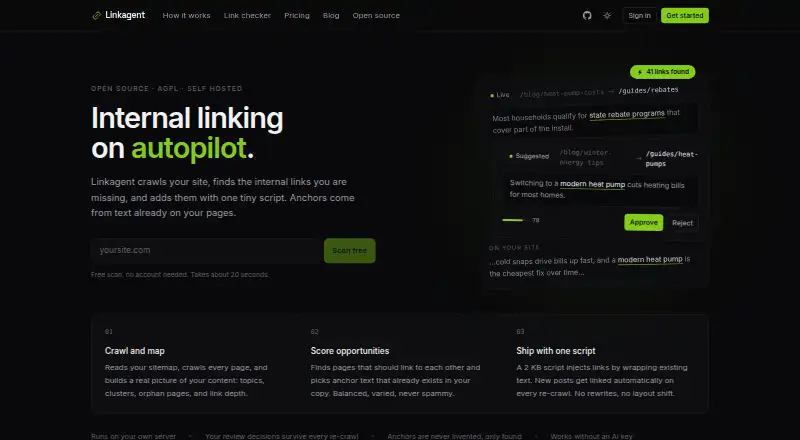
Linkagent finds missing internal links on a website and lets users approve suggestions before adding links through a script, WordPress plugin, or JSON API. It reads a sitemap to map page topics, clusters, orphan pages, click depth, and links within page text. Suggested anchors are drawn from existing copy, and optional AI review checks them against their original sentences. Crawling, clustering, scoring, and anchor selection do not need an AI key; a Claude API key enables additional review. Users can accept or reject recommendations, and those choices carry over to later crawls. Recommendations are balanced at roughly one new link per 250 words, with limits on new inbound links and repeated anchor use. The asynchronous embed script is about 2 KB and wraps existing text without adding or moving page content. Linkagent supports WordPress, Next.js, Shopify, Webflow, and other CMSs through a script or API. Self-hosters keep content, link graphs, and review decisions in their own Postgres database. A no-account scan is available, but hosted service has no free plan. Hosted plans start at $29/month; self-hosting is free and requires your infrastructure.
Who it suits
Linkagent suits site owners who want to identify internal-link gaps and review recommendations before they go live. It offers hosted plans as well as self-hosting for users with their own infrastructure.
What it does well
- Finds orphan pages and maps click depth.
- Anchor suggestions use phrases already in page copy.
- Approval decisions persist across re-crawls.
- Crawling and scoring work without an AI key.
- Self-hosting keeps data in your Postgres database.
What to know first
- Hosted product has no free plan.
- Self-hosting requires your infrastructure.
- Hosted plans start at $29/month.
- Additional AI review requires a Claude API key.
Limits
The hosted Starter plan costs $29/month and covers 1 site, biweekly re-crawls, and up to 200 pages. The free self-hosted plan requires your own infrastructure.
Plans
| Plan | Billed and limits | Price |
|---|---|---|
| Self-hosted | $0 forever · AGPL-3.0 · Every feature, ungated · requires your infrastructure | Free |
| Agency | $249/month · 25 sites · weekly re-crawls · up to 5,000 pages per site | $249 a month |
| Starter | $29/month · 1 site · biweekly re-crawls · up to 200 pages | $29 a month |
| Pro | $99/month · 5 sites · weekly re-crawls · up to 1,000 pages per site | $99 a month |
As linkagent.app lists them, read 4 Oct 2026. The maker's own page has the final word.
Getting started
- Run the no-account site scan, or choose a hosted plan starting at $29/month.
- For self-hosting, prepare your infrastructure and Postgres database.
- Connect a site through the script, WordPress plugin, or JSON API.
- Use the sitemap crawl to review link suggestions.
- Approve or reject suggestions; add a Claude API key for additional AI review.
Overview
Linkagent is a site-crawling tool for finding internal-link gaps and proposing changes through a review workflow. It suits site owners and teams that want to control link additions across different CMSs, or keep the system and its data on their own infrastructure. Its approval history and flexible deployment are useful strengths; hosted users must work within plan-specific site and page caps.
Key features
By reading a sitemap, Linkagent maps page topics, clusters, orphan pages, click depth, and the in-text link graph. That context can help teams prioritize pages with weak links into them and understand how proposed changes fit the wider site. Anchor suggestions draw on phrases already in each page’s copy, with optional AI review checking them against the original sentence.
Users approve or reject suggestions, and Linkagent carries those decisions into subsequent crawls. It balances suggestions at roughly one new link per 250 words and caps new inbound links and repeated anchor use. That makes the workflow more controlled than an indiscriminate linking pass, but teams wanting changes made without review will have an extra step.
Crawling, clustering, scoring, and anchor selection work without an AI key; adding a Claude API key enables further review. The approximately 2 KB embed script loads asynchronously and wraps existing text without adding or moving page content. WordPress, Google Search Console tracking, and a JSON API support different workflows. The site says the script or API can work with WordPress, Next.js, Shopify, Webflow, and other CMSs.
Self-hosters keep content, link graphs, and review decisions in their own Postgres database; the site says nothing phones home. The platform uses AGPL-3.0, while the embed script uses MIT. That combination may suit teams that want control over deployment and data, though self-hosting requires their own infrastructure.
Pricing
Linkagent has no free hosted plan or free trial. Its no-account site scan is free and requires no card, but it is a scan rather than an ongoing hosted plan.
- Self-hosted: free, billed $0 forever. Every feature is ungated under AGPL-3.0, but you provide the infrastructure. Community support is included through GitHub.
- Starter: $29 a month, billed $29/month, for 1 site, biweekly re-crawls, and up to 200 pages. It is the entry point for a single smaller site; the page cap may be restrictive for larger properties.
- Pro: $99 a month, billed $99/month, for 5 sites, weekly re-crawls, and up to 1,000 pages per site. This fits teams managing several sites that need more frequent crawls and greater room per property.
- Agency: $249 a month, billed $249/month, for 25 sites, weekly re-crawls, and up to 5,000 pages per site. Its higher caps are aimed at multi-site operators rather than a single-site owner.
Hosted plans differ by site count, crawl size, and re-crawl frequency; all include AI review and content edit suggestions. The self-hosted option avoids a subscription but shifts infrastructure responsibility to the user.
Platforms
Linkagent is available as a hosted web service, a self-hosted platform, and an API. A script, WordPress plugin, or JSON API can add approved links, including through server-side rendering. The breadth of integration makes it a plausible fit for sites beyond WordPress, while teams should choose the deployment method that matches their CMS and technical setup.
Who it's for
Linkagent is a strong fit for site owners who want to find orphan pages and other linking opportunities without surrendering editorial control. Agencies can use its higher hosted site and page allowances, while technically equipped teams can self-host and retain their content and decisions in their own database. It is less suitable for users seeking a hosted free tier or a workflow that publishes link changes without approval.
Pros and cons
- Pro: Approval and rejection decisions persist across crawls, so teams do not have to revisit the same choices each time.
- Pro: Sitemap-based maps include orphan pages, click depth, and the in-text link graph, giving link suggestions useful structural context.
- Pro: Core analysis does not require an AI key, and the script, plugin, and API provide multiple implementation paths.
- Pro: Self-hosting keeps content, link graphs, and review decisions in the operator’s own Postgres database.
- Con: The hosted product has no free plan or trial, so ongoing use starts at $29 a month.
- Con: Hosted plans cap sites, pages, and crawl frequency; Starter, for example, covers one site and 200 pages with biweekly crawls.
- Con: Self-hosting is free but requires the user’s own infrastructure, making it a less turnkey option.
- Con: The approval workflow adds a human review step for teams that want links published automatically.
Alternatives
For a broader comparison, browse Internal Linking Tools. Consider these alternatives when their pricing or stated scope is a closer fit:
- Interlink is a free WordPress plugin with no signup requirement, for users on WordPress 5.5+ and PHP 7.4+ who want a WordPress-specific option.
- InterLinks offers a demo with one free link and support for blog, page, product, and collection linking, as well as smart redirects for 404s. Its Professional plan is $19 a month or $180/year; choose it if that commerce-oriented linking scope and lower stated monthly price suit you.
- Internal Link Juicer has a free version for one site, limited to posts and pages, with keyword file import and export. Its 1 Site License is $69.99 a year; consider it if that WordPress-oriented, keyword-driven scope meets your needs.
- Link Whisper offers a free WordPress.org version for manually inserting outbound link suggestions. It is a fit if you want that narrower, manual workflow; its Agency plan is $1 a month.
- LinkBoss offers 50 signup credits for one site without a card, then a Launch (Monthly) plan at $11 a month. It may suit a reader who prefers a credits-based free entry point and lower monthly starting price.
- Linkbot offers a free Starter plan for one website property and up to 1,000 property URLs, with reports and diagnostics but no automated linking or ongoing sync. Its Pro plan is $19 a month; choose it if diagnostics are enough to start without automated links.
- Magic Rinku starts with 100 credits and adds 5 credits per month on its free plan; a 200 credits/month plan costs $9 a month. It is worth considering if a credit allowance and basic link features match your expected usage.
- redCacti has a free plan for one website and up to 1,000 pages, with results capped at 30 and no automated crawls, article analysis, CSV exports, link suggestions, health tracking, or meta tag features. It may suit someone who wants a limited free starting point rather than Linkagent’s ongoing approval workflow.
Verdict
Choose Linkagent if you need internal-link discovery with reviewable changes, persistent decisions, and the option to self-host. Its structural mapping and deployment flexibility make it a considered choice for teams that want control over link growth. Look elsewhere if you need a free hosted plan, have a site beyond the page caps of your budget, or want an unreviewed automatic-linking workflow.
Verdict
Linkagent combines site-link analysis with an approval workflow and preserves decisions across subsequent crawls. Hosted service is paid, while self-hosting is free but requires your own infrastructure.
Questions
Is Linkagent free?
A no-account site scan is available for free. The hosted product has no free plan; self-hosting is $0 forever and requires your own infrastructure.
How much do hosted plans cost?
Starter is $29/month for 1 site, biweekly re-crawls, and up to 200 pages. Pro is $99/month for 5 sites and up to 1,000 pages per site; Agency is $249/month for 25 sites and up to 5,000 pages per site.
Which platforms does Linkagent support?
It supports web, API, and self-hosted use. Its script or API works across WordPress, Next.js, Shopify, Webflow, and other CMSs.
Does Linkagent require an AI key?
Crawling, clustering, scoring, and anchor selection work without one. A Claude API key enables additional review.
Is Linkagent open source?
The platform is licensed under AGPL-3.0, and its embed script is MIT licensed.
What integrations does Linkagent offer?
It supports WordPress, Google Search Console tracking, and a JSON API for server-side rendering.
Facts from Linkagent's own pages
- AI requirement
- Crawling, clustering, scoring, and anchor selection work without an AI key; a Claude API key enables additional review. · linkagent.app, 4 Oct 2026
- Anchor text
- Suggested anchors come from phrases already present in page copy, and AI-reviewed anchors are validated against the original sentence. · linkagent.app, 4 Oct 2026
- Content analysis
- It reads a sitemap and maps page topics, clusters, orphan pages, click depth, and the in-text link graph. · linkagent.app, 4 Oct 2026
- Free scan
- A no-account site scan is available without a card, and the pricing page says the hosted product has no free plan. · linkagent.app, 4 Oct 2026
- Hosted limits
- Hosted plans differ by site count, crawl size, and re-crawl frequency; all include AI review and content edit suggestions. · linkagent.app, 4 Oct 2026
- Integrations
- Linkagent supports WordPress, Google Search Console tracking, and a JSON API for server-side rendering. · linkagent.app, 4 Oct 2026
- Licensing
- The platform is AGPL-3.0 licensed and the embed script is MIT licensed. · linkagent.app, 4 Oct 2026
- Link limits
- Suggestions are balanced at roughly one new link per 250 words, with caps on new inbound links and repeated anchor use. · linkagent.app, 4 Oct 2026
- Platform compatibility
- The site says it works across WordPress, Next.js, Shopify, Webflow, and other CMSs through a script or API. · linkagent.app, 4 Oct 2026
- Purpose
- Linkagent crawls a website, finds missing internal links, and adds approved links using a script, WordPress plugin, or JSON API. · linkagent.app, 4 Oct 2026
- Review workflow
- Users approve or reject link suggestions, and those decisions persist across re-crawls. · linkagent.app, 4 Oct 2026
- Script
- The embed script is about 2 KB, loads asynchronously, and wraps existing text without adding or moving page content. · linkagent.app, 4 Oct 2026
- Self-hosting and data
- Self-hosters keep content, link graphs, and review decisions in their own Postgres database; the site says nothing phones home. · linkagent.app, 4 Oct 2026
- Support
- The self-hosted plan includes community support on GitHub. · linkagent.app, 4 Oct 2026
Where Linkagent stands on Freedom251
- Internal Linking Tools#17 of 24