Freedom251 › AI Voice Biometrics Software
Lifegence Voiceprint API
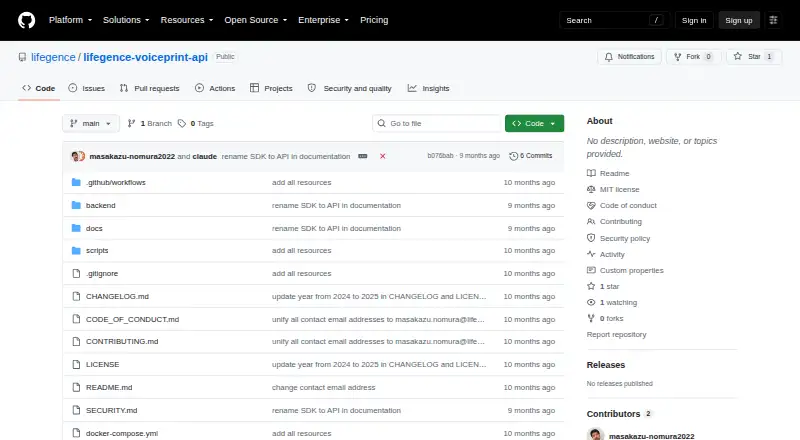
What Lifegence Voiceprint API is
Lifegence Voiceprint API is a self-hosted REST API for speaker verification and identification. It enrolls speakers by registering voiceprints, then offers two ways to match audio: verification checks a claimed speaker against one enrolled voiceprint for 1:1 authentication, while identification searches enrolled speakers for a 1:N match. The project uses SpeechBrain ECAPA-TDNN to generate 192-dimensional voice embeddings. Its README lists WAV, MP3, WebM, and OGG audio, with recordings between 3 and 30 seconds and 5 to 10 seconds recommended.
A Docker Compose quick start runs the API server with PostgreSQL 16 and pgvector, plus Redis 7. Requests use API keys sent in the X-API-Key header. Enrollment requires consent fields, and a deletion endpoint removes a speaker’s associated voiceprint data. The security policy says embeddings should be handled as sensitive biometric data and recommends encryption at rest and TLS 1.3 in transit. The current version has no liveness detection or anti-spoofing measures, and the project cautions that recognition is not guaranteed to be fully accurate. Users are responsible for compliance with applicable laws, including GDPR and BIPA. The repository is free and open source under the MIT License.
Who it suits
It suits developers building speaker verification or identification into services, using API clients such as curl, Python, JavaScript, or mobile apps. Teams that need self-hosting and control over voiceprint storage may also find its Docker Compose deployment and deletion endpoint relevant.
What it does well
- Provides both 1:1 verification and 1:N identification.
- Accepts WAV, MP3, WebM, and OGG audio.
- Docker Compose quick start includes PostgreSQL with pgvector and Redis.
- Enrollment includes consent fields, and speakers’ voiceprint data can be deleted.
- Free to use under the MIT License.
What to know first
- The current version has no liveness detection or anti-spoofing measures.
- Recognition is not guaranteed to be fully accurate.
- The API limits enrollment, verification, and identification requests per minute.
Limits
The API specification sets per-minute limits of 10 enrollment requests, 60 verification requests, and 30 identification requests. The current version does not include liveness detection or anti-spoofing measures.
Getting started
- Open the Lifegence Voiceprint API GitHub repository.
- Use the Docker Compose quick start to run the API server.
- Connect with an API client such as curl, Python, JavaScript, or a mobile app.
- Send API requests with a key in the X-API-Key header.
- Enroll speakers with the required consent fields before using verification or identification.
Verdict
Choose Lifegence Voiceprint API if you need a self-hosted API for speaker verification or identification and can operate its documented storage stack. Look elsewhere if your use case requires liveness detection or anti-spoofing, which the current version does not provide.
Questions
How much does Lifegence Voiceprint API cost?
It is free and distributed under the MIT License.
What does the API do?
It enrolls voiceprints and supports 1:1 speaker verification and 1:N speaker identification.
Which audio formats does it accept?
The README lists WAV, MP3, WebM, and OGG recordings from 3 to 30 seconds; 5 to 10 seconds is recommended.
How is API access authenticated?
Requests use API key authentication through the X-API-Key header.
Does it include liveness detection?
No. The current version does not include liveness detection or anti-spoofing measures.
What should users know about compliance?
The README says users are responsible for compliance with applicable laws, including GDPR and BIPA.
Facts from Lifegence Voiceprint API's own pages
- Accuracy limitation
- The project warns that voice recognition does not guarantee 100% accuracy. · github.com, 4 Oct 2026
- Audio input
- Supported audio formats are WAV, MP3, WebM, and OGG, with durations from 3 to 30 seconds. · github.com, 8 Oct 2026
- Authentication
- Verification compares submitted audio against an enrolled speaker and returns a score and confidence level. · github.com, 8 Oct 2026
- Biometric data
- The security policy says embeddings should be treated as sensitive biometric data and calls for encryption at rest and TLS 1.3 in transit. · github.com, 4 Oct 2026
- Client compatibility
- The architecture documentation lists curl, Python, JavaScript, and mobile apps as clients. · github.com, 8 Oct 2026
- Compliance note
- The README says compliance with applicable laws, including GDPR and BIPA, is the user's responsibility. · github.com, 8 Oct 2026
- Consent and deletion
- Enrollment requires consent information, and the API provides an endpoint to delete a speaker and associated voiceprint data. · github.com, 8 Oct 2026
- Deployment
- The project provides a Docker Compose quick start for running the API server. · github.com, 4 Oct 2026
- Enrollment
- The API enrolls speakers by registering a voiceprint from an audio file. · github.com, 8 Oct 2026
- Identification
- Identification searches across speakers and can return up to 20 results. · github.com, 8 Oct 2026
- License
- The repository identifies the project as MIT licensed. · github.com, 8 Oct 2026
- Purpose
- It is a self-hosted REST API for speaker verification (1:1) and identification (1:N). · github.com, 8 Oct 2026
- Rate limits
- The API specification lists limits of 10 enrollment, 60 verification, and 30 identification requests per minute. · github.com, 8 Oct 2026
- Security
- The security policy recommends TLS 1.3 in transit, encrypted database storage, API-key access control, and storing embeddings rather than raw audio. · github.com, 8 Oct 2026
- Security limitation
- The current version does not include liveness detection or anti-spoofing measures. · github.com, 8 Oct 2026
- Storage stack
- The documented stack includes PostgreSQL 16 with pgvector and Redis 7. · github.com, 4 Oct 2026
- Technology
- The project lists SpeechBrain ECAPA-TDNN with 192-dimensional embeddings, FastAPI, PostgreSQL with pgvector, Redis, and Docker Compose. · github.com, 8 Oct 2026
- Verification
- Its verification endpoint compares audio with an enrolled speaker for 1:1 authentication. · github.com, 4 Oct 2026
- Voice model
- The project uses SpeechBrain ECAPA-TDNN to produce 192-dimensional voice embeddings. · github.com, 4 Oct 2026
- Vulnerability support
- The security policy asks researchers to report vulnerabilities by email and lists acknowledgment within 24 hours. · github.com, 4 Oct 2026
Where Lifegence Voiceprint API stands on Freedom251
- AI Voice Biometrics Software#17 of 22