Freedom251 › Website Monitoring Software
LibrePing
What LibrePing is
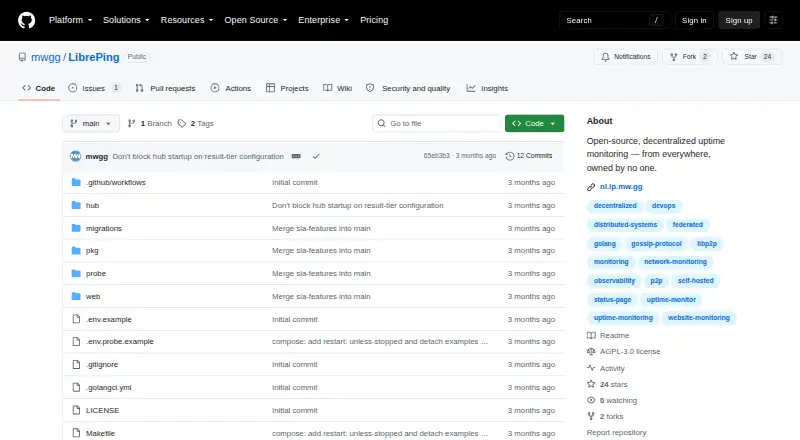
LibrePing is free, open-source monitoring software for websites and services. It checks targets from multiple locations and shows reachability on a live map, with HTTP(S), TCP, DNS, TLS certificate, ICMP ping, and traceroute checks. The dashboard provides a geographic map, network overview, and uptime and latency timelines with location details and recent checks. Hubs exchange results through a peer-to-peer libp2p gossip mesh instead of a central server, and duplicate targets are monitored once across the network. The browser dashboard creates an identity key without signup; a recovery phrase can move it to another device. Alerts support ntfy, Discord, Slack, and raw webhooks. Destinations are encrypted for notifying hubs, failed sends retry, and failover can produce duplicate notifications. Users can run hubs or probes with Docker images and Compose setups. AGPL-3.0 licensing requires sharing modifications when a modified version runs as a network service.
Who it suits
LibrePing suits people monitoring their own services across countries, contributing a probe, or hosting a federated hub. It is also intended for users who want self-hosted or API-accessible monitoring.
What it does well
- Multiple geographic monitoring locations
- HTTP, TCP, DNS, TLS, ICMP, traceroute checks
- Peer-to-peer federation without a central server
- Encrypted alert destinations
- Docker hub and probe deployments
What to know first
- Default probe cap is 300 checks per minute
- Detailed results retained seven days by default
- Probe locations lack cryptographic geographic proof
- Failover may send duplicate alerts
Verdict
LibrePing provides decentralized, self-hostable monitoring with signed results, shared checks, dashboards, and alert integrations. It is free under AGPL-3.0, with configurable probe limits and default history-retention periods.
Facts from LibrePing's own pages
- Alert delivery
- Failed alert sends are retried, and another hub can take over if the notifying hub goes offline; delivery is at-least-once and can produce duplicates during failover. · github.com, 11 Oct 2026
- Alert privacy
- Alert destinations are encrypted to the hubs responsible for notifying the user, so other hub operators see ciphertext. · github.com, 11 Oct 2026
- Alerts
- Alert integrations include ntfy, Discord, Slack, and raw webhooks, with alert destinations encrypted for the hubs responsible for sending notifications. · github.com, 11 Oct 2026
- Checks
- It supports HTTP(S), TCP, DNS, TLS certificate, ICMP ping and traceroute checks. · github.com, 11 Oct 2026
- Check types
- It supports HTTP(S), TCP, DNS, TLS certificate, ICMP ping, and traceroute checks. · github.com, 11 Oct 2026
- Dashboard
- The dashboard includes a geographic map, network overview, and per-monitor uptime and latency timelines with location breakdowns and recent checks. · github.com, 11 Oct 2026
- Data integrity
- Probes sign results and hubs verify signatures; operators can use an allowlist of trusted probes. · github.com, 11 Oct 2026
- Decentralized network
- Hubs share check data through a peer-to-peer libp2p gossip mesh without a central server. · github.com, 11 Oct 2026
- Deployment
- The maker provides Docker Compose setups for running a hub or a probe, and says both ship as Docker images. · github.com, 11 Oct 2026
- Federation
- Hubs form a peer-to-peer libp2p gossip mesh that shares monitoring data without a central server. · github.com, 11 Oct 2026
- History limits
- By default, hubs retain full-detail results for 7 days, hourly summaries for 90 days and daily summaries for 730 days; results are in memory only without a database. · github.com, 11 Oct 2026
- Integrity and trust
- Probes sign results and hubs verify signatures; operators can use an allowlist, while the default policy accepts validly signed results and relies on corroboration. · github.com, 11 Oct 2026
- Intended users
- The maker describes use cases including monitoring one's services across countries, contributing a probe, or hosting a federated hub. · github.com, 11 Oct 2026
- License
- LibrePing is free software under AGPL-3.0, which requires sharing modifications when running a modified version as a network service. · github.com, 11 Oct 2026
- Location caveat
- Probe locations are auto-detected from public IP by default but remain self-declared, with no cryptographic proof of geography. · github.com, 11 Oct 2026
- No signup
- The dashboard creates an identity key in the browser, and users can save a recovery phrase to move their identity to another device. · github.com, 11 Oct 2026
- Probe limit
- A probe defaults to a hard cap of 300 checks per minute, configurable with MAX_CHECKS_PER_MINUTE. · github.com, 11 Oct 2026
- Probe limits
- A probe defaults to a cap of 300 checks per minute, and ICMP and traceroute require the NET_RAW capability. · github.com, 11 Oct 2026
- Purpose
- LibrePing monitors websites and services from multiple locations and displays reachability results on a live map. · github.com, 11 Oct 2026
- Retention
- By default hubs retain detailed results for 7 days, hourly summaries for 90 days, and daily summaries for 730 days; older data is dropped. · github.com, 11 Oct 2026
- Self-hosting
- Users can run a hub with its own dashboard or run a probe to contribute a monitoring location; both ship as Docker images. · github.com, 11 Oct 2026
- Shared checks
- When multiple users add the same target, LibrePing deduplicates it so the network monitors it once and shares the result. · github.com, 11 Oct 2026
Where LibrePing stands on Freedom251
- Website Monitoring Software#16 of 55