LibreCrawl
by LibreCrawl
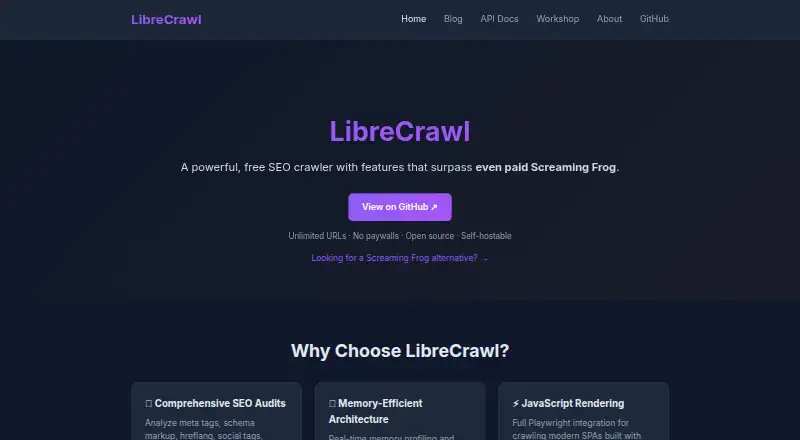
What LibreCrawl is
LibreCrawl is a free SEO crawler for auditing websites and examining technical SEO issues. It checks meta tags, schema markup, hreflang, social tags, PageSpeed metrics, and other technical factors. For JavaScript sites, it uses Playwright to render pages from applications built with React, Vue, Angular, and Next.js. Crawls can run in headed or headless mode. The maker says memory profiling and virtual scrolling support stable crawls of more than one million URLs.
Crawl results can be exported as CSV, JSON, or XML, with custom field selection. The REST API has endpoints for crawl control, settings, and exports; every endpoint requires session-based authentication. Guest API users can run three crawls per 24 hours, with the limit tracked by IP address. LibreCrawl is MIT-licensed and can be self-hosted. The maker says it does not track users, collect analytics, or send crawl data back to itself, and encourages self-hosting for privacy. It is available on the web and for Linux, macOS, and Windows, as well as through its API. The product has a free plan with unlimited URLs and no paid tiers or subscription.
Who it suits
LibreCrawl suits SEO consultants, agency developers, enterprise SEO teams, and open-source contributors who need technical site audits. It is also a fit for teams crawling JavaScript sites or wanting to self-host an MIT-licensed tool.
What it does well
- Checks meta tags, schema, hreflang, social tags, and PageSpeed metrics.
- Uses Playwright to crawl JavaScript applications in headed or headless mode.
- Maker says it supports stable crawls of more than one million URLs.
- Exports crawl data as CSV, JSON, or XML with custom field selection.
- Free plan includes unlimited URLs and has no subscription.
- MIT-licensed and available for self-hosting.
What to know first
- Guest API users are limited to three crawls per 24 hours.
- Every REST API endpoint requires session-based authentication.
Limits
The free plan includes unlimited URLs. Guest API use is limited to three crawls per 24 hours, tracked by IP address.
Plans
| Plan | Billed and limits | Price |
|---|---|---|
| LibreCrawl | Free and open source; no subscriptions. · Unlimited URLs · no paid tiers · MIT license | Free |
As librecrawl.com lists them, read 7 Oct 2026. The maker's own page has the final word.
Getting started
- Open the LibreCrawl website.
- Choose web access or use the Linux, macOS, Windows, or self-hosted option.
- Use the free plan, which includes unlimited URLs.
- For API use, establish a session before calling endpoints.
- Start a crawl and export results as CSV, JSON, or XML.
LibreCrawl is a web-based crawler for technical SEO audits, with a self-hosting option and an API for automating crawl workflows. It suits SEO teams and developers who want a focused crawler they can run on their own terms. Its core appeal is an unlimited-URL, MIT-licensed free plan; it is not a broad SEO research suite.
Overview
LibreCrawl examines technical site issues, including meta tags, schema markup, hreflang, social tags and PageSpeed metrics. That focus makes it useful for auditing a site’s technical health, but it does not cover keyword research, rank tracking, backlink analysis or competitor research. Teams that need those capabilities will need separate tools.
The MIT license allows self-hosting, a meaningful option for teams that want control over their crawling environment. The maker says the software does not track users, collect analytics or send crawl data home. Bug reports and feature requests go to GitHub Issues, while GitHub Discussions are the place for conversations.
Key features
JavaScript crawling
Playwright rendering lets LibreCrawl crawl sites built with React, Vue, Angular and Next.js, in headed or headless mode. That makes it a stronger fit than a crawler limited to static page content when important site elements depend on browser rendering.
The maker says memory profiling and virtual scrolling support stable crawling beyond one million URLs. That stated capacity is attractive for large sites, though teams should treat it as a product claim rather than a guarantee for every deployment.
Exports and API
Crawl data can be exported as CSV, JSON or XML, with custom field selection and no stated export restrictions. The REST API supports crawl control, settings and exports, giving developers a route to build crawling into their workflows.
API use has an important caveat: every endpoint requires a session, and authentication is session-based. Guest users are limited to three crawls per 24 hours, tracked by IP address. That suits occasional evaluation, but teams relying on regular API access must manage sessions and should not assume the guest allowance will cover ongoing use.
Pricing
LibreCrawl: free. The free, open-source plan includes unlimited URLs, carries no subscription, and is available under the MIT license. There are no paid tiers, so there is no higher plan to lift the guest API limit; the three-crawl-per-24-hour cap applies to guest use.
There is no free trial because the product is free. For teams able to self-host, unlimited URLs and no subscription make the plan suitable for sustained crawling without a per-URL charge. The trade-off is a focused tool rather than a paid suite of research features.
Platforms
LibreCrawl is available on the web and supports API use, Linux, macOS, Windows and self-hosting. That combination gives teams options to work through the web interface or run the software in their own environment.
Who it's for
SEO consultants, agency developers, enterprise SEO teams and open-source contributors are the maker’s intended users. Consultants and SEO teams can use it for technical audits; developers gain JavaScript rendering, configurable exports and API endpoints to support workflows. Self-hosting makes it particularly relevant to privacy-conscious teams. It is a weaker fit for anyone seeking keyword, backlink, ranking or competitor analysis in the same product.
Pros and cons
- Pros: Unlimited URLs on a free, MIT-licensed plan make sustained crawling accessible without a subscription.
- Pros: Playwright rendering covers several common JavaScript frameworks, while CSV, JSON and XML exports allow flexible handling of crawl data.
- Pros: Self-hosting and the maker’s stated no-tracking, no-analytics and no-phone-home practices appeal to users who want control over crawl privacy.
- Cons: Guest API use stops at three crawls per 24 hours, and all endpoints require session-based authentication.
- Cons: The product does not include keyword research, rank tracking, backlink analysis or competitor research, limiting its usefulness as a standalone SEO toolkit.
Alternatives
SEO Crawler Software and SEO tools are broader directories for comparing options in those categories.
- Open SEO Crawler is another free, MIT-licensed, self-hosted crawler with unlimited URLs and no account, API key or per-URL billing. Choose it if avoiding accounts and API keys is more important than LibreCrawl’s documented session-based API.
- SpiderNow offers a free plan with 10 single-page scans per month, five scan details and issue views, and five page metric scores. Choose it if that limited scan allowance suits your needs and its Android, iOS or browser-extension platforms matter.
- WebCrawler Pro has free guest and signed-in request allowances of 50 and 100 requests per day, respectively. Consider it if those request-based tiers suit your crawling needs.
- A1 Website Analyzer offers a free mode after a 30-day evaluation period, with 500 page URLs per website and 500 imported URLs. It may suit users whose sites and imports fit those caps and who prefer macOS or Windows software.
- Beam Us Up is a free crawler with no limits stated. Consider it as another free option.
- Crab is open-source software with source code available on GitHub. Consider it if that is the priority.
- FreeCrawl offers unlimited URLs on a free plan. Consider it as another no-cost crawler.
- Netpeak Spider has a free plan capped at 500 URLs, with five threads and two devices per user, for Windows and macOS. It may suit smaller crawls on those platforms.
Verdict
Choose LibreCrawl for free technical SEO audits when JavaScript rendering, flexible exports and the option to self-host matter. Its unlimited-URL plan is compelling for teams focused on crawling, but the session-required API and narrow scope make it a poor substitute for a broader SEO platform or a guest API workflow that needs more than three crawls a day.
Verdict
Pick LibreCrawl for free technical SEO audits, JavaScript rendering, and flexible crawl exports, especially if self-hosting matters. API users who need more than three guest crawls per day must use a session; every API endpoint requires one.
Questions
How much does LibreCrawl cost?
The LibreCrawl plan is free. The plan is free and open source, with no subscriptions or paid tiers.
Is LibreCrawl open source?
Yes. LibreCrawl is MIT-licensed and can be self-hosted.
Which platforms does it support?
It supports web, Linux, macOS, Windows, API, and self-hosted use.
What can LibreCrawl audit?
It analyzes meta tags, schema markup, hreflang, social tags, PageSpeed metrics, and other technical SEO issues.
Can it crawl JavaScript websites?
Yes. It uses Playwright for sites built with React, Vue, Angular, and Next.js, in headed or headless mode.
What are the API limits?
The REST API requires session-based authentication for all endpoints. Guest users are limited to three crawls per 24 hours, tracked by IP address.
Facts from LibreCrawl's own pages
- API access
- Yes · librecrawl.com, 21 Sept 2026
- API authentication
- The REST API uses session-based authentication and requires a session for all endpoints. · librecrawl.com, 7 Oct 2026
- Backlink analysis
- No · librecrawl.com, 21 Sept 2026
- Competitor research
- No · librecrawl.com, 21 Sept 2026
- Exports
- It exports crawl data as CSV, JSON, or XML, with custom field selection and no stated export restrictions. · librecrawl.com, 7 Oct 2026
- Founded
- 2025 · librecrawl.com, 28 Sept 2026
- Free plan
- Yes · librecrawl.com, 21 Sept 2026
- Guest limit
- The API documentation states guest users are limited to three crawls per 24 hours, tracked by IP address. · librecrawl.com, 7 Oct 2026
- Integrations
- The maker lists PageSpeed metrics and Playwright rendering; its API documentation describes REST endpoints for crawl control, settings, and exports. · librecrawl.com, 7 Oct 2026
- Intended users
- The maker describes LibreCrawl for SEO consultants, agency developers, enterprise SEO teams, and open-source contributors. · librecrawl.com, 7 Oct 2026
- JavaScript rendering
- It uses Playwright to crawl JavaScript sites, including React, Vue, Angular, and Next.js, in headed or headless mode. · librecrawl.com, 7 Oct 2026
- Keyword research
- No · librecrawl.com, 21 Sept 2026
- Open source
- LibreCrawl is MIT-licensed and can be self-hosted. · librecrawl.com, 7 Oct 2026
- Platforms
- The maker's repository describes Windows and Linux/Mac startup scripts and Docker installation; the application is accessed through a web browser. · github.com, 7 Oct 2026
- Purpose
- LibreCrawl is a web-based SEO crawler for website audits and analysis. · librecrawl.com, 7 Oct 2026
- Rank tracking
- No · librecrawl.com, 21 Sept 2026
- Scale
- The maker says its memory profiling and virtual scrolling support stable crawling of more than one million URLs. · librecrawl.com, 7 Oct 2026
- Security and privacy
- The maker says LibreCrawl does not track users, collect analytics, or phone home with crawl data, and encourages self-hosting for privacy. · librecrawl.com, 7 Oct 2026
- SEO audits
- It analyzes meta tags, schema markup, hreflang, social tags, PageSpeed metrics, and other technical SEO issues. · librecrawl.com, 7 Oct 2026
- Site audit
- Yes · librecrawl.com, 21 Sept 2026
- Support
- The maker directs users to GitHub Issues for bug reports and feature requests, and GitHub Discussions for conversations. · librecrawl.com, 7 Oct 2026
Where LibreCrawl stands on Freedom251
- SEO tools#52 of 245
- SEO Crawler Software#8 of 34