Freedom251 › Library Management
Librarika
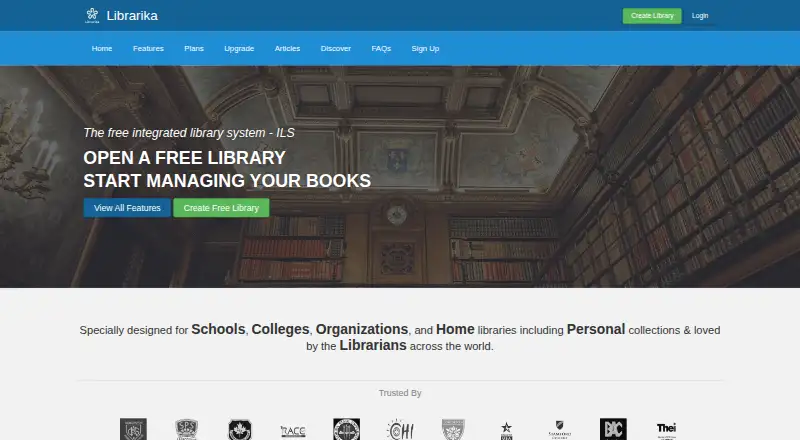
What Librarika is
Librarika is a hosted cloud Integrated Library System for cataloguing collections, handling circulation, and publishing an online public access catalog (OPAC) for members. Cataloguing tools include ISBN-based Smart Add, bulk catalog import and export, and bibliographic data integration with OpenLibrary. Members can check items in and out, reserve items online, and join a hold queue for checked-out items. Libraries can manage multiple branches through one system. Librarika also lists SIP2 connections for kiosks and RFID systems, SAML single sign-on with providers including Azure AD, Google, and Okta, and widgets for library websites. Its iOS and Android apps support catalog browsing, holds, self-service checkouts, push notifications, and library management. A free desktop self-service kiosk app is available for Windows, macOS, and Linux, and requires a SIP2 license. Librarika is intended for universities, colleges, schools, public, corporate, and community libraries, as well as personal collections. The Basic plan costs nothing and includes 2,000 records, unlimited patrons, staff, and check-outs, an OPAC, and email reminders. Paid plans start at $139/yr. E-book hosting is a separate add-on; storage is not included in plans.
Who it suits
Librarika suits libraries and personal collections that need hosted cataloguing, circulation, and a member-facing catalog. Its branch management, mobile apps, kiosk option, and listed integrations may also fit organizations connecting library services across locations or systems.
What it does well
- Hosted cloud deployment for cataloguing, circulation, and member access.
- Basic plan includes 2,000 records and unlimited patrons, staff, and check-outs.
- Manage multiple library branches through one system.
- Catalog tools include ISBN Smart Add and bulk import and export.
- iOS and Android apps support browsing, holds, and self-service checkouts.
- SAML SSO and SIP2 integrations are available on listed plans.
What to know first
- Basic plan is limited to 2,000 records.
- E-book storage is a separate add-on and is not included in plans.
- The free desktop kiosk app requires a SIP2 license.
- The librarian manual is described as being at a very early stage.
Limits
The free Basic plan costs nothing and includes 2,000 records, unlimited patrons, unlimited staff, unlimited check-outs, an OPAC, and email reminders. E-book storage is not included in plans and must be added separately; the kiosk app requires a SIP2 license.
Plans
| Plan | Billed and limits | Price |
|---|---|---|
| Basic | 2,000 records · Unlimited Patrons · Unlimited Staff · Unlimited Check-outs · OPAC · Email Reminders | Free |
| Basic Pro | $139 /yr · 5,000 records · Basic Features · Custom Greetings · Multiple Color Schemes · No Banner Ads · Hold Queue · More Controls | $139 a year |
| E-Books Hosting Starter | $249/yr · 5 GB · Separate add-on; e-book storage not included in plans | $249 a year |
| Silver | $299 /yr · 10,000 records · Basic Features · Hold Queue · SSO Login (SAML2) · SIP2 Integration (per license) · More Controls | $299 a year |
| E-Books Hosting Standard | $499/yr · 10 GB · Separate add-on; e-book storage not included in plans | $499 a year |
| Gold | $499 /yr · 15,000 records · Basic Features · Hold Queue · SSO Login (SAML2) · SIP2 Integration (1 license included) · More Controls | $499 a year |
| E-Books Hosting Premium | $999/yr · 20 GB · Separate add-on; e-book storage not included in plans | $999 a year |
As librarika.com lists them, read 4 Oct 2026. The maker's own page has the final word.
Getting started
- Open the Librarika website and choose the Basic plan or a paid plan.
- Add collection records using Smart Add or bulk catalog import.
- Set up the OPAC for members and configure circulation.
- Use the iOS or Android app for catalog browsing, holds, or self-service checkout.
- If needed, connect website widgets, SAML SSO, or SIP2 services; the desktop kiosk requires a SIP2 license.
Librarika is a cloud library system for schools, institutions, and community libraries that need to manage collections and lend across one or more branches. It is most compelling for organizations that want a hosted service with member self-service, rather than software to run on their own servers.
Overview
Cataloguing, circulation, and a public-facing online catalog (OPAC) share one system. Librarians can add records using ISBN-based Smart Add, import or export catalogs in bulk, and draw on OpenLibrary bibliographic data. Members can check items in and out, reserve titles, and join a queue when an item is already borrowed.
Branch management is built in, so organizations with multiple locations can manage them through a single system. Website widgets connect library functions to an existing site. The service also offers mobile apps for catalog browsing, holds, self-service checkouts, push notifications, and library management.
Key features
Collection and lending workflows
The combination of catalog tools and circulation covers the central work of running a lending library. The free Basic plan allows unlimited patrons, staff, and check-outs, so its main capacity constraint is the 2,000-record catalog cap. That makes it a practical starting point for smaller collections, but libraries approaching that ceiling will need a larger plan.
Integrations and self-service
OpenLibrary integration helps with bibliographic data, while SAML single sign-on can connect to Azure AD, Google, or Okta. SIP2 connects kiosks and RFID systems, but licensing affects the cost: the desktop self-service kiosk app is free for Windows, macOS, and Linux, yet requires a SIP2 license. Gold includes one SIP2 license; Silver offers SIP2 integration per license. Librarika also supplies an iOS and Android app and website widgets, giving members ways to interact with the catalog beyond the desk.
Security and support
Librarika uses TLS/SSL encryption in transit, access controls and authentication, role-based permissions, monitoring, and confidentiality obligations for staff and contractors. Raynux says it handles personal information under Australia's Privacy Act and APPs and, where applicable, the GDPR and UK GDPR. Primary hosting is in Amsterdam; data may also be processed in Australia, the Netherlands, the UK, the US, Singapore, and Bangladesh. Quick how-to videos and FAQs provide a starting point for support, though the librarian manual is still at an early stage.
Pricing
Librarika is freemium, with paid library plans billed annually and e-book storage sold separately. The free plan is functional rather than a short trial: Basic costs nothing and includes 2,000 records, unlimited patrons, unlimited staff, unlimited check-outs, an OPAC, and email reminders.
- Basic Pro — $139 a year: 5,000 records, Basic features, custom greetings, multiple color schemes, no banner ads, a hold queue, and more controls. This suits a modestly larger collection or a library wanting more control over its public-facing catalog.
- Silver — $299 a year: 10,000 records, Basic features, a hold queue, SAML2 SSO, SIP2 integration priced per license, and more controls. It is a step up for libraries that need identity integration or kiosk connectivity but can budget separately for each SIP2 license.
- Gold — $499 a year: 15,000 records, Basic features, a hold queue, SAML2 SSO, more controls, and one SIP2 license included. The included license makes this the clearer choice when a self-service kiosk is part of the plan.
E-book storage is a separate add-on, not part of the library plans: E-Books Hosting Starter costs $249 a year for 5 GB, Standard costs $499 a year for 10 GB, and Premium costs $999 a year for 20 GB. Libraries seeking an all-in-one plan with e-book storage included should look elsewhere.
Platforms
Librarika lists web, Android, iOS, Windows, macOS, Linux, and API support. Its cloud deployment avoids the need to host the core library system locally, while the separate desktop kiosk app runs on Windows, macOS, and Linux with a SIP2 license.
Who it's for
Librarika serves universities, colleges, schools, public, corporate, and community libraries, as well as personal collections. Its branch management, unlimited user and checkout counts on Basic, and member self-service features make it especially suitable for libraries that want shared cloud administration and online circulation. The Basic plan's record limit and the separate cost of e-book hosting make it less suitable for large collections or organizations that need included digital-book capacity.
Pros and cons
- Pro: Basic includes unlimited patrons, staff, and check-outs, keeping user and lending quotas out of the way for small collections.
- Pro: One system manages multiple branches, with member holds and online self-service supporting access beyond the library desk.
- Pro: Gold includes one SIP2 license, avoiding a separate per-license charge for a library that needs one kiosk connection.
- Con: Basic stops at 2,000 records, so collection growth can force an upgrade even when lending activity remains manageable.
- Con: E-book storage costs extra, and even the lowest hosting add-on is $249 a year.
- Con: SIP2 licensing is an additional consideration on Silver, and the librarian manual is at an early stage.
Alternatives
School Library Management Software is a useful place to compare options if you are choosing specifically for a school library.
- SLiMS is a free, open-source option for libraries prepared to self-host and meet its Apache, database, and PHP requirements.
- ABCD is another free software option for libraries and documentation centres.
- Pinakes is free GPL-3.0 software with no recurring fees for readers who prefer self-hosting.
- Koha is free open-source software for teams able to handle self-installation on a Linux server with root access and command-line work.
- OpenLibry is free, open-source school library software that can be installed locally.
- LibraryWorld is worth comparing if a 30-day trial with all modules and up to 50,000 catalog records per library is a priority.
- Orell Library Management Software is an option with pricing on request.
- Oliver is an option with pricing by quote.
Verdict
Choose Librarika if you want a hosted library system that brings cataloguing, circulation, branch management, and member self-service together, with a usable free tier for collections of up to 2,000 records. Its clearest strengths are broad lending capacity on Basic and an upgrade path to SSO and SIP2. Look elsewhere if you need e-book storage included, or want a desktop kiosk without paying for a SIP2 license.
Verdict
Choose Librarika if you need a hosted library system for cataloguing, circulation, and an OPAC, especially when branch management or member self-service matters. The free Basic plan covers core workflows for up to 2,000 records. Look elsewhere if you need included e-book storage or a desktop kiosk without a SIP2 license.
Questions
What does Librarika cost?
The Basic plan costs nothing. Paid plans start at $139/yr; listed options include Basic Pro at $139 a year and Silver at $299 a year.
What is included in the free Basic plan?
Basic includes 2,000 records, unlimited patrons, staff, and check-outs, an OPAC, and email reminders.
Does Librarika support multiple branches?
Yes. Librarika supports managing multiple library branches through one system.
Which integrations does Librarika list?
Its listed integrations include OpenLibrary bibliographic data, SIP2 connections for kiosks and RFID systems, and SAML SSO with Azure AD, Google, and Okta.
Are ebooks included in the plans?
E-book storage is not included in plans. Separate hosting add-ons are listed, starting with E-Books Hosting Starter at $249 a year.
Which platforms are supported?
Librarika lists Android, iOS, Linux, macOS, web, and Windows. Its free desktop kiosk app is available for Windows, macOS, and Linux and requires a SIP2 license.
Facts from Librarika's own pages
- Branches
- Librarika supports managing multiple library branches through one system. · librarika.com, 4 Oct 2026
- Cataloguing
- Catalog tools include ISBN-based Smart Add, bulk catalog import and export, and bibliographic data integration with OpenLibrary. · librarika.com, 4 Oct 2026
- Circulation
- Members can check items in and out, reserve items online, and join a hold queue for checked-out items. · librarika.com, 4 Oct 2026
- Company
- Librarika is operated by Raynux Pty Ltd, an Australian company based in Perth, Western Australia. · librarika.com, 4 Oct 2026
- Desktop kiosk
- A free desktop self-service kiosk app is available for Windows, macOS, and Linux, and requires a SIP2 license. · librarika.com, 4 Oct 2026
- Headquarters
- Perth, Western Australia, Australia · librarika.com, 28 Sept 2026
- Hosting and transfers
- The privacy policy identifies primary hosting in Amsterdam, Netherlands, and says data may also be processed in Australia, the Netherlands, the UK, the US, Singapore, and Bangladesh. · librarika.com, 4 Oct 2026
- Integrations
- The feature list names OpenLibrary bibliographic data integration, SIP2 connections for kiosks and RFID systems, and SAML SSO with providers including Azure AD, Google, and Okta. · librarika.com, 4 Oct 2026
- Intended users
- Librarika says it serves universities, colleges, schools, public, corporate, and community libraries, as well as personal collections. · librarika.com, 4 Oct 2026
- Mobile apps
- The site describes iOS and Android apps for browsing catalogs, placing holds, self-service checkouts, push notifications, and library management. · librarika.com, 4 Oct 2026
- Privacy and compliance
- Raynux says it handles personal information in line with the Australian Privacy Act and APPs and, where applicable, the GDPR and UK GDPR. · librarika.com, 4 Oct 2026
- Security
- The current privacy policy says Librarika uses encryption in transit (TLS/SSL), access controls and authentication, role-based permissions, monitoring, and confidentiality obligations for staff and contractors. · librarika.com, 4 Oct 2026
- Support
- Librarika offers quick how-to videos and FAQs, while its librarian manual is described as being at a very early stage. · librarika.com, 4 Oct 2026
- Website widgets
- Librarika provides integration widgets for library websites. · librarika.com, 4 Oct 2026
- What it does
- Librarika is a fully hosted cloud Integrated Library System for cataloguing collections, managing circulation, and publishing an OPAC for members. · librarika.com, 4 Oct 2026
Where Librarika stands on Freedom251
- Library Management#2 of 17
- School Library Management Software#3 of 22
- Library Automation#3 of 21