Freedom251 › Mind Mapping Software
Labyrinth
What Labyrinth is
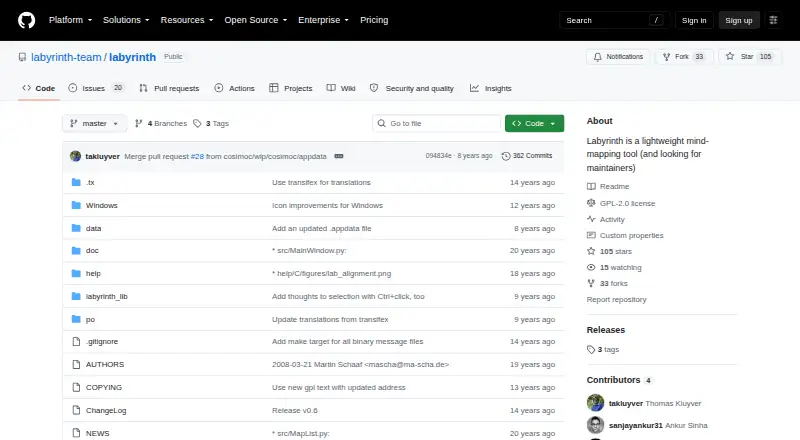
Labyrinth is a free, open-source mind-mapping tool for arranging ideas around a central thought. It runs on Linux and Windows and supports maps for generating, visualizing, structuring, and classifying ideas in study, organization, problem solving, and decision making. Maps can contain text, image, and drawing nodes; supported image formats are PNG, JPEG, and SVG. Drawing nodes provide a place for simple line diagrams inside the map. You can create and move thoughts, then create, strengthen, weaken, or delete links between them. Maps save automatically under `$XDG_DATA_HOME/labyrinth/`. The project is written in Python and uses GTK and Cairo for drawing. Listed requirements include Python 2.6 or later, gtk+, pygtk, pygobject, pycairo, and PyXDG. Labyrinth is released under GNU GPL version 2 or later. The repository says nobody is actively maintaining it and invites discussion about taking over the project through an issue. Questions and contributor participation are directed to [email protected]. GitHub’s releases page contains no releases.
Who it suits
It suits Linux or Windows users who need a simple map of connected text, images, and sketches. It may also interest contributors willing to discuss future maintenance.
What it does well
- Text, image, and drawing nodes
- PNG, JPEG, and SVG image support
- Links can be strengthened or weakened
- Automatic map saving
- GNU GPL version 2 or later
What to know first
- No active maintenance
- GitHub lists no releases
- Requires legacy Python and GTK dependencies
Verdict
Labyrinth covers core mind-mapping tasks with automatic saving and built-in sketch nodes. Its unmaintained status, dependency requirements, and lack of repository releases are important before adoption.
Facts from Labyrinth's own pages
- Drawing
- Drawing nodes let users sketch simple line diagrams inside a map. · github.com, 12 Oct 2026
- Intended use
- The project describes mind maps as a way to generate, visualize, structure, and classify ideas and support study, organization, problem solving, and decision making. · github.com, 12 Oct 2026
- License
- The software is released under the GNU GPL version 2 or later. · github.com, 12 Oct 2026
- Links
- Users can create, strengthen, weaken, and delete links between thoughts. · github.com, 5 Oct 2026
- Maintenance
- The repository says no one is actively maintaining Labyrinth and invites interested maintainers to open an issue. · github.com, 12 Oct 2026
- Map editing
- Users can create and move thoughts, link them, and strengthen or weaken links. · github.com, 12 Oct 2026
- Node types
- It provides text, image, and drawing nodes; image nodes support PNG, JPEG, and SVG files. · github.com, 12 Oct 2026
- Supported platforms
- linux,windows · github.com, 20 Sept 2026
- Product
- Labyrinth is a lightweight mind-mapping tool written in Python using Gtk and Cairo. · github.com, 12 Oct 2026
- Purpose
- Labyrinth describes itself as a lightweight mind-mapping tool for arranging ideas around a central thought. · github.com, 5 Oct 2026
- Releases
- The GitHub releases page says there are no releases. · github.com, 12 Oct 2026
- Requirements
- The README lists Python 2.6 or later, GTK+, PyGTK, PyGObject, PyCairo, and PyXDG as requirements. · github.com, 12 Oct 2026
- Saving
- Maps are saved automatically under the user's XDG data directory. · github.com, 12 Oct 2026
- Sketching
- Drawing nodes let users sketch simple line diagrams without opening a separate drawing program. · github.com, 5 Oct 2026
- Support
- The README lists [email protected] for questions and community participation. · github.com, 5 Oct 2026
- Support and contribution
- The README directs questions and contributor interest to the labyrinth-devel Google Groups mailing list. · github.com, 12 Oct 2026
- Technology
- The project says it is written in Python and uses GTK and Cairo for drawing. · github.com, 5 Oct 2026
Where Labyrinth stands on Freedom251
- Mind Mapping Software#70 of 72
- Mind mapping tools#71 of 72