Freedom251 › IaC Security Scanners
kube-score
What kube-score is
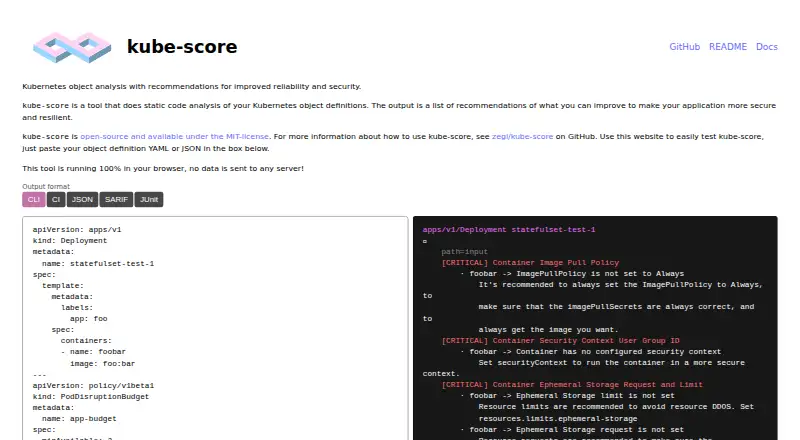
kube-score statically analyzes Kubernetes object definitions and recommends changes intended to improve application security and resilience. Its checks cover container limits, NetworkPolicy targeting, PodDisruptionBudget, Pod anti-affinity, probes, security context, and stable APIs. Optional checks include matching resource requests and limits, container ports, and seccomp profiles. The online demo accepts Kubernetes YAML or JSON and runs in the browser without sending data to a server, according to the site. For local workflows, prebuilt binaries are available for macOS, Linux, and Windows; Docker, Homebrew, and Kubernetes Krew are also installation options. The project documentation demonstrates use with Helm, Kustomize, static YAML files, Docker, and resources from a Kubernetes cluster. Output formats include human-readable, JSON, CI, and SARIF. In CI/CD, critical errors produce exit code 1, with an option to use warnings as the threshold. Tests can be ignored or enabled globally or per object. The project is free and open source under the MIT license; building from source requires Go 1.21 or later.
Who it suits
kube-score suits teams checking Kubernetes definitions during development or in CI/CD. Its browser demo may also suit people who want to analyze YAML or JSON without sending it to a server.
What it does well
- MIT-licensed and free
- Browser demo processes input without server transfer
- Supports human-readable, JSON, CI, and SARIF output
- Can run in CI/CD
What to know first
- Building from source requires Go 1.21 or later
- Results are best with all namespace applications included
Plans
| Plan | Billed and limits | Price |
|---|---|---|
| Free and open source | MIT-licensed tool; no paid plans listed | Free |
As kube-score.com lists them, read 8 Oct 2026. The maker's own page has the final word.
Getting started
- Open the online demo at https://kube-score.com/ and provide Kubernetes YAML or JSON.
- For local use, download a prebuilt binary for Linux, macOS, or Windows.
- Alternatively, install through Docker, Homebrew, or Kubernetes Krew.
- Use it with Helm, Kustomize, static YAML files, Docker, or resources retrieved from a cluster.
- Choose output format and configure tests globally or per object as needed.
kube-score is a static analyzer for Kubernetes object definitions, best suited to teams checking manifests before deployment or in CI/CD. Its configurable checks and flexible inputs suit varied workflows, while its results are strongest when related applications are analyzed together.
Overview
The project focuses on practical ways to improve the security and resilience of Kubernetes resources. Because it is MIT-licensed and free, teams can use it without a paid plan; its value depends on whether static checks fit their review process and whether they can supply enough namespace context for useful results.
Key features
Core checks cover container limits, security context, probes, stable APIs, NetworkPolicy targeting, PodDisruptionBudget and Pod anti-affinity. Optional checks add resource request-and-limit matching, container ports and seccomp profile configuration. Teams can enable optional checks or ignore tests globally or per object, making it possible to tune findings to a project’s needs. That flexibility is useful for varied deployments, though it puts responsibility on teams to decide which checks should apply.
Inputs can come from Helm, Kustomize, static YAML, Docker or resources retrieved from an existing cluster. The online demo accepts YAML or JSON, and the maker says processing happens entirely in the browser without sending data to a server. For ongoing use, prebuilt binaries cover Linux, macOS and Windows; Docker, Homebrew and Kubernetes Krew are also installation options. Building from source requires Go 1.21 or later.
In CI/CD, critical errors return exit code 1, and teams can instead set warnings as the failure threshold. Human-readable, JSON, CI and SARIF output support different consumers; SARIF is intended to simplify integration with CI platforms. This makes kube-score suitable for automated gates as well as manual review, with the chosen threshold determining how strictly a pipeline responds.
The main analysis caveat is scope: results are best when all applications deployed to the same namespace are included together. Reviewing isolated resources can therefore give a weaker picture of relationships among workloads and policies.
Pricing
Free and open source: free. The MIT-licensed tool has no paid plans, so there are no plan tiers, seat caps or trial terms to weigh. It is a straightforward fit for individuals and teams that can run and maintain the tool within their own workflows.
Platforms
kube-score is listed for Linux, macOS, Windows, self-hosted use and the web demo. Prebuilt binaries are offered for the three desktop operating systems; Docker, Homebrew and Krew provide additional installation paths.
Who it's for
Choose kube-score if you work with Kubernetes manifests and want configurable security and resilience checks before deployment, particularly if you can run it in CI/CD and analyze whole namespaces together. It is less suited to teams seeking a paid, supported service or a check that only evaluates a single isolated object without broader context.
Pros and cons
- Pro: Broad checks span resource settings, workload resilience, security context and API stability, giving teams several concrete review angles in one tool.
- Pro: Configurable checks, multiple input workflows and four output formats make it adaptable to both local review and CI pipelines.
- Pro: The browser demo runs locally in the browser according to the maker, which offers a quick way to inspect YAML or JSON without sending it to a server.
- Con: Stronger results require analyzing all applications in a namespace together, which can complicate review workflows that handle resources separately.
- Con: Building from source requires Go 1.21 or later, a setup requirement for teams that prefer not to use the prebuilt or packaged options.
Alternatives
For checks centered on Kubernetes configuration, kube-score is the direct fit among these choices. Pick kubeconform when you want a free tool focused on Kubernetes manifests; its listed platforms include Linux, macOS, self-hosted and Windows. For infrastructure policy work beyond Kubernetes, Conftest is a free, open-source option for Linux, macOS and Windows, while KICS is a free open-source option listed for Linux, macOS, self-hosted and Windows.
Readers evaluating other infrastructure checks can also consider AWS CloudFormation, cfn-lint, Chef InSpec, Cinc Auditor and OpenSCAP; each is a separate alternative with its own stated platforms and pricing model. Browse Infrastructure Testing Tools or Infrastructure as Code Security Software for more options.
Verdict
kube-score is a strong choice for Kubernetes teams that want a free, configurable static review step and can include namespace-level context in their analysis. Its checks, CI exit behavior and multiple formats support practical automation. Look elsewhere if your workflow cannot analyze related applications together or you need a paid service rather than a tool to incorporate into your own setup.
Verdict
kube-score offers configurable static checks for Kubernetes resources, with browser, local, and CI/CD workflows. For stronger results, include all applications deployed to the same namespace in the analysis.
Questions
How much does kube-score cost?
It is free and open source under the MIT license. No paid plans are listed.
Which platforms are supported?
Prebuilt binaries are listed for Linux, macOS, and Windows. The listed platforms also include self-hosted and web.
Can I use kube-score in CI/CD?
Yes. Critical errors return exit code 1, and warnings can be set as the exit threshold. CI and SARIF are supported output formats.
What can kube-score analyze?
It analyzes Kubernetes object definitions and can be used with Helm, Kustomize, static YAML files, Docker, and resources retrieved from a cluster.
Can I try it in a browser?
Yes. The online demo accepts Kubernetes YAML or JSON and runs entirely in the browser without sending data to a server.
What is required to build from source?
Building from source requires Go 1.21 or later.
Facts from kube-score's own pages
- Analysis input
- The README says results are best when input includes all applications deployed to the same namespace. · github.com, 4 Oct 2026
- Browser demo
- The website offers a browser demo for testing kube-score. · kube-score.com, 8 Oct 2026
- Browser privacy
- The maker’s website says the browser tool runs entirely in the browser and sends no data to a server. · kube-score.com, 8 Oct 2026
- Build requirement
- Building from source requires Go 1.21 or later. · github.com, 8 Oct 2026
- Checks
- Default checks include container resource settings, network policies, disruption budgets, probes, security contexts, and stable APIs. · github.com, 8 Oct 2026
- CI use
- kube-score can run in CI/CD and can exit with code 1 when it finds a critical error, or on warnings when configured to do so. · github.com, 8 Oct 2026
- Configuration
- Users can ignore tests globally or per object and enable optional tests globally or per object. · github.com, 4 Oct 2026
- Distribution
- The maker lists Docker, Homebrew, and Kubernetes Krew as installation options. · github.com, 8 Oct 2026
- Install options
- The project provides prebuilt binaries for macOS, Linux, and Windows, plus Docker, Homebrew, and Krew installation options. · github.com, 4 Oct 2026
- Integrations
- The README demonstrates use with Helm, Kustomize, static YAML files, existing clusters, and Docker. · github.com, 4 Oct 2026
- License
- The project is open source under the MIT license. · github.com, 8 Oct 2026
- Open source
- The project is available under the MIT license. · kube-score.com, 4 Oct 2026
- Optional checks
- Optional checks include matching resource requests and limits, container ports, and seccomp profile configuration. · github.com, 8 Oct 2026
- Output formats
- The CLI supports human, JSON, CI, and SARIF output formats. · github.com, 8 Oct 2026
- Platforms
- The maker lists prebuilt binaries for macOS, Linux, and Windows. · github.com, 8 Oct 2026
- Purpose
- kube-score statically analyzes Kubernetes object definitions and recommends improvements to security and resilience. · github.com, 8 Oct 2026
- Scope limit
- The documentation recommends analyzing all applications deployed to the same namespace together for the best result. · github.com, 8 Oct 2026
- Supported platforms
- Prebuilt binaries are listed for macOS, Linux, and Windows. · github.com, 4 Oct 2026
- Workflow integrations
- The documentation shows use with Helm, Kustomize, static YAML files, Docker, and resources retrieved from a Kubernetes cluster. · github.com, 8 Oct 2026
Where kube-score stands on Freedom251
- IaC Security Scanners#5 of 16
- Infrastructure Testing Tools#13 of 28
- Infrastructure as Code Security Software#15 of 22