Freedom251 › Keyboard and Mouse Customization Software
keyd
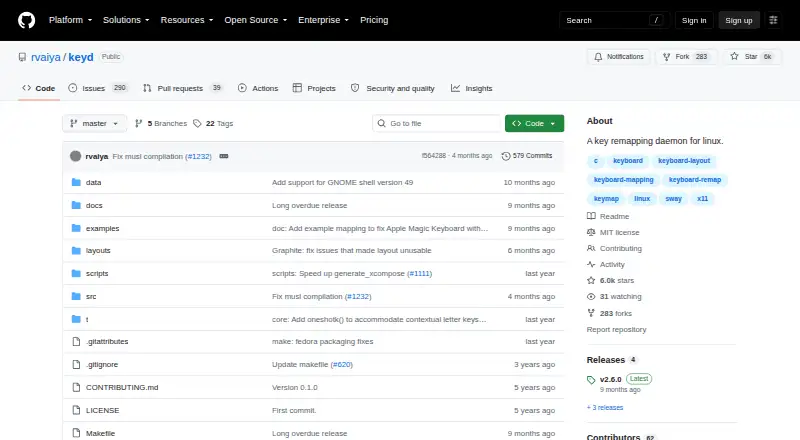
What keyd is
keyd is a free Linux daemon for remapping keyboard input system-wide. It uses kernel-level input primitives, so configurations can apply across the system and in a virtual terminal. You can define layers, hybrid modifiers, tap-versus-hold behavior, keyboard-specific layouts, macros, Unicode input, and per-application profiles. Remapping is instantaneous and does not require flashing keyboard firmware. Application-specific remapping supports X, sway, and GNOME on Wayland, although that function is experimental and may need optional Python dependencies. Packages or community packages are listed for Alpine, Arch, Debian, Fedora, Gentoo, openSUSE, Ubuntu, and Void Linux. Building from source requires a C compiler and Linux kernel headers. The project intentionally omits capabilities such as executing arbitrary executables as root. Its documentation warns that an incorrect configuration can make the machine unusable and provides a termination key sequence. keyd uses the MIT/X Consortium License.
Who it suits
keyd suits Linux users who need system-wide, layered, or keyboard-specific remapping. It is also relevant to users configuring application profiles on supported desktop environments.
What it does well
- Free Linux software
- Instant remapping without keyboard firmware flashing
- Supports layers and tap-versus-hold behavior
- Works in virtual terminals
- Includes macro and Unicode support
What to know first
- Application-specific remapping is experimental
- Source builds require compiler and kernel headers
- Bad configuration can make a machine unusable
Plans
| Plan | Billed and limits | Price |
|---|---|---|
| keyd | Linux key remapping daemon · MIT/X Consortium License | Free |
As github.com lists them, read 11 Oct 2026. The maker's own page has the final word.
Verdict
keyd offers deep Linux keyboard remapping with layers, profiles, and immediate changes. Its experimental application mode and configuration risk call for careful setup.
Facts from keyd's own pages
- Application remapping status
- Application-specific remapping is marked experimental and has optional Python dependencies. · github.com, 11 Oct 2026
- Configuration risk
- The README warns that a bad configuration can render the machine unusable and documents a key sequence to terminate keyd. · github.com, 11 Oct 2026
- Desktop support
- Application-specific remapping ships with support for X, sway, and GNOME on Wayland. · github.com, 11 Oct 2026
- Free plan
- Yes · github.com, 20 Sept 2026
- Install requirements
- Building from source requires a C compiler and Linux kernel headers. · github.com, 11 Oct 2026
- Keyboard-specific layouts
- It supports configurations specific to individual keyboards. · github.com, 11 Oct 2026
- Layers
- It supports layers, including hybrid modifiers. · github.com, 11 Oct 2026
- License
- The software is distributed under the MIT/X Consortium License. · github.com, 11 Oct 2026
- Live remapping
- The README describes remapping as instantaneous and says it does not require flashing keyboard firmware. · github.com, 11 Oct 2026
- Macro support
- Yes · github.com, 20 Sept 2026
- Per-app profiles
- Yes · github.com, 20 Sept 2026
- Purpose
- keyd is a system-wide Linux daemon for remapping keys using kernel-level input primitives. · github.com, 11 Oct 2026
- Security limitation
- The project intentionally omits features such as executing arbitrary executables as root. · github.com, 11 Oct 2026
- Support
- The README directs users to file GitHub issues for missing features or bugs and lists the #keyd IRC channel on OFTC. · github.com, 11 Oct 2026
- Supported distributions
- The README lists packages or community-maintained packages for Alpine, Arch, Debian, Fedora, Gentoo, openSUSE, Ubuntu, and Void Linux. · github.com, 11 Oct 2026
- Supported operating systems
- linux · github.com, 20 Sept 2026
- System-wide operation
- System-wide configuration works in a virtual terminal (VT). · github.com, 11 Oct 2026
- Tap and hold
- Keys can have different behavior when tapped or held. · github.com, 11 Oct 2026
- Unicode
- The listed features include Unicode support. · github.com, 11 Oct 2026