Freedom251 › Artifact repository software
Kellnr
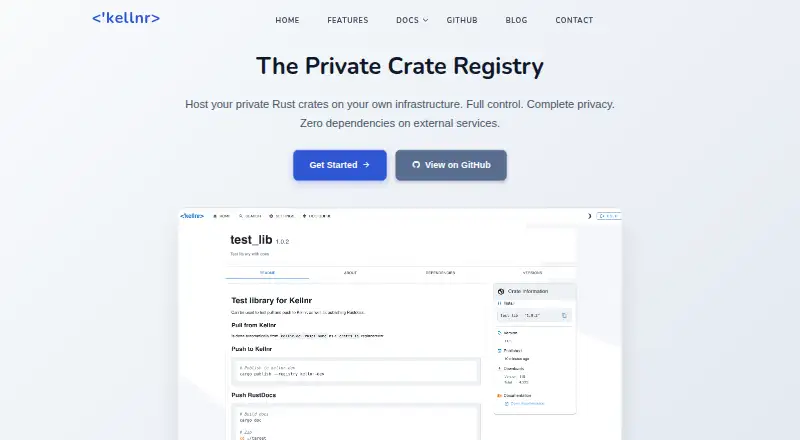
What Kellnr is
Kellnr is a private Rust crate registry that organizations can run on their own infrastructure to manage dependencies. Teams can publish private crates using standard Cargo commands, while its crates.io proxy caches upstream packages and can serve them offline after they have been cached. Kellnr can generate and serve rustdocs for uploaded crates or accept pre-built documentation. Access controls include roles, groups, API tokens, crate ownership, and optional authentication for crate downloads. OAuth2 and OpenID Connect support includes Authentik, Keycloak, Okta, Azure AD, and other compliant providers. A REST API, interactive API documentation, and webhooks support integrations such as CI/CD pipelines and chat systems. Storage choices include local filesystem, AWS S3, Google Cloud Storage, MinIO, and compatible services; database options are SQLite and PostgreSQL. Releases include CycloneDX SBOMs with license information, checksums, and package URLs. Documented deployment options include Docker, Kubernetes with Helm, bare metal, Cargo, and the Arch User Repository. Kellnr is free and MIT-licensed. Pre-built binaries are listed for Linux, Windows, and Apple Silicon macOS, though Windows binaries are described as untested and best-effort.
Who it suits
Kellnr suits organizations that want to host private Rust crates and manage dependencies on their own infrastructure. It is relevant to teams using Cargo and needing repository access controls or upstream caching.
What it does well
- Private crates publish through standard Cargo commands.
- Cached crates.io packages can be used offline.
- Supports OAuth2 and several OIDC providers.
- Storage and database choices include multiple options.
- Free and MIT-licensed.
What to know first
- Windows binaries are untested and best-effort.
- Toolchain download endpoints do not support authentication.
- No commercial version is offered.
Limits
Kellnr is free and open source under the MIT license. Its toolchain download endpoints do not support authentication, and the listed Windows binaries are not tested and are provided on a best-effort basis.
Plans
| Plan | Billed and limits | Price |
|---|---|---|
| Free and open source | Self-hosted Rust crate registry · MIT licensed | Free |
As kellnr.io lists them, read 11 Oct 2026. The maker's own page has the final word.
Getting started
- Open the Kellnr website and choose a deployment route: Docker, Kubernetes with Helm, bare metal, Cargo, or the Arch User Repository.
- Set up a supported storage option and SQLite or PostgreSQL database.
- Configure users, roles, groups, API tokens, crate ownership, and download authentication as needed.
- Connect an OAuth2 or OpenID Connect identity provider if required.
- Publish crates with standard Cargo commands and configure the crates.io proxy if needed.
Kellnr is a self-hosted private registry for Rust crates and organizational dependencies. It best fits Rust teams that need package control on infrastructure they operate, while teams distributing sensitive toolchains should weigh its unauthenticated download endpoints. The no-cost MIT-licensed model is compelling, provided you are prepared to run the service yourself.
Overview
Kellnr combines private crate hosting with a proxy for crates.io. Developers publish and consume packages with standard Cargo commands, and the proxy keeps upstream crates cached so builds can continue offline after those packages have been retrieved. That is useful for controlled or intermittently connected environments, while remaining focused on Rust rather than serving as a broad, multi-ecosystem artifact platform.
As a self-hosted service founded in 2021, Kellnr leaves infrastructure ownership, upgrades, and operational responsibility with your organization. Its MIT license and absence of a current commercial edition remove licensing fees, but there is no vendor-hosted tier to avoid that work.
Key features
Crates and documentation
Private crate publishing uses familiar Cargo workflows. Kellnr can generate and serve rustdocs for uploaded crates, or host documentation built elsewhere, giving developers reference material alongside each internal package.
Access and identity
Roles, groups, API tokens, crate ownership, and optional authentication for crate downloads provide granular ways to control who can publish or retrieve packages. OAuth2 and OpenID Connect integration covers Authentik, Keycloak, Okta, Azure AD, and other compliant identity providers, making it suitable for organizations with an existing single-sign-on system.
Automation and supply-chain data
A REST API, interactive API documentation, and webhooks support CI/CD and chat integrations without forcing teams to automate through the web interface. Every release includes a CycloneDX SBOM with dependency license information, cryptographic checksums, and package URLs, which helps with inventory and review of what enters the registry.
Storage and deployment
You can store packages on a local filesystem, AWS S3, Google Cloud Storage, MinIO, or another S3-compatible service. SQLite and PostgreSQL are supported databases, allowing a small installation to start simply and a larger deployment to use PostgreSQL. Documented deployment paths include Docker, Kubernetes with Helm, bare metal, Cargo, and the Arch User Repository, so the service can fit containerized, cluster-based, or host-managed operations.
The major security limitation concerns toolchains rather than crates: Kellnr's rustup-compatible distribution server does not authenticate download endpoints. Do not use that channel for toolchains requiring access restriction unless you can accept public downloads.
Pricing
Free and open source — free (self-hosted Rust crate registry, MIT licensed). This is the sole published plan. It suits teams willing to provide their own hosting and support processes; there are no paid upgrades, seat charges, usage quotas, or commercial edition to buy. The trade-off is that infrastructure, maintenance, and troubleshooting remain internal, with questions and bug reports directed to GitHub Issues and community discussion to GitHub Discussions.
Platforms
Kellnr supports API, Linux, macOS, self-hosted, web, and Windows environments. Pre-built binaries are documented for Linux, Windows, and Apple Silicon macOS, but Windows binaries are explicitly untested and supplied on a best-effort basis. Linux or Apple Silicon macOS deployments therefore offer a clearer operational footing than Windows. Deployment through Docker, Kubernetes with Helm, bare metal, Cargo, or the Arch User Repository adds flexibility beyond the binary packages.
Who it's for
Kellnr is a strong fit for Rust organizations that require private package hosting, crates.io caching, offline resilience, internal identity integration, and control over storage location. It also suits teams that want registry events in CI/CD or chat systems and need SBOM and checksum data for supply-chain review.
It is less suitable for organizations seeking a managed service, a general-purpose repository for many package ecosystems, or authenticated private toolchain downloads. Teams standardizing on Windows should also account for the best-effort status of its Windows binaries.
Pros and cons
Pros
- No license cost: The only plan is free and MIT licensed, with no published seat or quota limits.
- Offline-friendly upstream caching: Cached crates.io packages can remain usable without an upstream connection.
- Strong identity controls: Roles, groups, tokens, ownership, optional download authentication, and broad OIDC support cover common enterprise access patterns.
- Deployment choice: Filesystem or object storage, SQLite or PostgreSQL, and several installation methods let teams match existing infrastructure.
- Automation and provenance: REST, webhooks, SBOMs, checksums, and package URLs support integrated and auditable workflows.
Cons
- Self-hosting burden: Your organization supplies operations, capacity, upgrades, and support.
- Unauthenticated toolchain downloads: The rustup-compatible server cannot enforce access control on those endpoints.
- Windows uncertainty: Published Windows binaries are not tested and are provided on a best-effort basis.
- Rust-specific scope: It is not positioned as a broad artifact repository for unrelated ecosystems.
Alternatives
For a wider comparison, see Artifact repository software.
Choose Cloudsmith instead if you want a freemium hosted option with a free open-source plan that includes 50 GB of artifact data, 200 GB of package delivery, and a public repository.
Gemfury is the alternative for a freemium service whose free plan allows unlimited collaborators and public packages but no private packages.
Pick Sonatype Nexus Repository if you need a repository product with a free Community Edition, full ecosystem support, CI/CD integration, and an external PostgreSQL option.
Azure Test Plans is aimed at test planning rather than a Rust crate registry, with its Basic + Test Plans tier priced at $52 per user per month.
Buildkite is a CI-oriented alternative; its free plan covers up to five users, 10 concurrent jobs, and 2,000 Linux vCPU minutes monthly.
Inedo ProGet suits teams wanting unlimited private package and Docker feeds in a free edition, with limited security and compliance features.
Nexspence is a free-forever option with no license fees and a separate 5.00 USD-per-month supporter tier.
Packagecloud is a hosted freemium choice whose free plan includes 10 GB bandwidth, 2 GB storage, and unlimited CI/CD minutes.
Verdict
Choose Kellnr if you run Rust projects and want a free, MIT-licensed registry under your own control, with upstream caching, enterprise identity options, flexible storage, and automation hooks. Look elsewhere for managed operations, broader package-ecosystem coverage, or authenticated distribution of private Rust toolchains.
Verdict
Kellnr provides self-hosted crate management, upstream caching, access controls, and deployment flexibility at no charge. Teams should account for the stated limits on Windows binaries and unauthenticated toolchain downloads.
Questions
How much does Kellnr cost?
The Free and open source plan is listed as free. Kellnr is MIT-licensed.
Can Kellnr be self-hosted?
Yes. It is a private registry for an organization’s own infrastructure, with deployment options including Docker, Kubernetes with Helm, bare metal, Cargo, and the Arch User Repository.
Which platforms are supported?
Kellnr lists API, Linux, macOS, self-hosted, web, and Windows. Pre-built binaries are listed for Linux, Windows, and Apple Silicon macOS.
Can Kellnr cache crates.io packages?
Yes. Its proxy caches crates from crates.io and can work offline once packages are cached.
Which identity providers does it support?
OAuth2 and OpenID Connect support includes Authentik, Keycloak, Okta, Azure AD, and other OIDC-compliant providers.
How can users get support?
The contact page directs bug reports, feature requests, and questions to GitHub Issues, and community discussion to GitHub Discussions.
Facts from Kellnr's own pages
- Access control
- User roles, groups, API tokens, crate ownership, and optional authentication for crate downloads are supported. · kellnr.io, 11 Oct 2026
- Automation
- Kellnr provides a REST API, interactive API documentation, and webhooks for integrations such as CI/CD pipelines and chat systems. · kellnr.io, 11 Oct 2026
- Crate hosting
- It supports private crate hosting and publishing with standard Cargo commands. · kellnr.io, 11 Oct 2026
- Crates.io proxy
- Its proxy caches crates from crates.io and can work offline once crates are cached. · kellnr.io, 11 Oct 2026
- Deployment
- Documented deployment options include Docker, Kubernetes with Helm, bare metal, Cargo, and the Arch User Repository. · kellnr.io, 11 Oct 2026
- Documentation
- Kellnr can generate and serve rustdocs for uploaded crates, and supports uploading pre-built rustdocs. · kellnr.io, 11 Oct 2026
- Founded
- 2021 · kellnr.io, 28 Sept 2026
- Identity integrations
- OAuth2/OpenID Connect support includes Authentik, Keycloak, Okta, Azure AD, and other OIDC-compliant providers. · kellnr.io, 11 Oct 2026
- License and commercial offering
- Kellnr is available under the MIT license; its maker says the former commercial Professional license ended and there is no longer a commercial version. · kellnr.io, 11 Oct 2026
- Platform limits
- The documentation lists pre-built binaries for Linux, Windows, and Apple Silicon macOS; it says Windows binaries are not tested and are provided on a best-effort basis. · kellnr.io, 11 Oct 2026
- Purpose
- Kellnr is a private Rust crate registry for managing an organization’s Rust dependencies on its own infrastructure. · kellnr.io, 11 Oct 2026
- Security
- Each release includes a CycloneDX SBOM with dependency license information, cryptographic checksums, and package URLs. · kellnr.io, 11 Oct 2026
- Storage and databases
- Storage options include local filesystem, AWS S3, Google Cloud Storage, MinIO, and S3-compatible services; database options include SQLite and PostgreSQL. · kellnr.io, 11 Oct 2026
- Support
- The contact page directs users to GitHub Issues for bugs, feature requests, or questions and GitHub Discussions for community discussion. · kellnr.io, 11 Oct 2026
- Toolchain distribution
- Kellnr can host private Rust toolchains through a rustup-compatible distribution server, but its toolchain download endpoints do not support authentication. · kellnr.io, 11 Oct 2026
Where Kellnr stands on Freedom251
- Artifact repository software#19 of 64