Freedom251 › OT and ICS Security Monitoring Software
Kaspersky Industrial CyberSecurity Platform
Visit Kaspersky Industrial CyberSecurity Platform Alternatives Pricing
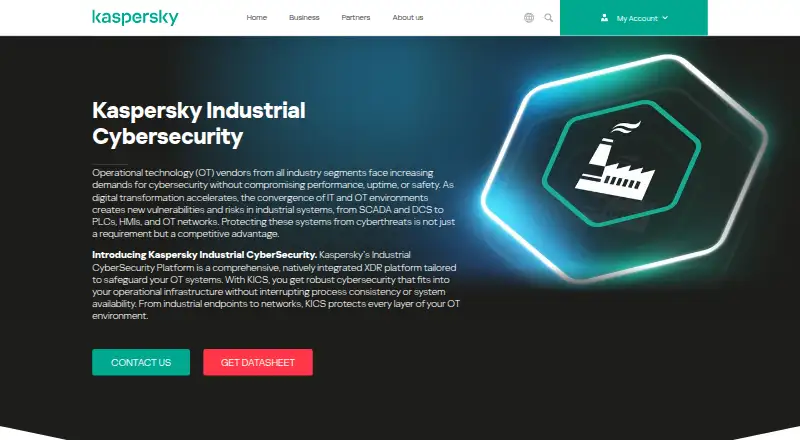
What Kaspersky Industrial CyberSecurity Platform is
Kaspersky Industrial CyberSecurity Platform is an XDR platform for protecting critical infrastructure and industrial OT and IoT environments. It covers converged, distributed, air-gapped, and legacy systems, with Linux, Windows, and web platforms and on-premises deployment. KICS tracks connected devices and configurations, maps networks, and analyzes data flows. It assesses vulnerabilities and security-setting changes on hosts, network devices, and controllers, while security audits include vulnerability scans, compliance checks, and configuration-change monitoring. Detection and response features connect host and network activity into incidents, provide investigation graphs and alert enrichment, and support manual response actions and network-access restriction. Asset management includes host monitoring, hardware and application inventories, and coverage of blind areas in spanless mode. The platform is designed to preserve process integrity and system availability while minimizing false detections. It supports passive monitoring, OT asset discovery, and SIEM integration, and is compatible with more than 200 industrial control systems and devices. Kaspersky lists certified integrations with systems including AVEVA, GE Cimplicity, and Schneider Electric EcoStruxure. Pricing is available on request.
Who it suits
KICS is aimed at industrial enterprises, including those in oil and gas, power and utilities, metals and mining, and manufacturing. Its stated coverage includes legacy, air-gapped, and distributed OT and IoT environments.
What it does well
- Covers air-gapped, legacy, and distributed OT and IoT environments.
- Compatible with more than 200 industrial control systems and devices.
- Includes passive monitoring, OT asset discovery, and SIEM integration.
- Provides vulnerability scanning and compliance auditing.
- Premium support is offered in over 200 countries.
What to know first
- Deployment is on premises.
- Pricing is available only on request.
Limits
The enterprise OT/IoT plan has no listed price; contact sales or request a demo. Deployment is on premises.
Plans
| Plan | Billed and limits | Price |
|---|---|---|
| Kaspersky Industrial CyberSecurity Platform | enterprise OT/IoT environments · request a demo/contact sales | On request |
| Kaspersky Industrial CyberSecurity directory listing | Contact vendor for pricing · No free version · No free trial | On request |
| KICS for Networks annual updates, year 1 | Annual updates · Signatures, rules, anti-APT and custom updates · 24/7 support · Analyst content | On request |
| KICS for Networks annual updates, years 2-3 | Annual updates · Signatures, rules, anti-APT and custom updates · 24/7 support · Analyst content | On request |
| KICS for Networks perpetual license | Perpetual license · Software deployed as servers and sensors · KICS for Networks | On request |
As kaspersky.com lists them, read 30 Sept 2026. The maker's own page has the final word.
Getting started
- Visit https://www.kaspersky.com/kics.
- Contact sales or request a demo for the enterprise OT/IoT plan.
- Deploy the platform on premises.
- Review supported industrial systems, devices and protocols for your environment.
Kaspersky Industrial CyberSecurity Platform is an on-premises XDR platform for protecting industrial control and IoT environments. It is best suited to organizations that need asset visibility, security auditing and response across complex or air-gapped OT networks. Its broad coverage is a strong fit for critical infrastructure, though custom pricing and on-premises deployment make it an enterprise purchase to evaluate carefully.
Overview
KICS combines monitoring, risk assessment, security audits and incident response across converged, distributed, legacy and air-gapped OT and IoT environments. It tracks devices and configurations, maps network relationships and analyzes data flows, giving industrial security teams a way to investigate activity across hosts and networks.
Its focus on operational continuity matters in plants where security controls must not compromise process integrity or availability. KICS is designed to minimize false detections while protecting performance. Kaspersky says the platform is compatible with more than 200 industrial control systems and devices, and reports more than 1,000 industrial customers worldwide and over 240,000 licenses shipped.
Key features
- Asset visibility: Hardware and application inventory, extended host monitoring and spanless-mode coverage of blind areas help teams build a fuller picture of industrial assets. Passive monitoring and OT asset discovery support visibility without requiring active disruption.
- Threat detection and response: XDR features bring host and network activity into single incidents, with an investigation graph and alert enrichment to support root-cause analysis. Manual response actions and network-access restriction give teams ways to contain threats, while safe response measures address the risks of intervention in live environments.
- Security auditing: Vulnerability scanning, compliance auditing and configuration-change monitoring help teams identify exposure and track changes to hosts, network devices and controllers.
- Industrial compatibility: Supported protocols include ABB SPA-Bus, Allen-Bradley EtherNet/IP, BACnet, BECKHOFF ADS/AMS and CODESYS V2/V3. Certified integrations include AVEVA, GE Cimplicity, Schneider Electric EcoStruxure, Mitsubishi Electric controllers and Kaspersky Security Center 13. SIEM integration is supported.
- Integration options: The OEM licensing program supports API connections to third-party apps, add-on distribution, white-labeling and customization. That flexibility can suit vendors and integrators as well as end-user security teams.
Pricing
KICS is a paid platform with custom pricing. Its single named plan, Kaspersky Industrial CyberSecurity Platform, is intended for enterprise OT and IoT environments and requires a demo request or sales contact. No seat or usage caps are given. The on-premises model means buyers should assess deployment requirements alongside the quote; organizations looking for self-service pricing or a free KICS tier should look elsewhere.
Platforms
KICS is deployed on premises and supports Linux, web and Windows. That deployment model suits organizations that need local control in industrial environments, including air-gapped sites, but is less suited to buyers seeking a SaaS-only service.
Who it's for
KICS is aimed at oil and gas, power and utilities, metals and mining, manufacturing and other industrial enterprises. It is particularly relevant where teams need to monitor mixed or legacy infrastructure, assess configuration and vulnerability risks, and respond across host and network activity without compromising operational continuity. Kaspersky also offers premium support in more than 200 countries from certified engineers, which may matter to globally distributed operators.
Pros and cons
Pros
- Broad OT and IoT visibility: Device tracking, inventory, network graphs and blind-area coverage address the asset-awareness challenge in complex industrial estates.
- Response and audit in one platform: Investigation and containment features sit alongside vulnerability and compliance auditing, serving teams that need both preventive review and incident handling.
- Industrial focus: Compatibility with more than 200 control systems and devices and a design centered on process integrity make it relevant to production environments.
- Flexible ecosystem: Certified integrations, SIEM support and OEM API options can fit existing systems or third-party offerings.
Cons
- Custom pricing: Buyers must contact sales to establish cost, making quick budget comparisons harder.
- On-premises deployment: This supports local and air-gapped environments but excludes organizations seeking a cloud-only deployment model.
Alternatives
- Nozomi Networks Platform is worth considering if a free plan is important: Nozomi Vantage SaaS costs nothing and is cloud-hosted security infrastructure used to license hardware and Guardian nodes.
- EmberOT offers a free OT PCAP Analyzer for device and protocol breakdown; downloading it requires a valid school or business email.
- Honeywell Forge is another paid option, with product-specific offerings and term-based licensing and feature choices for Advanced Process Control.
- FactoryTalk Analytics is another paid industrial analytics option to compare.
- OTDefend uses custom solutions with pricing tailored to the buyer's needs.
- Radiflow iSID requires a demo request or contact with Radiflow for pricing.
- Claroty CTD is an on-premises option focused on federal OT cybersecurity controls and mobile flyaway kits.
- Claroty xDome offers a modular SaaS platform with pricing by sales inquiry.
- OT and ICS Security Monitoring Software and File Integrity Monitoring Software provide category directories for comparing other tools.
Verdict
KICS is a strong candidate for industrial operators that need on-premises visibility, auditing and XDR response across varied or air-gapped OT and IoT assets. Its industrial compatibility and emphasis on continuity are compelling reasons to consider it. Look elsewhere if you need transparent pricing or a cloud-only product.
Verdict
KICS combines industrial asset visibility, security auditing, and XDR response features for critical infrastructure environments. Its on-premises deployment and pricing-on-request model are key details to consider before pursuing a demo or sales contact.
Questions
How much does KICS cost?
Pricing is available on request.
Which platforms does KICS support?
The listed platforms are Linux, web and Windows.
Can KICS monitor OT assets passively?
Yes. Passive monitoring and OT asset discovery are supported.
Does KICS integrate with SIEM systems?
Yes, SIEM integration is supported.
Where can KICS be deployed?
Deployment is on premises.
Which industrial integrations are listed?
Certified integrations include AVEVA, GE Cimplicity, Schneider Electric EcoStruxure, Mitsubishi Electric controllers and Kaspersky Security Center 13.
Facts from Kaspersky Industrial CyberSecurity Platform's own pages
- API and OEM options
- The OEM licensing program supports API integration with third-party apps, distribution as add-ons, and white-labeling or customization. · kaspersky.com, 30 Sept 2026
- Asset management
- Multiple collection methods automatically inventory industrial assets and their configurations. · usa.kaspersky.com, 15 Oct 2026
- Central management
- A centralized management approach handles OT risks, policies and assets and supports active and passive endpoint and network audits. · usa.kaspersky.com, 15 Oct 2026
- Certifications
- Kaspersky states that it has attained IEC62443-4-1, ISO27001 and SOC2 Type II certifications for KICS. · kaspersky.com, 30 Sept 2026
- Certified integrations
- Kaspersky lists interoperability with systems from Aveva, Schneider, Siemens, Emerson, Yokogawa, Mitsubishi, Valmet and others, including an IEC 62443 certificate entry. · kaspersky.com, 15 Oct 2026
- Company profile
- LinkedIn lists Kaspersky as privately held, founded in 1997, headquartered in Zurich and employing 5,001–10,000 people. · linkedin.com, 15 Oct 2026
- Compatibility
- The KICS Platform is compatible with more than 200 industrial control systems and devices. · kaspersky.com, 30 Sept 2026
- Detection and response
- XDR features include single host-network incidents, an investigation graph, alert enrichment, manual response actions and network-access restriction. · kaspersky.com, 30 Sept 2026
- Documentation depth
- The help center documents deployment, sensors, monitoring points, topology, incidents, roles, audit logs, reports, updates, SIEM and Kaspersky Security Center integration. · support.kaspersky.com, 15 Oct 2026
- Endpoint protection
- KICS for Nodes provides low-impact malware protection, detection and response for Linux and Windows endpoints, including device and application control. · usa.kaspersky.com, 15 Oct 2026
- Environment coverage
- The platform protects converged, distributed, air-gapped and legacy OT and IoT environments. · kaspersky.com, 30 Sept 2026
- Founded
- 1997 · kaspersky.com, 28 Sept 2026
- Geographic limit
- A June 20, 2024 Axios report says U.S. Commerce barred new Kaspersky sales from July 20, 2024 and software updates to existing U.S. customers after September 29, 2024, citing national-security concerns that Kaspersky disputed. · axios.com, 15 Oct 2026
- Google Play availability
- Google terminated Kaspersky's developer account and removed its apps globally in October 2024; installed apps could continue updating but could not be updated or reinstalled through Play. · kaspersky.com, 15 Oct 2026
- Historical Gartner rating
- Kaspersky's blog reports Gartner Peer Insights rated its Industrial Cybersecurity solution 4.7 out of 5 from 74 reviews with 95% recommending it as of November 1, 2020. · blog.kaspersky.co.jp, 15 Oct 2026
- Infrastructure visibility
- KICS tracks connected devices and configurations, builds network graphs and analyzes data flows. · kaspersky.com, 30 Sept 2026
- Integrations
- KICS has certified integrations with systems including AVEVA, GE Cimplicity, Schneider Electric EcoStruxure, Mitsubishi Electric controllers and Kaspersky Security Center 13. · kaspersky.com, 30 Sept 2026
- Legal and ownership facts
- Crunchbase identifies AO Kaspersky Lab as the legal name, founded in 1997, privately held, with Eugene Kaspersky and Evgeny Preobrazhensky listed as founders and General Atlantic as an investor. · crunchbase.com, 15 Oct 2026
- Limit: protocol and filesystem coverage
- Linux Nodes anti-cryptor protection supports SMB1/2/3 and NFS3, while some NFS, pseudo-filesystem, container and large-file cases can be delayed or missed. · support.kaspersky.com, 15 Oct 2026
- Limit: Trustpilot complaints
- Repeated complaints concern slow or ineffective support, VPN failures, subscription and activation problems, and connectivity issues. · trustpilot.com, 15 Oct 2026
- Limit: upgrade path
- Linux Nodes 1.2 cannot be upgraded in place; the prior version must be uninstalled before installation. · support.kaspersky.com, 15 Oct 2026
- Linux Nodes requirements
- Linux Nodes requires at least a Core2 Duo 1.86 GHz processor, 1 GB swap, 1 or 2 GB RAM depending on architecture and 4 GB disk. · support.kaspersky.com, 15 Oct 2026
- Network detection
- KICS for Networks performs device-agnostic OT traffic analysis, anomaly detection and response as a site-level central server. · usa.kaspersky.com, 15 Oct 2026
- Network visibility
- KICS supplies communications maps, topology diagrams and inspection of rogue-host traffic. · usa.kaspersky.com, 15 Oct 2026