Freedom251 › Formal Verification Tools
K Framework
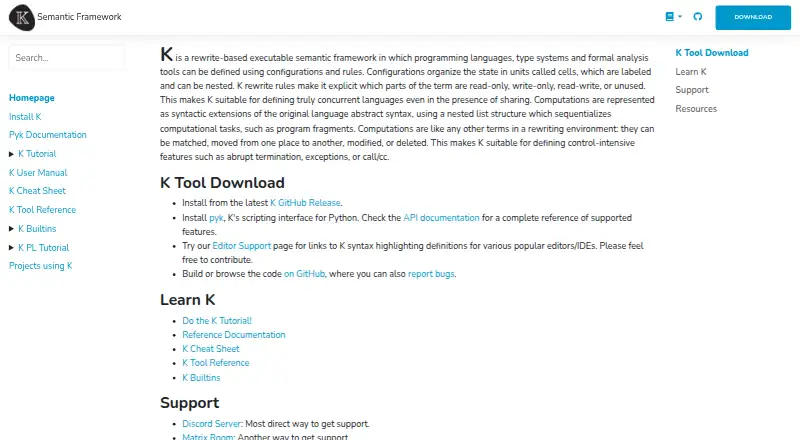
What K Framework is
K Framework is a free, self-hosted framework for defining programming languages, type systems, and formal analysis tools. Specifications organize program state in labeled, nestable configuration cells, while rewrite rules describe how terms change. From one semantic specification, K derives language tools. Its command-line suite supports compilation, concrete or symbolic execution, and theorem-proving analysis; the main tools are kompile, kparse, krun, and kprove. Rules can mark term regions as read-only, write-only, read-write, or unused, which supports defining concurrent languages with sharing. The project describes pyk as a Python scripting interface and lists editor support for Atom, BBEdit/TextWrangler, Emacs, IntelliJ IDEA, Notepad++, Pygments, Vim, and Visual Studio Code. Installation guidance covers Ubuntu 22.04, macOS Ventura 13 through Homebrew, GitHub releases, the kup command, and Docker images. Native Windows is unsupported, with WSL 2 recommended. K requires Z3 version 4.8.15.
Who it suits
K suits language designers, verification practitioners, and developers working with formal specifications and theorem proving. It is self-hosted and command-line oriented rather than a GUI tool.
What it does well
- Free and self-hosted
- Derives tools from one specification
- Concrete and symbolic execution
- Theorem-proving analysis
- Python scripting interface
What to know first
- Native Windows unsupported
- Requires Z3 4.8.15
- GUI tools are not provided
- Documentation is still under construction
Verdict
K provides a specification-driven route to executable language tools and formal analysis. Its command-line workflow and platform, dependency, and documentation constraints should be considered before adoption.
Facts from K Framework's own pages
- Command line
- The project README says K users should be comfortable with the command line and that GUI tools are not provided. · github.com, 9 Oct 2026
- Concurrency
- The site says K's rules make read and write access explicit, which supports defining concurrent languages with shared state. · kframework.org, 9 Oct 2026
- Configurations and rules
- K configurations organize program state into labeled, nestable cells, and rewrite rules describe how terms change. · kframework.org, 9 Oct 2026
- Control flow
- K represents computations as terms that can be matched, moved, modified, or deleted, supporting features such as exceptions and abrupt termination. · kframework.org, 9 Oct 2026
- Core tools
- The manual identifies kompile, kparse, krun, and kprove as its main user-facing tools. · kframework.org, 8 Oct 2026
- Dependency requirement
- K requires Z3 version 4.8.15; the installation page says other versions are unsupported and may cause incorrect behavior or performance issues. · github.com, 8 Oct 2026
- Docker
- The installation instructions provide Docker images with K pre-installed. · github.com, 8 Oct 2026
- Documentation status
- The K User Manual says it is still under construction and some features may have partial or missing documentation. · kframework.org, 8 Oct 2026
- Editor integrations
- The editor support page lists syntax support or plugins for Atom, BBEdit/TextWrangler, Emacs, IntelliJ IDEA, Notepad++, Pygments, Vim, and Visual Studio Code. · kframework.org, 8 Oct 2026
- Editor support
- The official site links to editor syntax highlighting support for popular editors and IDEs. · kframework.org, 9 Oct 2026
- Execution and analysis
- K’s command-line tools support compiling, running concrete or symbolic executions, and analyzing specifications through theorem proving. · kframework.org, 8 Oct 2026
- Generated tools
- A K language definition can provide tools such as a parser, interpreter, state-space explorer, and deductive program verifier. · kframework.org, 9 Oct 2026
- Headquarters
- The K site lists the address 202 S Broadway Ave #31, Urbana, IL. · kframework.org, 8 Oct 2026
- Installation
- The official site directs users to install K from GitHub releases and provides a `kup` installation command. · github.com, 9 Oct 2026
- Known limitation
- The FAQ says K does not provide explicit support for metamodel technologies such as EMF. · kframework.org, 9 Oct 2026
- Maker and founding
- Runtime Verification says it was founded in 2010 by Grigore Rosu, and that it released the K Framework in 2014. · runtimeverification.com, 8 Oct 2026
- Purpose
- K is a rewrite-based executable semantic framework for defining programming languages, type systems, and formal analysis tools. · kframework.org, 9 Oct 2026
- Python interface
- pyk is K's scripting interface for Python and has API documentation. · kframework.org, 9 Oct 2026
- Support
- The official site lists Discord as its most direct support channel and also links to a Matrix room. · kframework.org, 9 Oct 2026
- Supported installation platforms
- The installation page lists Ubuntu Jammy 22.04 and macOS Ventura 13 via Homebrew, and says K is not currently supported natively on Windows. · github.com, 8 Oct 2026
- Supported systems
- The installation guide lists Ubuntu 22.04, macOS via Homebrew, and Docker images; it says native Windows is not supported and recommends WSL 2. · github.com, 9 Oct 2026
- Use cases
- The official site links to projects using K, including examples and tools based on K definitions. · kframework.org, 9 Oct 2026
Where K Framework stands on Freedom251
- Formal Verification Tools#18 of 34