Freedom251 › Formal Verification Tools
HOL Light
What HOL Light is
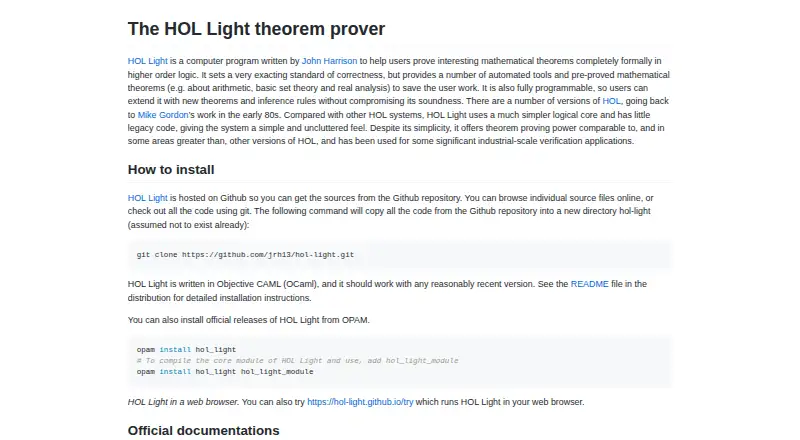
HOL Light is a computer program for formally proving mathematical theorems in higher-order logic. It combines interactive theorem proving with proof checking, using a logical core intended to support exact reasoning about correctness. The system is fully programmable: users can add theorems and inference rules while preserving soundness. Its library includes automated tools and previously proved theorems in arithmetic, basic set theory and real analysis.
HOL Light is written in OCaml and is usually used through the OCaml read-eval-print loop. A browser version is linked from its official site. Installation options include OPAM, building from source and a hol-light package for Debian-based distributions. The tutorial covers Linux, macOS package managers and Windows environments through WSL or Cygwin; the README also mentions native Windows support in some configurations. Package-manager versions may be out of date, while building from source provides the latest features. A documented VS Code extension offers a REPL connection, proof-step controls, goal display, code completion, navigation, hover information and interactive notebooks. The site also links to a tutorial, reference manual, HOW-TO guide and HOL Light Zulip Chat. Applications cited include Flyspeck, AWS s2n-bignum and floating-point verification work at Intel.
Who it suits
HOL Light suits people who need to prove or check mathematical theorems in higher-order logic and are comfortable working with OCaml. Its programmable extensions, existing theorem library and editor support can also suit users building formal verification work.
What it does well
- Free to use.
- Includes automated tools and pre-proved theorems in several mathematical areas.
- Users can add theorems and inference rules while preserving soundness.
- Offers a browser version and installation routes including OPAM and source.
- VS Code extension includes a REPL connection and interactive notebooks.
- Tutorial, reference manual, HOW-TO guide and Zulip Chat are available.
What to know first
- The usual interaction environment is the OCaml read-eval-print loop.
- Package-manager versions may be out of date.
- Windows instructions focus on WSL or Cygwin, with native support noted for some configurations.
Getting started
- Open the HOL Light website and choose the browser version, or follow its installation instructions.
- Install through OPAM, build from source, or use the hol-light package on a Debian-based distribution.
- For Windows, follow the tutorial’s WSL or Cygwin route, or consult the README’s native support notes for some configurations.
- Use the OCaml read-eval-print loop to interact with HOL Light.
- Optionally use the documented VS Code extension for REPL and editor features.
Verdict
Choose HOL Light if you need an interactive theorem prover and proof checker for higher-order logic, with a programmable system and existing mathematical resources. Look elsewhere if you need a tool that does not rely on OCaml or its read-eval-print loop as the usual working environment.
Questions
Is HOL Light free?
Yes. It has a free plan.
Which platforms does HOL Light support?
Its listed platforms are Linux, macOS, self-hosted, web and Windows. The tutorial discusses Linux, macOS package managers, and Windows through WSL or Cygwin; the README mentions native Windows support for some configurations.
What language does HOL Light use?
HOL Light is written in OCaml and uses the OCaml read-eval-print loop as its usual interaction environment. Its input languages are OCaml and higher-order logic.
Can HOL Light be extended?
Yes. Users can add theorems and inference rules while preserving soundness.
What documentation and support are available?
The official site links to a tutorial, reference manual in HTML and PDF, a HOW-TO guide and HOL Light Zulip Chat.
Facts from HOL Light's own pages
- Applications
- The site cites the Flyspeck project, AWS s2n-bignum, and floating-point verification work at Intel as applications of HOL Light. · hol-light.github.io, 8 Oct 2026
- Automation and library
- It provides automated tools and pre-proved theorems in areas including arithmetic, basic set theory, and real analysis. · hol-light.github.io, 8 Oct 2026
- Browser access
- The official site links to a browser version that runs HOL Light in a web browser. · hol-light.github.io, 8 Oct 2026
- Built-in resources
- It includes automated tools and pre-proved theorems covering areas such as arithmetic, basic set theory, and real analysis. · hol-light.github.io, 8 Oct 2026
- Dependencies
- The README lists OCaml, camlp5, and either Zarith or Num as dependencies, with the rational arithmetic library depending on the OCaml version. · github.com, 8 Oct 2026
- Documentation
- The official site provides a tutorial and a reference manual in HTML and PDF formats. · hol-light.github.io, 8 Oct 2026
- Editor integration
- The official site links to a Visual Studio Code extension for HOL Light. · hol-light.github.io, 8 Oct 2026
- Extensibility
- HOL Light is fully programmable, allowing users to extend it with new theorems and inference rules without compromising soundness. · hol-light.github.io, 8 Oct 2026
- Extension features
- The linked VS Code extension provides a REPL connection, code completion, hover information, go-to-definition, goal display, and interactive notebooks. · marketplace.visualstudio.com, 8 Oct 2026
- Implementation
- HOL Light is written in OCaml and uses the OCaml toplevel as its front end. · github.com, 8 Oct 2026
- Installation
- The official installation instructions recommend installing HOL Light through OPAM or cloning its GitHub source repository. · github.com, 8 Oct 2026
- Installation limitation
- The tutorial says package-manager versions may be out of date, while building from source provides the latest features. · hol-light.github.io, 8 Oct 2026
- Language and interface
- HOL Light is written in OCaml and uses the OCaml read-eval-print loop as its usual interaction environment. · hol-light.github.io, 8 Oct 2026
- Operating systems
- The tutorial discusses Linux, macOS package managers, Windows through WSL or Cygwin, and installation through OPAM across operating systems. · hol-light.github.io, 8 Oct 2026
- Platform notes
- The installation instructions describe Unix-like environments such as Linux and Windows through Cygwin; the README also mentions native Windows support for some configurations. · github.com, 8 Oct 2026
- Proof checking
- HOL Light is an interactive theorem prover and proof checker with a logical core the site describes as simple and exacting about correctness. · hol-light.github.io, 8 Oct 2026
- Purpose
- HOL Light is a computer program for formally proving mathematical theorems in higher-order logic. · hol-light.github.io, 8 Oct 2026
- Security and trust
- When compiling with HOLLIGHT_USE_MODULE=1, the repository documentation says the trusted base expands to include the inline_loads.ml script. · github.com, 8 Oct 2026
- Support and community
- The official site links to HOL Light Zulip Chat and a written HOW-TO guide. · hol-light.github.io, 8 Oct 2026
- Support and documentation
- The official site links to a tutorial, reference manual, HOW-TO, and HOL Light Zulip chat. · hol-light.github.io, 8 Oct 2026
Where HOL Light stands on Freedom251
- Formal Verification Tools#17 of 34