Freedom251 › Coding Playgrounds
JupyterLite
What JupyterLite is
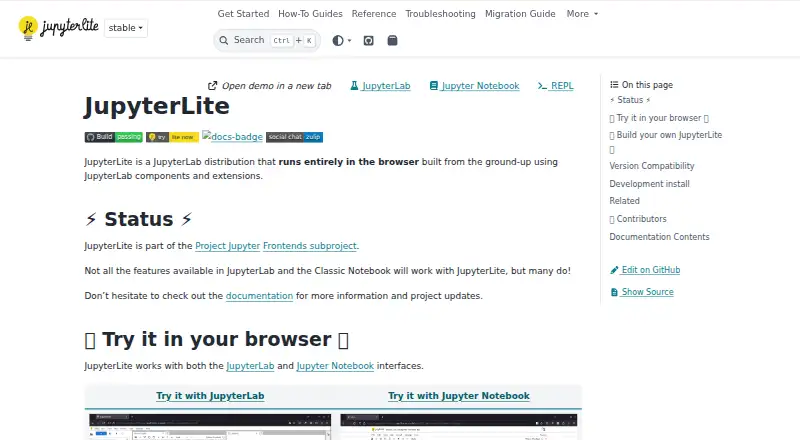
JupyterLite is a free, open-source JupyterLab distribution that runs entirely in a web browser. It provides JupyterLab and Jupyter Notebook interfaces without a dedicated application server or container orchestrator. Browser kernels include Pyodide and Xeus Python, with an R kernel based on Xeus R, and notebooks can use visualization libraries such as Altair, Bqplot, ipywidgets, Matplotlib, and Plotly. Sites are static HTTP(S) assets that can run locally, on listed static hosts, or inside another application through an iframe REPL. Users can open examples, edit notebooks, save files in browser IndexedDB or localStorage, and download them. Sites can be customized with content, configuration, kernels, and extensions, and archives can support offline use. Data stays in the browser unless extensions or notebook code send it externally. Not every JupyterLab or Classic Notebook feature works.
Who it suits
JupyterLite suits learners, educators, and developers who want browser-based notebooks without installing software or running a dedicated server. It also fits teams deploying static, embeddable notebook sites.
What it does well
- Runs entirely in the browser
- No dedicated server or orchestrator required
- Supports Python and R browser kernels
- Static hosting and iframe embedding
- Offline archive option available
What to know first
- Not all JupyterLab features work
- Core package provides no kernels by default
- Browser storage limits uploads
- Files are not shared across sites
Plans
| Plan | Billed and limits | Price |
|---|---|---|
| JupyterLite | Open source · runs in the browser · no paid plans stated | Free |
As jupyterlite.readthedocs.io lists them, read 11 Oct 2026. The maker's own page has the final word.
Verdict
JupyterLite offers portable notebook computing through static browser deployments and several browser kernels. Its feature coverage, storage limits, and kernel setup requirements matter when planning a site.
Facts from JupyterLite's own pages
- Audience
- The project describes its goal as providing lightweight browser based computing that is accessible without installing software. · jupyterlite.readthedocs.io, 11 Oct 2026
- Compatibility limit
- The project states that not all features available in JupyterLab and the Classic Notebook work with JupyterLite. · jupyterlite.readthedocs.io, 11 Oct 2026
- Customization
- A JupyterLite site can be customized with content, configuration, kernels, and extensions. · jupyterlite.readthedocs.io, 11 Oct 2026
- Data privacy
- The documentation says data stays in the browser unless enabled extensions send it to external services or notebook code uses the browser fetch mechanism. · jupyterlite.readthedocs.io, 11 Oct 2026
- Deployment
- JupyterLite sites are served as static HTTP(S) assets locally or on most static web hosts, and can be embedded in larger applications. · jupyterlite.readthedocs.io, 11 Oct 2026
- Deployment options
- static · jupyter.org, 22 Sept 2026
- Embedding
- A JupyterLite REPL can be embedded on another website with an iframe. · jupyterlite.readthedocs.io, 11 Oct 2026
- Extensions
- JupyterLite uses the JupyterLab extension system and can be extended with frontend extensions and custom kernels. · jupyterlite.readthedocs.io, 11 Oct 2026
- Files and storage
- Created files are stored in the browser’s IndexedDB by default and are not shared across different sites. · jupyterlite.readthedocs.io, 11 Oct 2026
- File size limit
- Browser storage is limited, and the guide says smaller uploads up to approximately 50 MB should be fine. · jupyterlite.readthedocs.io, 11 Oct 2026
- Free plan
- No · jupyter.org, 22 Sept 2026
- Full-stack runtime
- No · jupyter.org, 22 Sept 2026
- Hosting options
- The documentation describes deployment on GitHub Pages, Read the Docs, Vercel, Netlify, GitLab Pages, and Binder. · jupyterlite.readthedocs.io, 11 Oct 2026
- Integrations
- The how-to guides list deployment options including GitHub Pages, ReadTheDocs, Vercel, Netlify, GitLab Pages, and Binder. · jupyterlite.readthedocs.io, 11 Oct 2026
- Interfaces
- Deployments can provide JupyterLab, Jupyter Notebook, and a minimal REPL application. · jupyterlite.readthedocs.io, 11 Oct 2026
- Kernel limitation
- The jupyterlite-core package does not provide any kernels by default; a kernel must be installed in the build environment. · jupyterlite.readthedocs.io, 11 Oct 2026
- Kernels
- The project maintains browser based Python kernels using Pyodide and Xeus Python, plus an R kernel using Xeus R. · jupyterlite.readthedocs.io, 11 Oct 2026
- License
- The GitHub repository identifies the project license as BSD-3-Clause. · github.com, 11 Oct 2026
- Limitations
- The project states that not all features available in JupyterLab and Classic Notebook work with JupyterLite. · jupyterlite.readthedocs.io, 11 Oct 2026
- Maker
- JupyterLite is part of the Project Jupyter Frontends subproject, and Project Jupyter describes itself as a nonprofit open source project born in 2014. · jupyter.org, 11 Oct 2026
- Notebook storage
- Users can view hosted example notebooks and files, then edit, save, and download them using browser IndexedDB or localStorage. · jupyterlite.readthedocs.io, 11 Oct 2026
- Offline use
- The documentation includes a guide for creating a JupyterLite archive that can be used offline. · jupyterlite.readthedocs.io, 11 Oct 2026
- Private projects
- No · jupyter.org, 22 Sept 2026
- Project status
- JupyterLite is part of Project Jupyter’s Frontends subproject. · jupyterlite.readthedocs.io, 11 Oct 2026
Where JupyterLite stands on Freedom251
- Coding Playgrounds#52 of 138