Freedom251 › AI Legal Research Software
Judicex
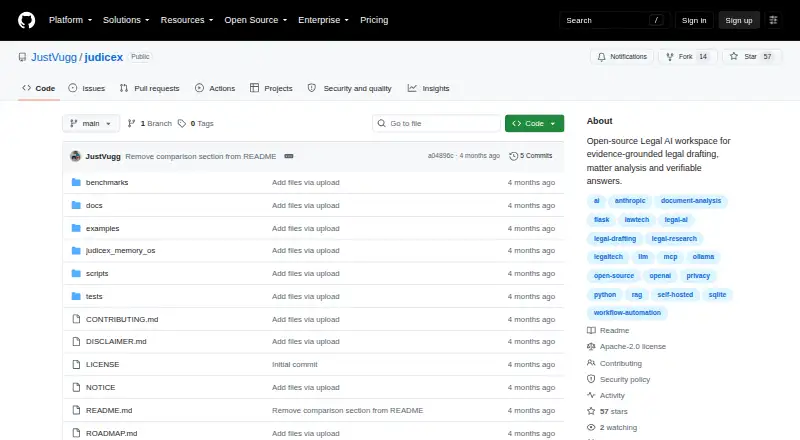
What Judicex is
Judicex is an open-source legal AI workspace for matter management, evidence-grounded drafting, and AI-assisted legal work. Its workflow packs compare available material with a legal thesis, identify present, partial, and missing elements, and suggest next actions. Drafting tools include templates, a split-view page, tabular review, and DOCX/PDF export. The answer engine ties citations to retrieved legal evidence and is designed to abstain when evidence is insufficient. It supports Ollama, OpenAI, Anthropic, OpenAI-compatible providers, and MCP-aware clients, and can run without an LLM. Matter data is stored in an operator-controlled SQLite database and attachment directory; it stays on the host unless a hosted LLM is configured. Listed operational features include a local password gate, backup and restore, optional matter-file encryption, and API keys kept out of the browser. The current v0.2.0-alpha is a usable prototype for local development and private evaluation, not production SaaS. It gives no security guarantee for shared, multi-user, or internet-exposed deployments. The security policy also says audited infrastructure requirements such as HIPAA or FINRA are unsupported without significant additional engineering.
Who it suits
Judicex is aimed at lawyers and legal teams, including a single lawyer or small team running it locally or on a private firm server. It is suited to private evaluation rather than shared, internet-exposed, or audited production deployments.
What it does well
- Matter workflows identify present, partial, and missing elements
- Citations are tied to retrieved legal evidence
- Can run without an LLM
- Matter data stays on the host unless hosted LLM is configured
- Includes backup and restore
What to know first
- Current release is v0.2.0-alpha
- No security guarantee for shared or internet-exposed deployments
- Not suitable for audited infrastructure without significant engineering
Limits
The project describes v0.2.0-alpha as a usable prototype for local development and private evaluation. It provides no security guarantee for shared, multi-user, or internet-exposed deployments; audited infrastructure requirements such as HIPAA or FINRA need significant additional engineering.
Getting started
- Visit the Judicex GitHub project.
- Choose a listed platform: Linux, macOS, Windows, web, or self-hosted.
- Choose whether to connect a supported LLM provider or run without an LLM.
Verdict
Judicex brings matter analysis, evidence-linked answers, and drafting tools into a locally controlled workspace. Its alpha status and stated deployment limits make it important to assess security needs before use.
Questions
Is Judicex free?
Yes. It is listed as free and open source.
What platforms does Judicex support?
Linux, macOS, Windows, web, and self-hosted use are listed.
Which AI providers can it use?
It supports Ollama, OpenAI, Anthropic, OpenAI-compatible providers, and MCP-aware clients. It can also run without an LLM.
How does Judicex handle matter data?
Matter data is stored in an operator-controlled SQLite database and attachment directory. It stays on the host unless a hosted LLM is configured.
Is Judicex intended for production use?
The current v0.2.0-alpha is described as a usable prototype for local development and private evaluation, rather than production SaaS.
Does it support audited infrastructure requirements?
Deployments needing audited infrastructure for requirements such as HIPAA or FINRA are not supported without significant additional engineering.
Facts from Judicex's own pages
- Compliance limits
- The security policy says deployments requiring audited infrastructure for requirements such as HIPAA or FINRA are not supported without significant additional engineering. · github.com, 4 Oct 2026
- Documents
- Users can upload PDF, DOCX, text, Markdown, CSV, JSON and image files, with OCR via Ollama. · github.com, 9 Oct 2026
- Drafting
- Judicex provides a split-view drafting page and can export drafts to DOCX or PDF. · github.com, 9 Oct 2026
- Drafting and review
- It includes document templates, a split-view drafting page, tabular review, and DOCX/PDF export for drafts. · github.com, 4 Oct 2026
- Evidence and answers
- Its answer engine binds citations to retrieved documents and can abstain when evidence is insufficient. · github.com, 9 Oct 2026
- Evidence and citations
- Its answer engine binds citations to retrieved legal evidence and is designed to abstain when evidence is insufficient. · github.com, 4 Oct 2026
- Installers
- Script-based local installers are documented for Windows and macOS, and launch Judicex at a localhost address. · github.com, 9 Oct 2026
- Integrations
- The software supports Ollama, OpenAI, Anthropic and OpenAI-compatible LLM providers, as well as an MCP stdio server for MCP-aware clients. · github.com, 9 Oct 2026
- Intended users
- The project describes its workspace as intended for lawyers and legal teams. · github.com, 9 Oct 2026
- Legal disclaimer
- Judicex states that it does not provide legal advice or replace a qualified legal professional, and that outputs may be incomplete, incorrect, outdated or unsuitable for a jurisdiction. · github.com, 9 Oct 2026
- Local storage and privacy
- Matter data is stored in a SQLite database and attachment directory selected by the operator, and data stays on the host unless a hosted LLM is configured. · github.com, 9 Oct 2026
- Matter analysis
- Matter analysis maps a legal thesis to proof elements and reports present, partial or missing support with next actions. · github.com, 9 Oct 2026
- Platforms
- The repository provides script-based local installers for Windows and macOS, and describes running the web app on a workstation or private server. · github.com, 4 Oct 2026
- Privacy
- Matter data is stored in a SQLite database and attachment directory controlled by the operator, and data stays on the host unless the operator configures a hosted LLM. · github.com, 4 Oct 2026
- Product
- Judicex describes itself as an open-source legal AI workspace for evidence-grounded drafting, matter analysis and verifiable answers. · github.com, 9 Oct 2026
- Product maturity
- The repository labels the current release v0.2.0-alpha and describes it as a usable prototype rather than production SaaS. · github.com, 4 Oct 2026
- Security controls
- The project says API keys should be kept in environment variables and are not sent to the browser. · github.com, 9 Oct 2026
- Security features
- The listed privacy and operations features include a local password gate, backup and restore, optional matter-file encryption, and API keys kept out of the browser. · github.com, 4 Oct 2026
- Security limitations
- The current v0.2.0-alpha is intended for local development and private evaluation, and the project gives no security guarantee for shared, multi-user, or internet-exposed deployments. · github.com, 4 Oct 2026
- Security limits
- The security policy says Judicex v0.2.0-alpha has no security guarantee for shared, multi-user or internet-exposed deployments and is not designed for audited regulatory workloads without significant additional engineering. · github.com, 9 Oct 2026
- Support
- The security policy directs vulnerability reports through GitHub Security Advisories or the maintainer contact channel and says to expect acknowledgement within a reasonable time. · github.com, 9 Oct 2026
- Support and reporting
- The security policy asks users to report vulnerabilities privately through GitHub Security Advisories or a maintainer contact channel listed on the GitHub profile. · github.com, 4 Oct 2026
Where Judicex stands on Freedom251
- AI Legal Research Software#8 of 32