Freedom251 › Package Registries
JSR
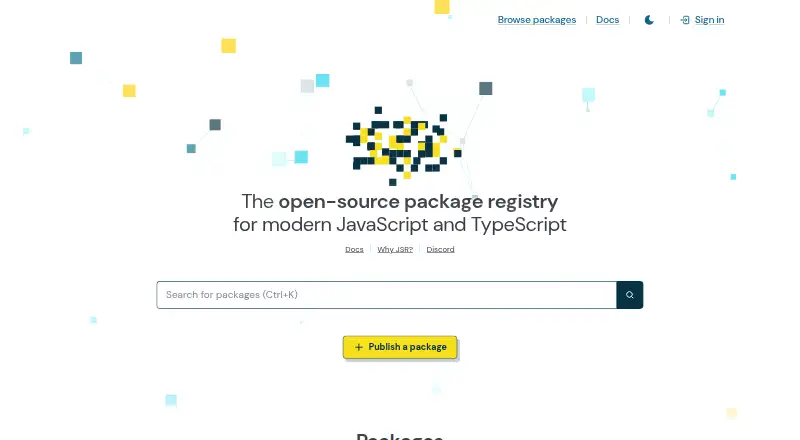
What JSR is
JSR is a package registry for JavaScript and TypeScript, distributing packages as web-standard ECMAScript modules. It accepts TypeScript source, then generates declaration files and documentation and transpiles code for compatibility across runtimes. JSR says its packages work with Node.js, Deno, Bun, browsers and more. Developers can add packages through Deno, pnpm, Yarn, npm or Bun tooling.
The registry creates documentation from source code and JSDoc comments, and provides package scores that can be used to filter package searches. To publish from GitHub Actions, developers can use OIDC without setting up secrets or authentication. Other CI providers can publish with a personal access token, but that method does not create provenance attestations. GitHub Actions publishing can produce SLSA provenance statements recorded in the Sigstore Rekor transparency log.
JSR is open source under the MIT License. Published versions are immutable and generally cannot be changed or deleted. Its listed Free plan costs nothing; quotas apply to scopes and package versions, and JSR says users can request quota increases by email. The Deno company operates JSR and pays its hosting bills; the service is designed to remain free to use.
Who it suits
JSR suits JavaScript and TypeScript developers who want to publish packages for several runtimes and use familiar package manager tooling. It may also suit teams that want generated documentation, package scoring or provenance from GitHub Actions.
What it does well
- Accepts TypeScript source and generates declaration files.
- Creates package documentation from source code and JSDoc comments.
- Packages are distributed as web-standard ECMAScript modules.
- Works with Deno, pnpm, Yarn, npm and Bun tooling.
- GitHub Actions publishing can use OIDC without configured secrets.
- Open source under the MIT License.
What to know first
- Quotas apply to scopes and package versions.
- Packages are limited to 20 MB.
- Private packages are not supported.
- Versions are immutable and generally cannot be changed or deleted.
Limits
The Free plan costs nothing, with quotas on scopes and package versions. Packages are limited to 20 MB; quota increases can be requested by email.
Plans
| Plan | Billed and limits | Price |
|---|---|---|
| Free | Always free to use; quotas apply to scopes and package versions | Free |
As jsr.io lists them, read 7 Oct 2026. The maker's own page has the final word.
Getting started
- Visit https://jsr.io/.
- Choose a package manager supported by JSR: Deno, pnpm, Yarn, npm or Bun.
- For GitHub Actions publishing, use OIDC without configuring secrets or authentication.
- For another CI provider, publish with a personal access token.
Verdict
Choose JSR if you want a free registry for JavaScript or TypeScript packages distributed across runtimes, with generated documentation and several publishing options. Look elsewhere if you need private packages, packages above 20 MB or mutable published versions.
Questions
How much does JSR cost?
Its Free plan costs nothing, and JSR is designed to remain free to use.
Can I publish private packages?
No. Private packages are not supported.
Which package managers can use JSR packages?
Packages can be added with Deno, pnpm, Yarn, npm or Bun tooling.
Is JSR open source?
Yes. JSR is open source and licensed under the MIT License.
How does publishing from CI work?
GitHub Actions can publish using OIDC without configured secrets or authentication. Other CI providers can use a personal access token; token-based publishing does not generate provenance attestations.
Can a published version be changed or deleted?
Published versions are immutable and generally cannot be changed or deleted.
Facts from JSR's own pages
- Automatic documentation
- JSR automatically generates package documentation from source code and JSDoc comments. · jsr.io, 7 Oct 2026
- ES modules
- JSR packages are distributed as web-standard ECMAScript modules. · jsr.io, 7 Oct 2026
- GitHub Actions publishing
- JSR supports publishing from GitHub Actions using OIDC without configuring secrets or authentication. · jsr.io, 7 Oct 2026
- Immutable versions
- Published package versions are immutable and generally cannot be changed or deleted. · jsr.io, 7 Oct 2026
- Open source
- JSR is open source and licensed under the MIT License. · jsr.io, 7 Oct 2026
- Operator and funding
- JSR is currently operated by the Deno company, which pays its hosting bills; JSR says it is designed to always be free to use. · jsr.io, 7 Oct 2026
- Other CI publishing
- Publishing from other CI providers is supported with a personal access token, and token-based publishing does not generate provenance attestations. · jsr.io, 7 Oct 2026
- Package managers
- JSR packages can be added with Deno, pnpm, Yarn, npm, or Bun tooling. · jsr.io, 7 Oct 2026
- Package scoring
- JSR provides package scoring and supports filtering package search by score. · jsr.io, 7 Oct 2026
- Provenance
- For packages published from GitHub Actions, JSR can create SLSA provenance statements stored in the Sigstore Rekor transparency log. · jsr.io, 7 Oct 2026
- Runtime compatibility
- JSR says packages work with Node.js, Deno, Bun, browsers, and more. · jsr.io, 7 Oct 2026
- TypeScript support
- JSR accepts TypeScript source and generates package documentation and declaration files, and transpiles code for cross-runtime compatibility. · jsr.io, 7 Oct 2026
- Usage limits
- JSR applies quotas to scopes and package versions to prevent abuse and says users can request quota increases by email. · jsr.io, 7 Oct 2026
- What it is
- JSR is a modern package registry for JavaScript and TypeScript. · jsr.io, 7 Oct 2026
Where JSR stands on Freedom251
- Package Registries#12 of 28