Freedom251 › Dark Web Monitoring Services
Jsmon Dark Web Monitoring
What Jsmon Dark Web Monitoring is
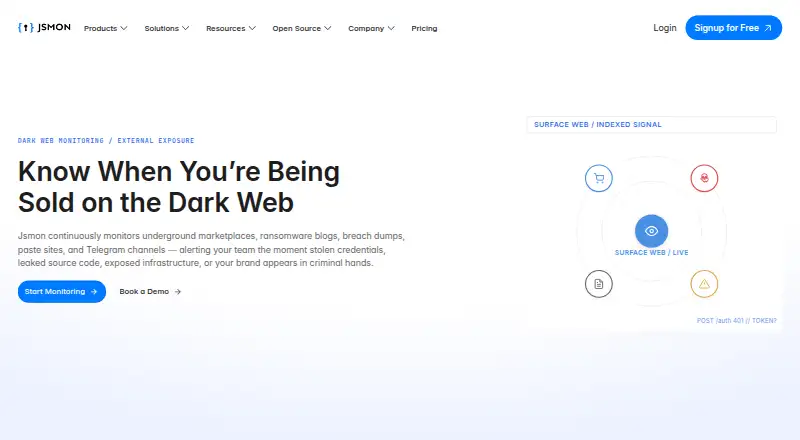
Jsmon Dark Web Monitoring is a web-based service for businesses that want to identify exposed company information across underground and breach-related sources. It monitors marketplaces, ransomware blogs, breach dumps, paste sites, and Telegram channels for items such as credentials, source code, infrastructure, and brand mentions. The service says its crawlers, bots, and scrapers ingest more than 100 sources, including forums, stealer log marketplaces, and code repository leaks. Users can set watchlists for domains, brands, executives, IP ranges, products, and code signatures. Jsmon says its AI models match and deduplicate mentions, attribute actors, filter false matches, and add severity and source context. It reports a median posting-to-alert time under four hours. Alerts can connect to Slack, Teams, Jira, PagerDuty, and XSOAR; API and SOAR playbooks can automate workflows. Exposed credentials are hashed for matching, and raw passwords are not stored or shown in full. Collection is described as passive: Jsmon says it observes and indexes rather than buying data or engaging with threat actors. Pricing starts at $15/mo (annual), and a free trial is listed.
Who it suits
The service is aimed at threat intelligence and incident response teams, as well as executives or boards needing exposure reporting for compliance or insurance reviews. It may suit organizations that want to monitor business-related data and receive remediation support.
What it does well
- Monitors more than 100 sources.
- Watchlists cover domains, executives, and code signatures.
- Integrates with Slack, Teams, Jira, PagerDuty, and XSOAR.
- Raw passwords are not stored or shown in full.
What to know first
- Paid plans start at $15/mo (annual).
- The free Starter offer is a one-time trial.
- Starter has email alerts only.
Limits
The free Starter option is a one-time trial with 1,500 lifetime credits and email alerts only. It excludes WAF bypass, authenticated scans, custom modules, and workspace sharing.
Plans
| Plan | Billed and limits | Price |
|---|---|---|
| Starter | One-time trial; no card needed · 1,500 credits lifetime · Findings and leaked secrets · Email alerts only · No WAF bypass, authenticated scans, custom modules, or workspace sharing | Free |
As jsmon.sh lists them, read 8 Oct 2026. The maker's own page has the final word.
Getting started
- Visit the Jsmon Dark Web Monitoring website.
- Start the one-time Starter trial; no card is needed.
- Set watchlists for the domains, brands, people, networks, or code signatures to monitor.
- Choose an alert or workflow connection, such as Slack, Teams, Jira, PagerDuty, or XSOAR.
- Review the paid service, which starts at $15/mo (annual).
Jsmon Dark Web Monitoring is an exposure-monitoring service for organizations tracking leaked credentials, code, infrastructure, and brand mentions. It is best suited to threat intelligence and incident response teams that need configurable watchlists and alerts they can route into existing workflows. Broad source coverage and credential safeguards make it a considered choice; its lifetime-capped trial is a limited way to assess ongoing needs.
Overview
Jsmon says it monitors more than 100 sources, including underground forums, stealer-log marketplaces, code repository leaks, ransomware blogs, breach dumps, paste sites, and Telegram channels. Watchlists can cover domains, brands, executives, IP ranges, products, and code signatures, so organizations can track exposure across identities, infrastructure, intellectual property, and reputation.
Its collection is passive: Jsmon says it observes and indexes material without purchasing data or interacting with threat actors. It hashes exposed credentials for matching against a watchlist and says raw passwords are never stored or displayed in full. That approach suits teams that need exposure signals while limiting handling of sensitive secrets.
Key features
Context for investigation
Jsmon says its AI models match mentions, remove duplicates, attribute actors, filter false matches, and add severity, source reputation, and blast-radius context. This can help teams sort findings by potential impact, though it does not replace investigation. The claimed median time from a post to an alert is under four hours; that is a median, not a response-time guarantee for each finding.
Alerts and response workflows
Alerts can go to Slack, Teams, Jira, PagerDuty, and XSOAR. A native API with webhooks and SOAR playbooks can connect findings to automated workflows. Remediation support is included, making the service a stronger fit for teams with established response processes than for readers seeking a standalone awareness feed.
Jsmon cites support for NIST CSF Identify and Detect, SOC 2 CC7.2, ISO 27001 A.12.4, and GDPR breach-awareness obligations. Those references may help teams map monitoring to compliance work; they do not by themselves establish compliance.
Pricing
The Starter plan costs nothing as a one-time trial, with no card needed. It includes 1,500 lifetime credits, findings and leaked secrets, and email alerts only. It excludes WAF bypass, authenticated scans, custom modules, and workspace sharing. The finite lifetime allowance and email-only alerts make Starter useful for an initial evaluation, but a poor fit for ongoing or collaborative monitoring.
Paid access starts at $15/mo (annual). The lower-cost entry point may suit teams with modest monitoring needs, but the published plan details do not establish its seat count or quotas. Teams should confirm those limits and the applicable renewal terms before committing. Business monitoring is supported.
Platforms
Jsmon offers API and web access. The API, webhooks, and named alert integrations suit teams that want monitoring to feed existing security workflows.
Who it's for
Threat intelligence and incident response teams are the clearest fit: they can watch a varied set of assets, triage contextualized findings, and route alerts into response tools. Executives and boards may also use exposure reporting for compliance and insurance reviews. Organizations that only need a small number of email alerts may find the trial adequate for an initial look, but its lifetime credit cap is restrictive for sustained monitoring.
Pros and cons
Pros
- More than 100 monitored sources and watchlists spanning credentials, infrastructure, code, and brand exposure give security teams broad coverage.
- Hashed credential matching avoids storing or displaying raw passwords in full.
- Slack, Teams, Jira, PagerDuty, XSOAR, API, and SOAR playbooks provide several routes for alert handling.
- The no-card Starter trial allows an initial evaluation without a payment commitment.
Cons
- Starter is limited to 1,500 lifetime credits and email alerts, with no workspace sharing, which constrains ongoing team use.
- WAF bypass, authenticated scans, and custom modules are excluded from Starter.
- The $15/mo (annual) starting price requires an annual term and may not suit buyers seeking a low-commitment ongoing plan.
Alternatives
Dark Web Monitoring Services is the broader category page for readers comparing services.
CyberGuard360 Deep Diver has a free-forever plan with five dark web prospect scans per month and 1,000 Swift Owl AI credits per month, so it may suit readers who want a recurring free allowance for prospect scans.
DARKX offers a free plan with 15 credits per month and one domain, IP, or phone, alongside a $21 a month Pro plan. It may suit buyers comparing a lower-cost monthly entry plan with a small free monitoring allowance.
PhishEye has a free plan for one monitored brand, one single-run typosquat scan, and 30-day scan history, making it the more focused option for readers whose priority is brand and typosquat monitoring.
Allure Security Dark Web Monitoring is another paid option with API and web platforms.
Dark Web ID is another paid option with API and web platforms.
DarkOwl Vision UI may suit buyers seeking a web-based service with a published 12-month license at $38,000 a year, including one Vision license and unlimited alerts and monitors.
RiskProfiler KnyX is another paid option with API and web platforms.
Symbol Cyber Threat Surveillance is a paid API and web option with daily searches of internet sources; buyers must request a demo or quote for pricing.
Verdict
Jsmon is a strong fit for security teams that need broad underground-source monitoring, flexible asset watchlists, contextual triage, and integrations into response workflows. Its careful credential handling reinforces that case. Look elsewhere if you need a substantial free tier or prefer to assess long-term use without an annual starting commitment.
Verdict
Jsmon combines broad source monitoring with configurable watchlists, alert integrations, and credential safeguards. Check whether the Starter trial’s limits and the paid annual starting price fit your monitoring needs.
Questions
What does Jsmon Dark Web Monitoring cost?
Paid service starts at $15/mo (annual). The Starter option is a one-time trial with no card needed.
Is there a free plan?
The listed free option is a one-time Starter trial with 1,500 lifetime credits, findings and leaked secrets, and email alerts only.
Which platforms are supported?
The listed platforms are API and web.
What integrations does Jsmon list?
It lists Slack, Teams, Jira, PagerDuty, and XSOAR, and describes API and webhook integration.
How does Jsmon handle exposed credentials?
Jsmon says credentials are hashed and matched against watchlists. It says raw passwords are never stored or shown in full.
Who founded Jsmon?
Jsmon says it was founded by security researchers Inderjeet and Gaurav Bisht.
Facts from Jsmon Dark Web Monitoring's own pages
- Alert timing
- The page claims a median time from posting to alert of under four hours. · jsmon.sh, 8 Oct 2026
- API and webhooks
- The comparison section describes Jsmon's SIEM/SOAR integration as a native API with webhooks. · jsmon.sh, 8 Oct 2026
- Collection approach
- Jsmon describes its collection as passive: it observes and indexes and says it does not purchase data or interact with threat actors. · jsmon.sh, 8 Oct 2026
- Company founders
- Jsmon says it was founded by security researchers Inderjeet and Gaurav Bisht. · jsmon.sh, 8 Oct 2026
- Company founding date and headquarters
- The opened company page names the founders but does not state a founding year or headquarters location. · jsmon.sh, 8 Oct 2026
- Compliance references
- The product page says it supports NIST CSF Identify and Detect, SOC 2 CC7.2, ISO 27001 A.12.4, and GDPR breach-awareness obligations. · jsmon.sh, 8 Oct 2026
- Credential handling
- Jsmon says exposed credentials are hashed and matched against the watchlist, and raw passwords are never stored or displayed in full. · jsmon.sh, 8 Oct 2026
- Integrations
- The page lists Slack, Teams, Jira, PagerDuty, and XSOAR, and says workflows can be automated through an API and SOAR playbooks. · jsmon.sh, 8 Oct 2026
- Intended users
- The page describes use by threat intelligence teams, incident response teams, and executives or boards, including exposure reporting for compliance and insurance reviews. · jsmon.sh, 8 Oct 2026
- Matching and context
- Jsmon says AI models match mentions, deduplicate results, attribute actors, filter false matches, and add severity, source reputation, and blast-radius context. · jsmon.sh, 8 Oct 2026
- Monitoring coverage
- Jsmon says it continuously monitors underground marketplaces, ransomware blogs, breach dumps, paste sites, and Telegram channels for exposed credentials, source code, infrastructure, and brand mentions. · jsmon.sh, 8 Oct 2026
- Source coverage
- The page says its crawlers, Telegram bots, and scrapers continuously ingest more than 100 sources, including forums, stealer log marketplaces, and code repository leaks. · jsmon.sh, 8 Oct 2026
- Watchlists
- Users can define domains, brands, executives, IP ranges, products, and code signatures to monitor. · jsmon.sh, 8 Oct 2026
Where Jsmon Dark Web Monitoring stands on Freedom251
- Dark Web Monitoring Services#3 of 25