Freedom251 › Journaling Software
JournalOS
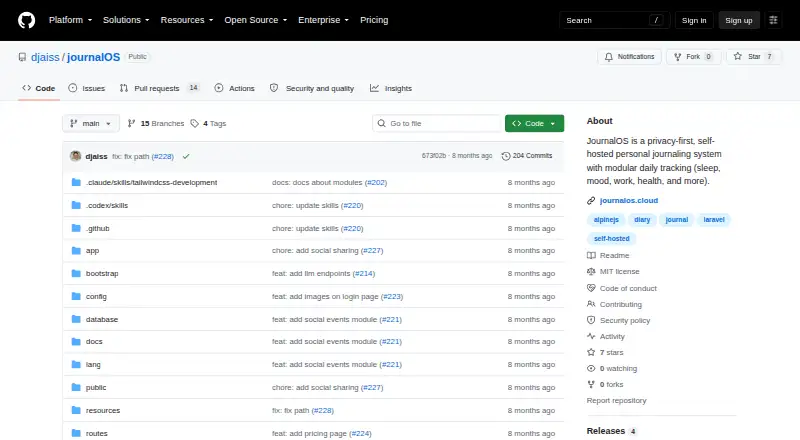
What JournalOS is
JournalOS is an open-source diary for recording structured details of daily life. Its modules cover body and health, mind and emotions, work, social life, and places, including sleep, physical activity, mood, energy, social events, travel, and weather. Users can prevent editing older entries and access their data with an LLM of their choice through a friendly URL. JournalOS runs on the maker-hosted server or can be self-hosted, with Docker and manual installation documented. It is available for web, API, and self-hosted use, and is released under the MIT license. The project is translated into English and French. The maker says users own their data and that the project has no ads, data resale, or behavioral manipulation. The repository describes full encryption at rest while noting severe drawbacks. Its stated scope excludes long personal journals, social sharing, coaching, and habit gamification.
Who it suits
JournalOS suits people seeking structured daily memory, privacy, and data ownership. It also targets developers and power users comfortable with hosted or self-hosted tools.
What it does well
- Open source under MIT license
- Web and self-hosted options
- Structured modules for daily life
- Users own their data
- English and French translations
What to know first
- Not intended for long personal journals
- Excludes social sharing and coaching
- Encryption at rest has stated drawbacks
- No bug bounty program
Verdict
JournalOS focuses on structured personal records rather than free-form journaling or social features. Its self-hosting support, open license, and stated privacy principles fit users who want control over their diary data.
Facts from JournalOS's own pages
- Audience
- JournalOS is intended for people who want structured daily memory, users who care about privacy and data ownership, and developers or power users. · github.com, 5 Oct 2026
- Encryption
- The README says data is fully encrypted at rest and notes that this has severe drawbacks. · github.com, 11 Oct 2026
- Entry controls
- Users can prevent editing older journal entries. · github.com, 11 Oct 2026
- Hosting
- Users can use the maker-hosted server or host JournalOS themselves; installation documentation mentions Docker and manual installation. · github.com, 11 Oct 2026
- Languages
- The project says it is fully translated into English and French. · github.com, 11 Oct 2026
- License
- JournalOS is released under the MIT license. · github.com, 11 Oct 2026
- LLM access
- The README says users can access their data with an LLM of their choice through a friendly URL. · github.com, 11 Oct 2026
- Maker
- The repository credits Régis Freyd. · github.com, 11 Oct 2026
- Notable limits
- The project says it is not intended for long personal journals, social sharing, coaching, or habit gamification. · github.com, 11 Oct 2026
- Not intended for
- The project says it is not for long personal journals, social sharing, coaching, or habit gamification. · github.com, 5 Oct 2026
- Available platforms
- web,self_hosted · github.com, 20 Sept 2026
- Privacy principles
- The project states that users own their data and that it has no ads, data resale, or behavioral manipulation. · github.com, 11 Oct 2026
- Product
- JournalOS is a privacy-first, self-hosted personal journaling system for structured daily tracking. · github.com, 11 Oct 2026
- Security support
- The security policy asks users to report vulnerabilities by email and says there is no bug bounty program; merchandise may be awarded for actionable reports. · github.com, 11 Oct 2026
- Technical architecture
- Developer documentation describes JournalOS as a Laravel monolith with web app, API, and marketing site, using server-rendered Blade views and AlpineJS interactivity. · github.com, 5 Oct 2026
- Tracking modules
- Modules cover body and health, mind and emotions, work, social life, and places, including sleep, mood, meals, reading, travel, and weather. · github.com, 11 Oct 2026
- Use case
- It is aimed at people who want structured daily memory, privacy and data ownership, and tools for developers or power users. · github.com, 11 Oct 2026
Where JournalOS stands on Freedom251
- Journaling Software#23 of 37
- Journaling apps#30 of 37