Jammy
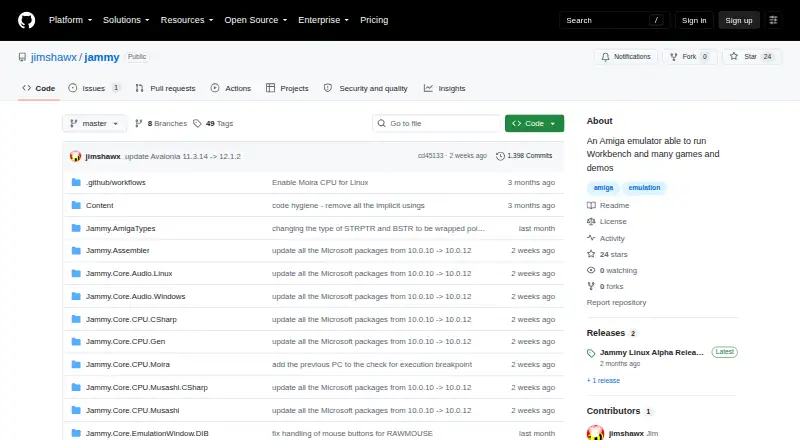
What Jammy is
Jammy is a free Amiga emulator written in C# that aims to run Workbench, games, and demos. It lists emulation for A1000, A500, A500+, A600, A1200, A2000, A3000, A4000, and CD32 systems, with OCS, ECS, and AGA support and emulation for components such as the Copper, Blitter, CIA, sprites, playfields, and audio. It reads ADF, zipped ADF, ADZ, DMS, and RP9 floppy images, and ATA hard disks support reading and writing. Developer tools include a debugger, disassembler, automated code analysis, and SQLite storage for disassemblies. JavaScript and Lua APIs can run code at breakpoints, and a web API is available for custom interfaces. Windows Alpha and Linux Alpha releases are listed as version 0.0.30. The project reports DMA timing problems and incomplete cycle accuracy, and says some software does not yet work. CD32 CD-ROM and NVRAM do not work, the IPF floppy reader is broken, and there is no ARM build. Linux lacks debugging interfaces, and its scripting, web, and database APIs need more work. AVX2-capable CPUs significantly improve the experience.
Who it suits
Jammy may suit Amiga enthusiasts and developers seeking an emulator for Windows or Linux, particularly those interested in debugging, disassembly, or breakpoint scripting. Its stated compatibility and known limitations are important to check against the intended software and setup.
What it does well
- Supports a range of listed Amiga models and chipsets
- Reads five listed floppy image formats
- Includes a debugger and disassembler
- Free under the MIT License
What to know first
- Listed releases are Alpha version 0.0.30
- CD32 CD-ROM and NVRAM do not work
- Linux lacks debugging interfaces
- No ARM build is available
Limits
The free MIT-licensed Alpha release has reported compatibility and timing limits, including programs that do not yet work and poor emulation above 7 MHz. CD32 CD-ROM and NVRAM do not work, IPF floppy reading is broken, and Linux lacks debugging interfaces; several APIs also need more work.
Plans
| Plan | Billed and limits | Price |
|---|---|---|
| Free (MIT License) | Free software under the MIT License | Free |
As github.com lists them, read 8 Oct 2026. The maker's own page has the final word.
Getting started
- Open the Jammy GitHub project page.
- Choose the Windows Alpha or Linux Alpha release, version 0.0.30.
- Run Jammy on a listed host platform.
- Use a supported Amiga model and floppy image format, or configure an ATA hard disk.
Jammy is a free, open-source Amiga emulator for Windows and Linux that combines broad machine coverage with unusually substantial debugging and scripting tools. It suits developers, reverse engineers, and enthusiasts exploring Amiga software; players who need one particular title to run reliably should choose a more mature emulator.
Overview
Jammy targets Workbench, games, and demos across the A1000, A500, A500+, A600, A1200, A2000, A3000, A4000, and CD32. That range makes it useful for comparing software across Amiga generations, but compatibility varies by program and configuration. The project reports DMA timing problems, incomplete cycle accuracy, weak emulation of CPUs running above 7 MHz, and many programs that do not yet work.
The project began in December 2020 and is released under the MIT License. Windows Alpha and Linux Alpha builds are listed at version 0.0.30, so Jammy is better viewed as an evolving technical project than a finished replacement for established gaming-focused emulators.
Key features
Hardware and storage
Emulation covers 68000 and other 680x0 processors, OCS, ECS and AGA chipsets, Copper, Blitter, CIA, sprites, playfields, audio, and sprite or playfield collision and priority. RAM expansions, a battery-backed clock, and a VT100 serial terminal extend the scope beyond basic game playback. Jammy reads ADF, zipped ADF, ADZ, DMS, and RP9 floppy images, while ATA hard disks support both reading and writing. An AVX2-capable processor can significantly improve the experience, making newer desktop hardware preferable.
CD32 support is incomplete: CD-ROM and NVRAM do not work, and the IPF floppy reader is broken. Those restrictions matter if your library depends on CD32 software or protected disk images.
Developer tools and automation
A built-in debugger and disassembler give programmers a way to inspect execution rather than merely start an application. Automated code analysis is intended to improve disassemblies, and results can be stored in SQLite. JavaScript and Lua APIs can run code at breakpoints, while a web API supports custom user interfaces. These capabilities make Jammy a strong laboratory for studying 680x0 software and building tooling around it.
Linux users get less of that advantage. Debugging UIs are missing, and the JavaScript, Lua, web API, and database features still need more work on Linux. Windows is therefore the more complete host for users choosing Jammy specifically for its development environment. There is no ARM build.
Pricing
| Plan | Price | What you get |
|---|---|---|
| Free (MIT License) | free | Free software under the MIT License |
There is one plan, with no trial or paid tier to compare. It is appropriate for anyone who wants to evaluate the emulator, inspect its code, or contribute without a purchase. Contributions, pull requests, and comments are welcomed. The trade-off is that you accept alpha-stage compatibility and unfinished platform features rather than receiving a supported commercial service.
Platforms
Jammy runs on Windows and Linux. The current release listings identify Alpha 0.0.30 builds for both systems. Windows is the better fit for debugger-oriented work because Linux lacks debugging UIs and has less-complete scripting, web, and database support. ARM hardware is not supported by a build.
Who it's for
Choose Jammy if you want to investigate Amiga internals, analyze code, automate breakpoint workflows, or experiment with software spanning OCS, ECS, and AGA machines. It also suits contributors comfortable with an unfinished project. Look elsewhere if your priority is dependable execution of a specific game, accurate timing for demanding software, CD32 CD-ROM use, or a polished Linux debugging interface.
Pros and cons
- Pros: Broad coverage from A1000 through A4000 and CD32; OCS, ECS, and AGA hardware plus core peripherals; reads five listed floppy-image formats and writes ATA hard disks; debugger, disassembler, automated analysis, SQLite storage, breakpoint scripting, and a web API; free under the MIT License.
- Cons: DMA timing and cycle-accuracy issues can break timing-sensitive software; many programs still fail; CPUs above 7 MHz are poorly emulated; CD32 CD-ROM and NVRAM do not work; IPF reading is broken; Linux tooling is incomplete; no ARM build.
Alternatives
Amiga Emulators is the broader directory for comparing other options. Choose Damisoft Amiga Emulator if browser access matters and you can provide a Kickstart ROM and disk. Amiberry is a free, GPLv3 option spanning Android, Linux, macOS, and Windows. Meta Amiga Emulator is another free open-source project, but it is pre-alpha with no emulator to run yet. E-UAE and FS-UAE are free open-source alternatives for Linux, macOS, and Windows; FS-UAE also accepts donations. UAE4ALL2 Mod targets Android and iOS. Amigo — Amiga Emulator is free on Apple's platforms without ads or accounts, but requires your own Kickstart ROM and disks. Buddi is budgeting software rather than an Amiga emulator.
Verdict
Jammy is a compelling free choice for technically minded Amiga users who value a debugger, disassembler, automation APIs, and wide model coverage more than guaranteed compatibility. Choose it for experimentation and development; choose another emulator when accurate timing, complete CD32 support, or reliable execution of a specific program is the deciding requirement.
Verdict
Jammy combines Amiga emulation with developer tools, but the project lists several compatibility gaps and unfinished Linux features. Check the supported models, image formats, and reported limitations before relying on it for a particular program.
Questions
How much does Jammy cost?
Jammy is free under the MIT License.
Which platforms are available?
The releases page lists Alpha version 0.0.30 for Windows and Linux.
Which Amiga models does it support?
It lists the A1000, A500, A500+, A600, A1200, A2000, A3000, A4000, and CD32, with emulation to at least some level.
Which disk formats can it read?
For floppy images, it lists ADF, zipped ADF, ADZ, DMS, and RP9. ATA hard disks support reading and writing.
Is Jammy open source?
It is free software under the MIT License.
What are its main reported limitations?
The project reports DMA timing issues, incomplete cycle accuracy, limited support for faster CPUs and some programs, nonworking CD32 CD-ROM and NVRAM, and a broken IPF reader. Linux lacks debugging interfaces, and there is no ARM build.
Facts from Jammy's own pages
- Chipsets and peripherals
- The listed emulation includes OCS, ECS, AGA, Copper, Blitter, CIA, sprites, playfields, audio, floppy disks, ATA hard disks, RAM expansions, a battery-backed clock, and a VT100 serial terminal. · github.com, 8 Oct 2026
- Compatibility limits
- The maker lists DMA timing issues, poor emulation of CPUs faster than 7 MHz, and software that does not yet work. · github.com, 8 Oct 2026
- Contributions and support
- The maker welcomes contributions, pull requests and comments. · github.com, 8 Oct 2026
- Database
- Disassemblies can be stored in a SQLite database. · github.com, 8 Oct 2026
- Debugger
- The project includes a debugger and disassembler, with automated code analysis intended to produce better disassemblies. · github.com, 8 Oct 2026
- Developer tools
- The project includes a debugger and disassembler, automated code analysis for disassemblies, and storage of disassemblies in a SQLite database. · github.com, 8 Oct 2026
- Disks and storage
- It supports floppy disk formats ADF, zipped ADF, ADZ, DMS and RP9 for reading, and ATA hard disks for reading and writing. · github.com, 8 Oct 2026
- Download platforms
- The releases page lists Windows Alpha Release 0.0.30 and Linux Alpha Release 0.0.30. · github.com, 8 Oct 2026
- Founded
- 2020 · github.com, 28 Sept 2026
- Hardware emulation
- It lists 68000 and other 680x0 CPU emulation, Copper, Blitter and CIA emulations, sprite and playfield collision and priority, and OCS, ECS and AGA emulation. · github.com, 8 Oct 2026
- Known limitations
- The project reports DMA timing problems, incomplete cycle accuracy, nonworking CD32 CDROM and NVRAM, poor emulation of CPUs above standard 7 MHz, and many programs that do not yet work. · github.com, 8 Oct 2026
- License and price
- The README describes Jammy as free under the MIT License. · github.com, 8 Oct 2026
- Linux limitations
- The Linux version is missing debugging UIs, and the JavaScript, Lua, web APIs, and database need more work. · github.com, 8 Oct 2026
- Maker and project start
- The maker signs as Jim and says he started the project in December 2020; the license names James Shaw. · github.com, 8 Oct 2026
- Other limitations
- The maker says CD32 CD-ROM and NVRAM do not work, the IPF floppy reader is broken, and there is no ARM build. · github.com, 8 Oct 2026
- Performance
- The README says AVX2-capable CPUs significantly improve the experience. · github.com, 8 Oct 2026
- Product
- Jammy is Jim’s Amiga emulator, written in C# and able to run Workbench and many games and demos. · github.com, 8 Oct 2026
- Project background
- The maker says the project began in December 2020 as a lockdown project. · github.com, 8 Oct 2026
- Purpose
- Jammy is an Amiga emulator written in C# that aims to run Workbench, games, and demos. · github.com, 8 Oct 2026
- Release availability
- The releases page lists Windows Alpha and Linux Alpha releases, both version 0.0.30. · github.com, 8 Oct 2026
- Scripting
- It provides JavaScript and Lua APIs for running code on breakpoints. · github.com, 8 Oct 2026
- Scripting and API
- It provides JavaScript and Lua APIs for code running on breakpoints and a web API for custom user interfaces. · github.com, 8 Oct 2026
- Supported Amigas
- It says it can emulate A1000, A500, A500+, A600, A1200, A2000, A3000, A4000, and CD32 models to at least some level. · github.com, 8 Oct 2026
- Web API
- A web API is available for building custom user interfaces. · github.com, 8 Oct 2026
Where Jammy stands on Freedom251
- Amiga Emulators#10 of 22