Freedom251 › Cross-Platform App Development Frameworks

Ionic Framework
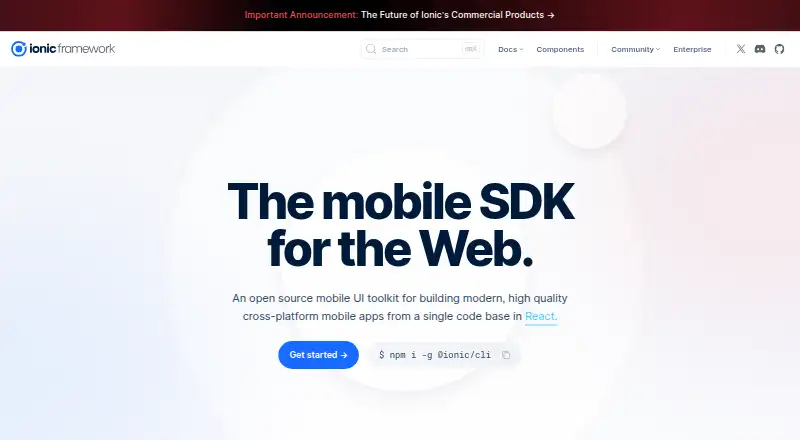
What Ionic Framework is
Ionic Framework is an open-source UI toolkit for creating mobile apps and web experiences with HTML, CSS, and JavaScript. A shared codebase can serve iOS, Android, and the web. Developers can use it alongside Angular, React, or Vue, or build without a frontend framework. The toolkit provides ready-made interface components, typography, and a theme that adjusts to different platforms. Ionic describes its motion and interaction approach as hardware-accelerated transitions and touch-oriented gestures.
For native app deployment, projects can use Capacitor or Cordova; they can also run in a browser as Progressive Web Apps. The Ionic CLI can scaffold a project and provides tools for installation, updates, running a development server, building, and debugging. Emulator or simulator support and app packaging are included among its stated capabilities. The UI Toolkit uses the MIT license and is free for personal and commercial projects. Ionic was founded in 2012 by Max Lynch and Ben Sperry, and is based in Madison, Wisconsin. Its documentation points developers to a community forum, GitHub issues, and community channels for support and contributions. Native device API calls require a native bridge, so browser-based projects may need alternative fallbacks.
Who it suits
Ionic suits developers building for mobile and web with HTML, CSS, and JavaScript who want to share a codebase across iOS, Android, and web. It also fits teams using Angular, React, or Vue, as well as those working without a frontend framework.
What it does well
- One codebase can target iOS, Android, and the web.
- Works with Angular, React, Vue, or no frontend framework.
- MIT-licensed and free for personal and commercial projects.
- CLI includes scaffolding, development, build, and debugging tools.
- Includes emulator or simulator support and app packaging.
What to know first
- Native device API calls need a native bridge.
- Browser projects may need fallbacks for device APIs.
Limits
Native device API calls do not work in a web environment without a native bridge, so browser fallbacks may be needed.
Plans
| Plan | Billed and limits | Price |
|---|---|---|
| Ionic Framework | Open-source UI toolkit · MIT license · personal and commercial use | Free |
As ionicframework.com lists them, read 8 Oct 2026. The maker's own page has the final word.
Getting started
- Visit ionicframework.com.
- Use HTML, CSS, and JavaScript for the project.
- Choose Angular, React, Vue, or no frontend framework.
- Use the Ionic CLI to scaffold the app and install or update it.
- Run the development server, then build and debug with the CLI.
- Use Capacitor or Cordova for native deployment, or run it as a browser Progressive Web App.
Verdict
Choose Ionic Framework if you want a free, MIT-licensed toolkit for building mobile and web apps with one codebase and web languages. Look elsewhere if your browser experience must call native device APIs without a bridge or fallback.
Questions
Is Ionic Framework free?
Yes. The Ionic UI Toolkit is MIT-licensed and free for personal and commercial use.
Which platforms can it target?
A shared codebase can build for iOS, Android, and the web. Native deployment uses Capacitor or Cordova, and projects can also run as browser Progressive Web Apps.
Which programming languages does it use?
Its listed languages are HTML, CSS, and JavaScript.
Does it require Angular, React, or Vue?
No. Ionic integrates with those frameworks and can also be used without a frontend framework.
What tools does the Ionic CLI provide?
It scaffolds apps and provides installation, update, development-server, build, and debugging tools.
Who made Ionic Framework?
Ionic says it was founded in 2012 by Max Lynch and Ben Sperry.
Facts from Ionic Framework's own pages
- CLI
- The Ionic CLI scaffolds apps and provides installation, update, development server, build, and debugging tools. · ionicframework.com, 8 Oct 2026
- Founded
- 2012 · ionicframework.com, 28 Sept 2026
- Framework support
- Ionic integrates with Angular, React, and Vue, and can also be used without a frontend framework. · ionicframework.com, 8 Oct 2026
- Headquarters
- Ionic says its headquarters are in Madison, Wisconsin. · ionic.io, 8 Oct 2026
- License
- The Ionic UI Toolkit is released under the MIT license and can be used in personal or commercial projects for free. · ionicframework.com, 8 Oct 2026
- Maker and founding
- Ionic says it was founded in 2012 by Max Lynch and Ben Sperry. · ionic.io, 8 Oct 2026
- Native API limitation
- Native device API calls do not work in a web environment without a native bridge, so browser fallbacks may be needed. · ionicframework.com, 8 Oct 2026
- Native deployment
- Ionic uses Capacitor or Cordova to deploy natively and can run in a browser as a Progressive Web App. · ionicframework.com, 8 Oct 2026
- Performance
- Ionic describes its approach as using hardware-accelerated transitions and touch-optimized gestures. · ionicframework.com, 8 Oct 2026
- Shared codebase
- Ionic supports building apps for iOS, Android, and the web from one codebase. · ionicframework.com, 8 Oct 2026
- Support
- Ionic’s documentation points developers to its community forum, GitHub issues, and community channels for help and contributions. · ionicframework.com, 8 Oct 2026
- UI features
- The toolkit includes pre-designed components, typography, and a theme that adapts to platforms. · ionicframework.com, 8 Oct 2026
- What it does
- Ionic is an open-source UI toolkit for building performant mobile apps with HTML, CSS, and JavaScript. · ionicframework.com, 8 Oct 2026
Where Ionic Framework stands on Freedom251
- Cross-Platform App Development Frameworks#5 of 62
- Mobile App Development Platforms#3 of 37
- Ui Frameworks#3 of 24
- Frameworks#4 of 28
- Mobile Development IDEs#14 of 41