Freedom251 › Disposable Email Services
InboxKitten
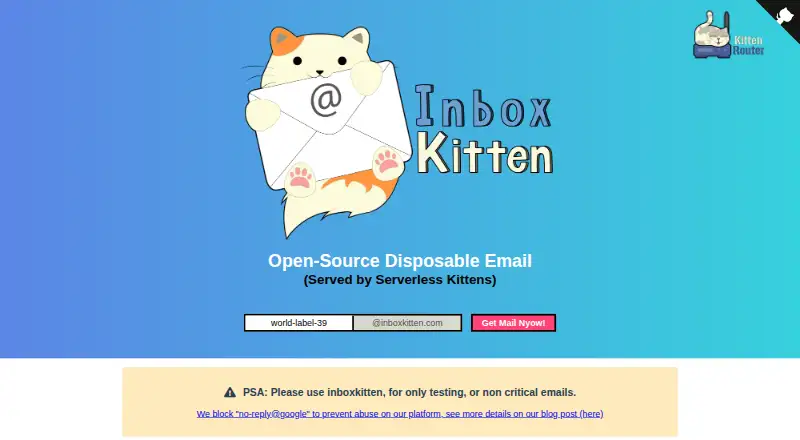
What InboxKitten is
InboxKitten is a free, open-source disposable email service for testing signup flows and email notifications in web applications. It provides a web interface and API, plus a command-line tool for interacting with the API. Using a temporary address can help people avoid sharing their real email address and reduce unwanted spam. The maker recommends the service for testing or other non-critical emails, not private or important correspondence: InboxKitten.com inboxes are public and messages auto-delete after several hours. The project’s Mailgun setup instructions say received mail is stored for three days, and the service connects to Mailgun to receive messages. Users can clone and deploy their own instance, with documented options including Docker, serverless Firebase or Cloudflare, and localhost or custom deployments. Self-hosting requires Firebase and Mailgun accounts. The project is listed under the MIT license, and the service supports custom addresses, custom domains, and API access. Its facts describe both hosted disposable inboxes and self-hosting, with different practical requirements for each route.
Who it suits
It suits developers testing web-app signup flows and email notifications, or anyone needing disposable email for non-critical messages. Self-hosting may suit users prepared to obtain Firebase and Mailgun accounts.
What it does well
- Free and open-source.
- Offers a web interface, API, and CLI.
- Supports Docker and serverless deployment options.
- Custom addresses and domains are supported.
What to know first
- Public inboxes are not private.
- Hosted messages auto-delete after several hours.
- Self-hosting requires Firebase and Mailgun accounts.
Limits
Hosted inboxes are public and messages disappear after several hours. Mailgun's documented setup stores received mail for three days, so the service is limited to testing and non-critical email.
Plans
| Plan | Billed and limits | Price |
|---|---|---|
| Self-Host | *per month · Deploy your own instance · Requires Firebase and Mailgun accounts | On request |
As inboxkitten.com lists them, read 8 Oct 2026. The maker's own page has the final word.
Getting started
- Open https://inboxkitten.com/
- Use the web interface for a disposable inbox
- Call the API or use the command-line tool for application testing
- Create a custom address or custom domain when needed
- Clone the project for a self-hosted instance
- Deploy with Docker, Firebase, Cloudflare, localhost, or a custom setup
- Connect the deployment to Mailgun, with Firebase and Mailgun accounts for self-hosting
Verdict
InboxKitten is designed for disposable addresses in testing and other non-critical use, with web, API, and self-hosted options. Public inboxes and short retention make it unsuitable for private or important messages.
Questions
Is InboxKitten free?
Yes. InboxKitten has a free plan.
Which platforms does it support?
It offers web, API, and self-hosted access. The repository also describes a command-line tool for the API.
Can I run my own instance?
Yes. The maker says you can clone and deploy InboxKitten using documented Docker, Firebase, Cloudflare, localhost, or custom routes.
Are InboxKitten.com inboxes private?
No. The hosted inboxes are public, and messages are deleted after several hours.
Does it provide API and custom-domain access?
Yes. API access, custom addresses, and custom domains are supported.
What license does the project use?
The GitHub repository lists the MIT license.
Facts from InboxKitten's own pages
- Abuse prevention
- The site says it blocks no-reply@google to prevent abuse. · inboxkitten.com, 8 Oct 2026
- Components
- The repository describes an API, a web UI, and a command-line tool for interacting with the API. · github.com, 8 Oct 2026
- Data retention
- The repository’s Mailgun setup instructions say received mail is stored for 3 days. · github.com, 8 Oct 2026
- Deployment options
- The repository documents Docker, serverless Firebase or Cloudflare, and localhost or custom deployments. · github.com, 8 Oct 2026
- License
- The GitHub repository lists the project under the MIT license. · github.com, 8 Oct 2026
- Mail provider
- The repository says InboxKitten connects to Mailgun to receive email. · github.com, 8 Oct 2026
- Privacy limitation
- InboxKitten.com inboxes are public, and emails auto-delete after several hours; the page says Mailgun’s stated retention is 3 days. · inboxkitten.com, 8 Oct 2026
- Product
- InboxKitten is an open-source disposable email service. · github.com, 8 Oct 2026
- Self-hosting
- The maker says users can clone and deploy their own InboxKitten instance. · github.com, 8 Oct 2026
- Spam avoidance
- The service is intended to help avoid spam by letting users avoid sharing their real email address. · inboxkitten.com, 8 Oct 2026
- Testing
- The site describes using InboxKitten to test signup flows and email notifications in web applications. · inboxkitten.com, 8 Oct 2026
- Use case
- The site recommends using InboxKitten for testing or non-critical emails. · inboxkitten.com, 8 Oct 2026
Where InboxKitten stands on Freedom251
- Disposable Email Services#7 of 25
- Temporary email services#35 of 44