hexer
What hexer is
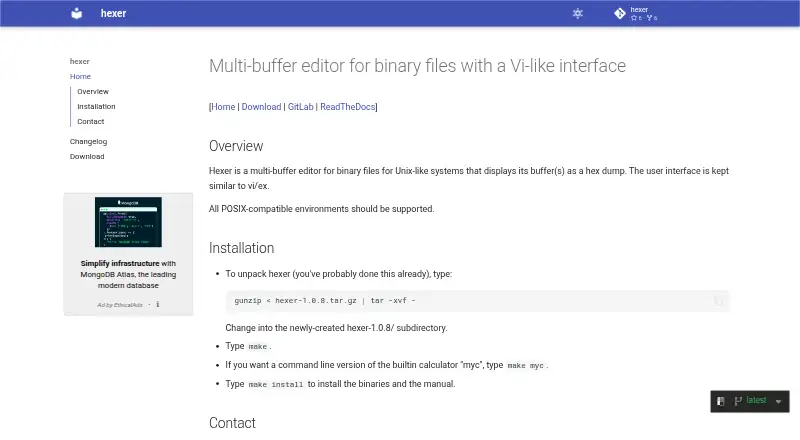
Hexer is a free multi-buffer editor for binary files, displaying buffer contents as a hex dump. Its interface is similar to vi/ex, and the documentation describes it as intended for Unix-like systems, with POSIX-compatible environments supported. Linux is the listed platform. Hexer is distributed as source: unpack an archive, run `make`, then run `make install` to install the binaries and manual. Version 1.0.7 is available as gzip, bzip2, and xz source tarballs, each with a PGP signature link. The build assumes a POSIX environment and requires termios and termcap support. The built-in calculator, myc, can be compiled as a command-line program with `make myc`. Version 1.0.7 includes a build fix for compilers such as GCC 15 and marks the start of MkDocs documentation and a Python test suite. The changelog says that suite currently tests little beyond a basic startup and one editing command. Hexer was written by Sascha Demetrio and is maintained by Peter Pentchev. The documentation lists scripting support; disk editing is not supported.
Who it suits
Hexer suits users who need a source-distributed, multi-buffer binary editor with a vi/ex-style interface. It is aimed at Unix-like and POSIX-compatible systems, with Linux listed as a platform.
What it does well
- Free multi-buffer binary editor
- Displays buffers as a hex dump
- Source archives offered in three formats
- Built-in calculator can be compiled separately
What to know first
- Requires source compilation to install
- Build requires POSIX, termios, and termcap support
- Disk editing is not supported
- Test suite covers only basic cases
Limits
Hexer is free, but disk editing is not supported. The current Python test suite checks little beyond startup and one editing command.
Getting started
- Open the Hexer documentation or download page
- Download a version 1.0.7 source archive in gzip, bzip2, or xz format
- Verify the available PGP signature link if desired
- Unpack the source archive
- Run make in the source directory
- Run make install to install the binaries and manual
- Run make myc to build the calculator command
Verdict
Hexer offers a free, source-based option for multi-buffer binary editing in a vi/ex-like interface. Its POSIX build requirements and limited current test coverage are important considerations.
Questions
Is Hexer free?
Yes. Hexer is presented as free software with a free plan.
Which systems does Hexer support?
Linux is the listed platform. Its documentation targets Unix-like systems and says POSIX-compatible environments should be supported.
How is Hexer installed?
Download and unpack a source archive, run make, then run make install to install the binaries and manual.
What release is available?
The download page lists version 1.0.7, dated 2025-08-17, in gzip, bzip2, and xz source tarballs, each with a PGP signature link.
Does Hexer support scripting or disk editing?
Scripting support is listed. Disk editing is listed as unsupported.
Who maintains Hexer?
The project was written by Sascha Demetrio and is currently maintained by Peter Pentchev.
Facts from hexer's own pages
- Build and install
- The installation instructions say to unpack the source archive, run make, and then run make install to install the binaries and manual. · hexer.readthedocs.io, 8 Oct 2026
- Build portability
- Version 1.0.7 updated the build to work with compilers such as GCC 15 by enabling C99 features. · hexer.readthedocs.io, 8 Oct 2026
- Build requirements
- The changelog says the project assumes a POSIX environment and that its code requires termios and termcap support. · hexer.readthedocs.io, 8 Oct 2026
- Calculator
- The built-in calculator myc can be built as a command-line version with make myc. · hexer.readthedocs.io, 8 Oct 2026
- Command options
- The changelog says version 1.0.5 added command-line options for version and features information. · hexer.readthedocs.io, 8 Oct 2026
- Download formats
- Version 1.0.7 is offered as gzip, bzip2, and xz source tarballs, each with a PGP signature link. · hexer.readthedocs.io, 8 Oct 2026
- Installation
- Installation instructions say to unpack the source archive, run make, and then run make install to install the binaries and manual. · hexer.readthedocs.io, 8 Oct 2026
- Interface
- Its user interface is kept similar to vi/ex. · hexer.readthedocs.io, 8 Oct 2026
- Latest listed release
- The download page lists version 1.0.7, dated 2025-08-17. · hexer.readthedocs.io, 8 Oct 2026
- Maintainer
- The documentation says Hexer was written by Sascha Demetrio and is currently maintained by Peter Pentchev. · hexer.readthedocs.io, 8 Oct 2026
- Maker identity
- The documentation identifies the project maintainer and links to its GitLab repository; it does not state a company name, headquarters, or founding date. · hexer.readthedocs.io, 8 Oct 2026
- Project age
- The GitLab project page states that the project was created on April 14, 2015. · gitlab.com, 8 Oct 2026
- Purpose
- Hexer is a multi-buffer editor for binary files that displays its buffers as a hex dump. · hexer.readthedocs.io, 8 Oct 2026
- Recent maintenance
- Version 1.0.7 includes a build fix for compilers such as GCC 15 and marks the start of MkDocs documentation and a Python-based test suite. · hexer.readthedocs.io, 8 Oct 2026
- Release status
- The changelog lists version 1.0.7 dated 2025-08-17 and an Unreleased section. · hexer.readthedocs.io, 8 Oct 2026
- Source releases
- The download page lists source archives for version 1.0.7, dated 2025-08-17, in gzip, bzip2, and xz formats, each with a PGP signature. · hexer.readthedocs.io, 8 Oct 2026
- Support contact
- The project page lists the maintainer's email as [email protected]. · hexer.readthedocs.io, 8 Oct 2026
- Supported systems
- The documentation says Hexer is for Unix-like systems and that all POSIX-compatible environments should be supported. · hexer.readthedocs.io, 8 Oct 2026
- Testing limit
- The changelog describes the Python test suite as currently testing almost nothing beyond a trivial startup and one editing command. · hexer.readthedocs.io, 8 Oct 2026
Where hexer stands on Freedom251
- Hex Editors#25 of 32