Halotools
What Halotools is
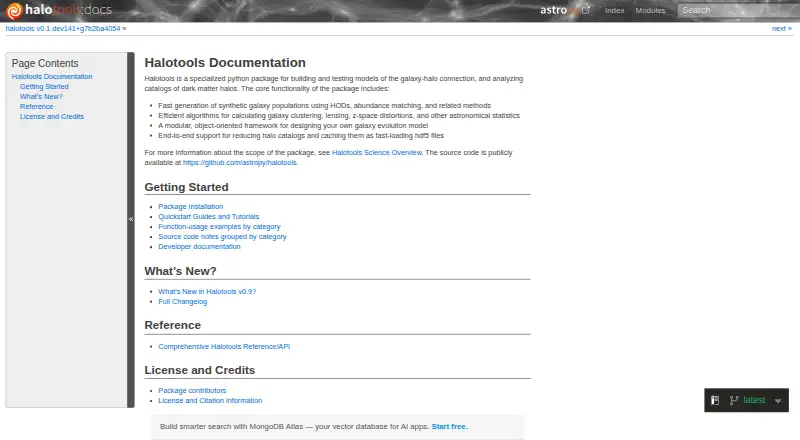
Halotools is a free, open-source Python package for building and testing galaxy–halo connection models and analyzing dark matter halo catalogs. It generates synthetic galaxy populations with halo occupation distributions, abundance matching, and related methods. Its algorithms calculate galaxy clustering, lensing, redshift-space distortions, and other astronomical statistics. A modular, object-oriented framework lets users assemble galaxy-evolution models from interchangeable components. Halotools can reduce halo catalogs and cache them as fast-loading HDF5 files. It can also download publicly available raw simulation catalogs, reduce them to memory-mapped files, and manage a simulation cache. Other halo catalogs can be transformed into the standard form required by its mock-population factories. Tutorials cover clustering, galaxy–galaxy lensing, group identification, velocity statistics, void statistics, and isolation criteria. The documentation recommends conda-forge installation and also gives pip and source-build instructions; h5py 3.7 or later may be needed. Different models require different halo properties, so catalogs must provide the fields each model needs.
Who it suits
Halotools is intended for researchers studying cosmology, galaxy evolution, and structure formation with simulations and mock galaxy populations. It suits Python users who need customizable models and halo-catalog analysis.
What it does well
- Generates mock galaxies with several modeling methods
- Calculates clustering, lensing, and redshift-space statistics
- Supports HDF5 caching and simulation management
- Provides modular, interchangeable model components
- Distributed under a 3-clause BSD license
What to know first
- Catalogs must supply properties required by each model
- h5py 3.7 or later may be needed
- Designed for Linux
Verdict
Halotools offers a focused toolkit for galaxy–halo modeling, mock populations, catalog preparation, and astronomical statistics. Its modular design and open-source license support research workflows, but users must format catalogs for their selected models.
Facts from Halotools's own pages
- Analysis examples
- The tutorials demonstrate galaxy clustering, galaxy-galaxy lensing, group identification, velocity statistics, void statistics, and isolation criteria. · halotools.readthedocs.io, 4 Oct 2026
- Catalog handling
- Halotools supports reducing halo catalogs and caching them as fast-loading HDF5 files. · halotools.readthedocs.io, 4 Oct 2026
- Custom catalogs
- Users can transform halo catalogs beyond those provided by Halotools into a standard form for its mock-population factories. · halotools.readthedocs.io, 4 Oct 2026
- Custom models
- Its modular, object-oriented framework lets users design galaxy evolution models from interchangeable components. · halotools.readthedocs.io, 4 Oct 2026
- Dependencies
- The installation documentation lists h5py 3.7 or later as an additional dependency that may be needed with conda or pip. · halotools.readthedocs.io, 4 Oct 2026
- Installation
- The documentation recommends installing the latest release with conda-forge and also provides pip and source-build instructions. · halotools.readthedocs.io, 4 Oct 2026
- License
- Halotools is fully open source and distributed under a 3-clause BSD-style license. · halotools.readthedocs.io, 4 Oct 2026
- Mock galaxies
- It generates synthetic galaxy populations using HODs, abundance matching, and related methods. · halotools.readthedocs.io, 4 Oct 2026
- Notable model requirement
- Different models require different halo properties, so users must format their catalog to supply the properties needed by the model they choose. · halotools.readthedocs.io, 4 Oct 2026
- Observables
- Its algorithms calculate galaxy clustering, lensing, redshift-space distortions, and other astronomical statistics. · halotools.readthedocs.io, 4 Oct 2026
- Purpose
- Halotools is a specialized Python package for building and testing galaxy-halo connection models and analyzing dark matter halo catalogs. · halotools.readthedocs.io, 4 Oct 2026
- Research audience
- The package is designed to study cosmology, galaxy evolution, and structure formation using simulations and mock galaxy populations. · halotools.readthedocs.io, 4 Oct 2026
- Simulation data
- The package supports downloading publicly available raw simulation catalogs, reducing them to memory-mapped files, and managing a simulation cache. · halotools.readthedocs.io, 4 Oct 2026
- Support
- Users can request support by Slack or personal email, or raise a public GitHub issue tagged as a feature request or question. · halotools.readthedocs.io, 4 Oct 2026
Where Halotools stands on Freedom251
- Astronomy Apps#25 of 35